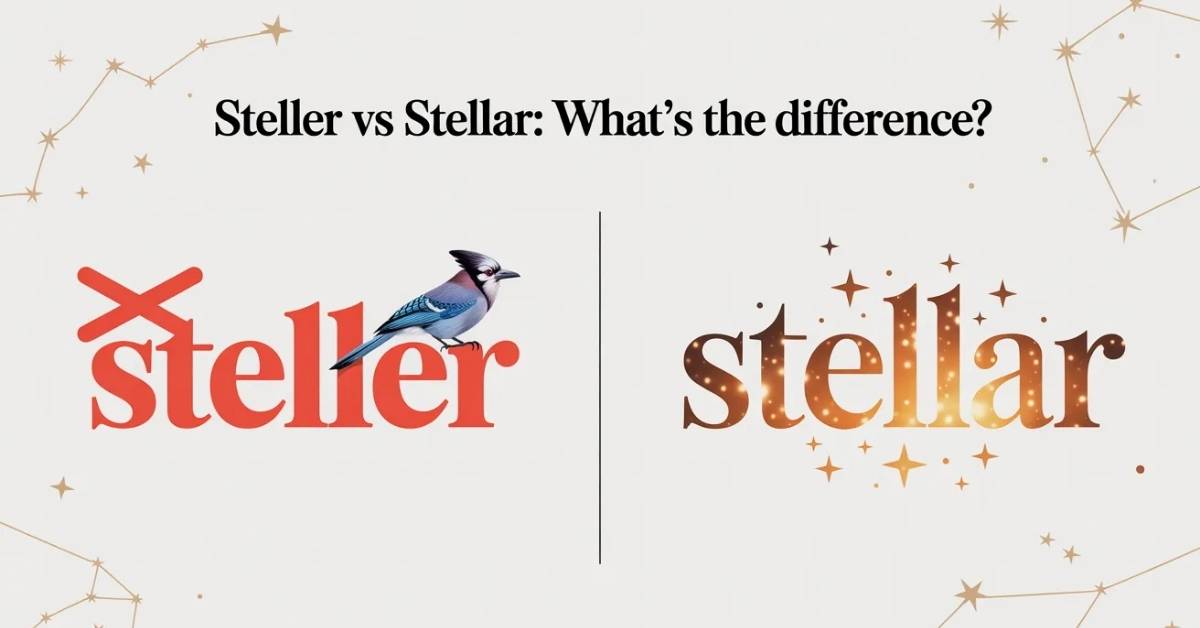
People confuse steller and stellar more often than you’d think and it’s not hard to see why. They sound identical, slip past spellcheck, and look believable at a glance. But here’s the catch: only one of them works in everyday writing. If you’re aiming for clear, professional content, mixing them up can quietly hurt your credibility.
This guide breaks it down in the simplest way possible so you never second-guess yourself again. By the end, you’ll know exactly when to use stellar for praise and when Steller only belongs in names, history, and science contexts.
What Does “Stellar” Actually Mean?
Stellar is an adjective. It comes from the Latin word stella, which means star. So at its most basic level, stellar means “relating to stars.”
But in everyday use, people use it to mean outstanding, exceptional, or excellent. “She gave a stellar performance.” “The team had a stellar season.” That is the version you will encounter most often.
What Is “Steller” and Is It Even a Real Word?
Here is the honest answer: Steller by itself is not a common dictionary word. It is not an adjective you can use to describe something as great or impressive.
However, Steller is a proper noun. It refers to Georg Wilhelm Steller, an 18th-century German naturalist who explored Alaska and the North Pacific. Several species are named after him, including the Steller’s jay, Steller’s sea eagle, and the now-extinct Steller’s sea cow.
So if you are writing about wildlife or natural history, Steller (capitalized) shows up a lot. Otherwise, it has no standard usage.
The Most Common Mistake People Make
The confusion usually goes one way: people write “steller” when they actually mean “stellar.”
You will see this in product reviews, social media posts, and even some blog content. “This hotel was absolutely steller!” That is a typo. What the writer meant was “stellar,” meaning excellent or outstanding.
It is the kind of error that spell-check sometimes misses because steller is not always flagged as wrong in every system.
Why Autocorrect Does Not Always Save You
Most word processors and phones will catch obvious typos, but “steller” sometimes slips through. It looks like a plausible word. It is not flagged as a glaring error by every tool.
This is why reading your own writing carefully still matters. You cannot fully rely on autocorrect or AI writing tools to catch context-based errors. They handle spelling better than meaning.
How to Remember Which One Is Correct
Here is a simple trick. Stellar contains the word “star.” Think: stellar = star-level quality.
If you are using the word to compliment something or call it exceptional, you need stellar. Just remember the star connection and you will not get confused again.
Steller only makes sense when you are writing about the naturalist Georg Steller or animals named after him, like the Steller’s jay.
Real Examples of “Stellar” Used Correctly
Let’s look at how stellar works in actual sentences:
- “The restaurant got stellar reviews from every food critic in the city.”
- “She had a stellar academic record that impressed every admissions officer.”
- “The product launch was stellar, with record-breaking sales in the first week.”
- “His stellar reputation in the industry took years to build.”
Notice how in each case, stellar is doing the job of saying something is top-tier, impressive, or outstanding. That is the meaning you want when you reach for this word.
Real Examples of “Steller” Used Correctly
Since Steller is a proper noun, here is how it correctly shows up in writing:
- “The Steller’s jay is the only crested jay found in western North America.”
- “Georg Steller documented dozens of new species during the Bering expedition of 1741.”
- “The Steller’s sea cow was hunted to extinction within 27 years of its discovery.”
You can see immediately how different this context is. If your content has nothing to do with wildlife, natural history, or Georg Steller himself, there is almost no reason to ever write “steller.”
When You See “Steller” Online, What Does It Usually Mean?
Nine times out of ten, when someone writes “steller” on the internet, they are making a spelling mistake. They meant to say stellar.
It pops up in casual writing, comment sections, Yelp reviews, and Twitter/X posts. Rarely in edited, published content. That alone tells you it is not an accepted alternate spelling of stellar. It is just a common error that has spread because of how similar the two words sound.
Does “Steller” Show Up in SEO or Digital Marketing?
This is actually an interesting question from a digital perspective. Some content creators search for “steller vs stellar” because they want to understand which word to use in their writing. Others stumble across it because they typed “steller” into a search engine and got corrected.
From an SEO writing standpoint, using the wrong word can hurt your credibility. Search engines are increasingly focused on content quality. Repeated grammar or vocabulary errors send signals that content is low-effort. Always use stellar when you mean excellent.
How This Confusion Affects Professional Writing
If you are writing a resume, a cover letter, a business proposal, or any professional document, this error can leave a bad impression.
Imagine writing “My team delivered steller results last quarter.” A hiring manager or client reading that will notice. It is a small thing, but small things add up when someone is evaluating your attention to detail.
Professional writing demands precision. Getting commonly confused words right shows that you care about the quality of your communication.
Related Words and Phrases That Can Help
If you keep second-guessing yourself between steller and stellar, it helps to have alternatives in your vocabulary:
- Exceptional
- Outstanding
- Brilliant
- First-rate
- Top-notch
- Excellent
These are all solid synonyms for stellar in its complimentary sense. Using them gives you variety in your writing and removes any risk of the steller/stellar mix-up entirely.
Quick Reference Summary
Here is a fast breakdown you can save or bookmark:
Stellar:
- An adjective meaning star-related or excellent
- Used to describe people, performances, products, results
- Example: “She did a stellar job on the presentation.”
Steller:
- A proper noun referring to naturalist Georg Wilhelm Steller
- Used in names of wildlife species (Steller’s jay, Steller’s sea eagle)
- Not a correct substitute for stellar in any other context
If your content has nothing to do with Georg Steller or animals named after him, always go with stellar.
Frequently Ask Question
Is “steller” a real word?
No, it is not a dictionary word — it only exists as a proper noun referring to naturalist Georg Wilhelm Steller.
Can I use “steller” instead of “stellar” in casual writing?
No, even in casual writing “steller” is considered a spelling mistake, not an accepted alternate form.
What does stellar mean in simple terms?
It means outstanding or excellent, originally derived from the Latin word for star.
Why do so many people write “steller” by mistake?
Because both words sound nearly identical when spoken, the error slips in easily during fast or casual typing.
Will spell-check always catch the steller mistake?
Not always — some tools skip it because “steller” resembles a valid proper noun and does not always trigger a red flag.
Final Verdict
The steller vs stellar mix-up is one of those small but persistent errors in written English. It does not make someone a bad writer, but fixing it makes your writing sharper and more credible.
The rule is simple: if you mean excellent or star-quality, write stellar. If you are writing about the 18th-century naturalist or the species named after him, write Steller with a capital S. That is really all there is to it.

I’m Daniel Carter, founder of wordwix.com, a creative space focused on powerful and meaningful words. I explore ideas, meanings, and inspiration to help you find the perfect words for any purpose with clarity and creativity.