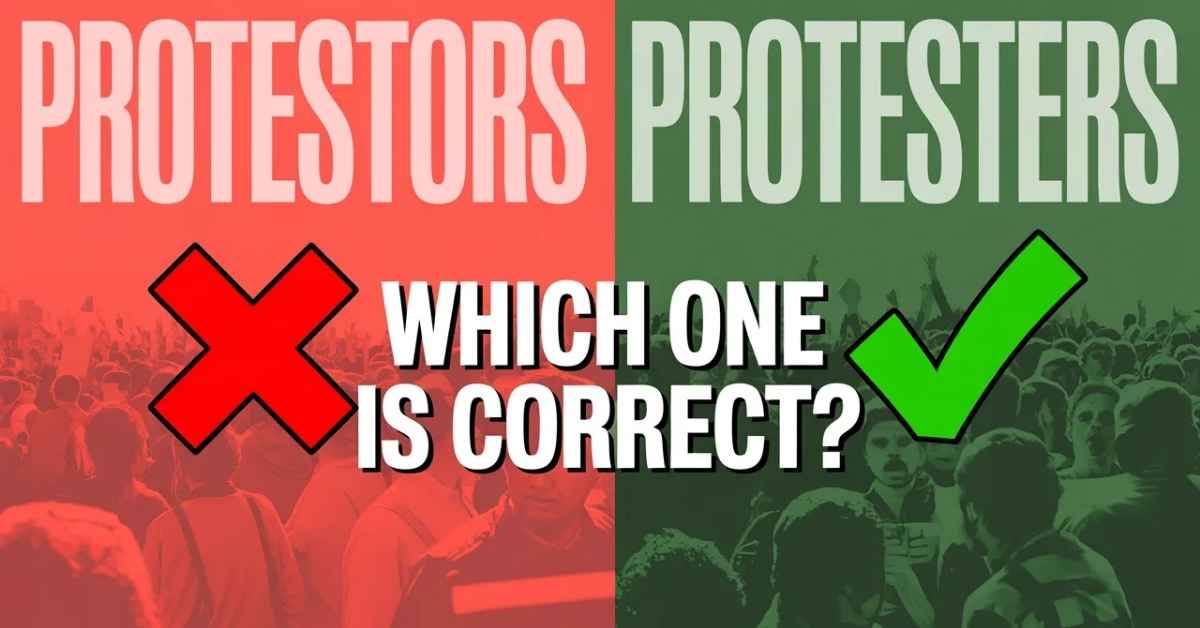
Writers often stop mid-sentence wondering whether to write protestors or protesters. Both versions appear in newspapers, textbooks, and online articles every single day. Picking the wrong one in a professional piece can make your writing look sloppy, even when your message is strong.
This article breaks down the protesters vs protestors debate in plain, simple language. You will see exactly which spelling fits American English, which one belongs to British writing, and why major news organizations have a clear preference. Real examples make the difference easy to understand and even easier to remember.
After reading this guide, choosing between protestors or protesters will never slow you down again. From grammar rules to style guides to everyday usage, everything is covered here so you can write with full confidence every single time.
Both Spellings Are Correct (Really)
Yes, both protestors and protesters are accepted spellings of the same word. Neither is wrong. They refer to the same thing — people who publicly oppose or demonstrate against something, whether it’s a government policy, a social injustice, or a corporate decision.
The confusion comes from how English handles agent nouns — words that describe people who do a particular action. Sometimes we add “-er,” sometimes “-or.” There’s no single rule, and that’s what makes it tricky.
Which Spelling Do Most People Use?
If you search major publications, you’ll find that protesters is far more common. Outlets like The New York Times, BBC, and Reuters consistently use “protesters” as their default spelling.
“Protestors” still appears regularly, especially in British and Australian English, but in American English, “protesters” has become the dominant form.
So if you’re writing for a general audience or following AP Style guidelines, stick with protesters.
The History Behind the Word
The word traces back to the Latin protestari, meaning to declare publicly. It entered English through Old French, and over time, both suffixes (“-er” and “-or”) attached to it depending on the dialect or region.
This kind of variation isn’t unusual. Think of “advisor” vs. “adviser” — same deal. The language evolves differently in different places, and both forms end up in circulation.
When to Use “Protesters” vs “Protestors”
Here’s a simple breakdown:
- Use protesters if you’re writing for American audiences or following AP/Chicago Style
- Use protestors if you’re writing in British or Australian English contexts
- Either works for casual writing, personal blogs, or informal use
The most important thing is to stay consistent within a single piece of writing. Don’t switch back and forth — pick one and use it throughout.
What Exactly Is a Protester?
A protester (or protestor) is someone who takes part in a public demonstration to express opposition or support for a cause. This can mean:
- Marching in the streets
- Holding signs at a rally
- Organizing sit-ins or peaceful blockades
- Speaking at public forums
- Even participating in online campaigns
Protests have driven some of history’s most important changes — from the civil rights marches of the 1960s in the U.S. to the pro-democracy demonstrations in Hong Kong, to climate strikes led by young people across Europe. The people behind all of these were protesters.
Common Related Terms You Should Know
When writing or reading about demonstrations, you’ll often encounter related terms like:
- Demonstrators — a near-synonym, often considered more neutral in tone
- Activists — people who campaign for social or political change, not necessarily through public protest
- Civil disobedience — deliberate, nonviolent refusal to obey laws as a form of protest
- Rally — a large public meeting to show support or opposition
Knowing these terms helps you write or speak more precisely when discussing protest movements and social change.
Why Spelling Actually Matters in This Context
Words around protests often carry political weight. Journalists and writers know that the language they choose can shape perception. That’s part of why outlets have style guides that standardize terms like “protesters” — consistency builds credibility.
If you’re a student, journalist, or content writer, using the wrong form (or mixing both) can undermine your professionalism, even if the meaning is perfectly clear. It signals carelessness to a sharp-eyed reader or editor.
Real-World Example: How Major Outlets Use It
Here’s something interesting. During the 2020 Black Lives Matter movement, most American news networks and wire services used “protesters” consistently. Meanwhile, some UK-based outlets defaulted to “protestors.” Both were covering the same events, same people — just different spelling conventions at play.
This shows it’s less about grammar and more about editorial style and regional convention.
Tips for Remembering the Right Spelling
A quick memory trick: think of words you already know that end in “-er” — like teacher, writer, worker. These are all people who do something. The same logic applies to protesters — people who protest.
The “-or” ending is actually less common in everyday English and tends to show up in more formal or Latinate words (like “senator” or “janitor”). Since “protester” follows the everyday English pattern, “-er” is the more natural choice.
Should You Correct Someone Who Uses “Protestors”?
Honestly? No — unless you’re editing their work. Both are valid, and correcting someone over a widely accepted spelling variant can come off as pedantic. Save your energy for actual errors.
If you’re editing or proofreading, the better approach is to flag it only if the house style requires one form over the other.
What About Autocorrect and Spell Checkers?
Most modern spell checkers accept both spellings, though some may flag “protestors” as a less preferred variant. Microsoft Word and Google Docs tend to accept both without complaint in most language settings.
If your tool underlines “protestors,” it’s not saying it’s wrong — it might just be defaulting to the more common American English form.
Frequently Ask Question
Are protestors and protesters the same word?
Yes, both spellings mean exactly the same thing and refer to people who publicly demonstrate against something.
Which spelling is more commonly used in American English?
Protesters is the preferred and more widely accepted spelling in American English writing and journalism.
Is protestors wrong or incorrect to use?
No, protestors is not wrong — it is simply more common in British and Australian English contexts.
Which spelling should I use for professional or formal writing?
Always use protesters for professional writing, as it follows AP Style and most major editorial guidelines worldwide.
Do spell checkers accept both protestors and protesters?
Yes, most modern spell checkers including Google Docs and Microsoft Word accept both spellings without flagging errors.
A Quick Summary
- Protesters and protestors mean the same thing
- “Protesters” is more common, especially in American English
- “Protestors” is used more in British and Australian English
- For professional writing, pick one and stay consistent
- When in doubt, go with “protesters” — it’s the safer, more universally recognized form
Language is always evolving, and both spellings have earned their place. The real takeaway is understanding who these people are and why they matter — people who stand up publicly for what they believe in, regardless of how you spell it.

I’m Daniel Carter, founder of wordwix.com, a creative space focused on powerful and meaningful words. I explore ideas, meanings, and inspiration to help you find the perfect words for any purpose with clarity and creativity.