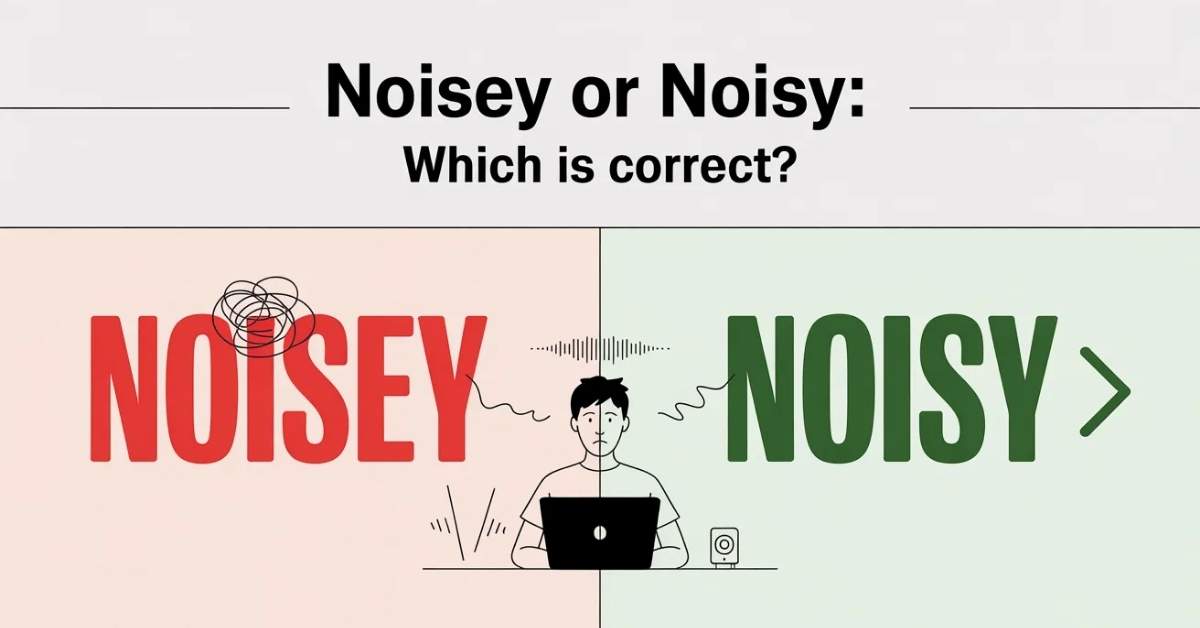
You typed it fast, hit send, and then stared at the word wondering if you just embarrassed yourself. Was it “noisey” or “noisy“? It’s one of those small spelling traps that catches even fluent English speakers off guard. The good news: there is a clear right answer, and once you know it, you’ll never second-guess it again.
The Short Answer: Only One Spelling Is Correct
“Noisy” is the correct spelling. “Noisey” is not a real word in standard English. It does not appear in the Oxford English Dictionary, Merriam-Webster, or any recognized style guide. If you wrote “noisey,” the spell-checker was right to flag it.
This is not a case where both spellings are acceptable in different regions, like “colour” vs “color.” “Noisey” is simply a misspelling, nothing more.
Why Do So Many People Spell It Wrong?
The confusion makes sense when you think about it. The base word is “noise,” which ends in an “e.” When people add “-y” to make it an adjective, they instinctively want to keep that “e” because it feels like it belongs there. So “noise” plus “-y” becomes “noisey” in their heads.
But English does not work that way when adding “-y” to words that end in a silent “e.” The rule is to drop the “e” first, then add the suffix. So “noise” becomes “noisy,” just like “ice” becomes “icy” and “lace” becomes “lacy.”
The Simple Spelling Rule Behind This
When a word ends in a silent “e” and you add a suffix that starts with a vowel, the “e” gets dropped. The suffix “-y” starts with a vowel, so the “e” in “noise” has to go before it arrives.
Here are a few more examples of this exact same pattern so you can see it clearly:
- Grease becomes greasy (not greasey)
- Smoke becomes smoky (not smokey, in most dictionaries)
- Breeze becomes breezy (not breezey)
- Rose becomes rosy (not rosey)
See the pattern? “Noisy” fits perfectly into this group.
Wait, What About “Smokey”?
You might be wondering about “Smokey” because that spelling does appear in some places, like the famous Smokey Bear. But that is a proper name, not the standard adjective. When describing something that smells or looks like smoke, the correct adjective is “smoky,” not “smokey.”
Proper nouns and brand names sometimes break spelling conventions on purpose. They do not set a rule for general English usage. So “Smokey” as a name is fine, but “the room was smokey” is still technically incorrect. The same logic applies to “noisy.” Even if you have seen “noisey” written somewhere online, that does not make it correct.
How to Use “Noisy” Correctly in a Sentence
“Noisy” is an adjective. It describes people, places, things, or situations that produce a lot of noise or unwanted sound. You place it before a noun or after a linking verb.
Some natural examples:
- The apartment above mine has noisy neighbors who move furniture at midnight.
- The old engine got noisier every time the temperature dropped.
- She avoided the noisy café and found a quiet corner in the library instead.
- That construction outside is so noisy I can barely think straight.
Notice how naturally it works. You never need “noisey” to say what you mean. “Noisy” handles everything.
The Comparative and Superlative Forms
When comparing levels of noise, “noisy” follows standard adjective rules. The forms are:
- Positive: noisy (this street is noisy)
- Comparative: noisier (this street is noisier than the last one)
- Superlative: noisiest (this is the noisiest street in the city)
None of these forms bring back the “e.” You would never write “noisier” as “noiseier” or “noisiest” as “noiseiest.” The same logic applies to the base form: just “noisy,” not “noisey.”
Related Words You Should Know
If you are writing about loud environments or unwanted sound, a few related terms come up often.
“Loud” is the most direct synonym. It describes something with high volume or intensity. “The concert was loud” and “the concert was noisy” are both correct, but “loud” focuses on volume while “noisy” often carries a sense of unpleasantness or disturbance.
“Clamorous” means full of confused, loud noise. It is more formal and implies a crowd or chaotic situation. A noisy protest could also be described as clamorous.
“Boisterous” describes noisy, energetic behavior, often in a positive or playful way. A group of kids playing outside might be boisterous rather than just noisy, because the energy feels lively rather than disturbing.
“Raucous” is louder and harsher. A raucous crowd is wilder and less controlled than a simply noisy one.
Knowing these alternatives helps you write with more precision. Sometimes “noisy” is exactly right. Other times, one of these synonyms fits better.
Common Phrases With “Noisy”
Some phrases with “noisy” pop up often enough that you will want to recognize them.
“Noisy minority” refers to a small group that is vocal and attention-grabbing, making them seem larger or more influential than they are. “Don’t let the noisy minority make all the decisions” is something you might hear in a business or community meeting.
“Noisy data” is a term used in data science and statistics. It describes datasets that contain random errors or irrelevant information that interferes with finding meaningful patterns.
“Noisy environment” is used in both everyday speech and technical writing, such as audio engineering, where background noise affects recording quality.
What If You Keep Making This Mistake?
Honest answer: you probably make this mistake because you are writing quickly and your fingers remember “noise” before your brain edits it. That is normal. The fix is simple: when you add “-y” to any word ending in a silent “e,” pause for half a second and remember to drop the “e.”
You could also just type it naturally and let autocorrect do the job. Most modern devices will flag “noisey” immediately. But understanding the rule means you do not have to rely on the machine every time.
A Quick Check Before You Hit Send
If you are not sure whether you spelled it right, ask yourself one thing: does the word end in “-ey” or “-y”? For adjectives formed from nouns that end in a silent “e,” the correct ending is almost always just “-y.” No extra “e” needed.
Noisy. Greasy. Breezy. Icy. Rosy. Lacy.
They all follow the same rule. Once you see them grouped like this, the pattern sticks. You will not reach for “noisey” again.
Why This Matters More Than You Think
Spelling might seem like a small thing, but it shapes how people read your writing. A single misspelling in a headline, a professional email, or a product description can make readers pause and question your attention to detail.
“Noisey” is the kind of mistake that looks careless rather than ignorant. Most readers can tell it was a speed error, not a knowledge gap. But fixing it takes two seconds and keeps your writing clean.
Write “noisy.” Drop the “e.” Move on.
Frequently Ask Question
Is “noisey” a real word?
No, “noisey” is not a real word — “noisy” is the only correct spelling recognized in all standard dictionaries.
Why do people spell it “noisey” instead of “noisy”?
Because the base word is “noise,” people instinctively keep the “e,” not knowing the silent “e” drops when adding “-y.”
What is the correct spelling: noisey or noisy?
Always “noisy” — drop the “e” from “noise” before adding the “-y” suffix.
How do you use “noisy” in a sentence?
Example: “The noisy street outside made it impossible to sleep.”
What are some synonyms for “noisy”?
Loud, clamorous, boisterous, and raucous are all common synonyms for noisy.
Final Verdict
The word you want is always “noisy.” It follows a consistent English spelling rule, it is the only version recognized by dictionaries, and it works in every context where you need to describe something loud or disruptive.
“Noisey” is not a variant, not a regional spelling, and not acceptable in formal writing. Just one small spelling habit to fix, and you are good to go.

I’m Daniel Carter, founder of wordwix.com, a creative space focused on powerful and meaningful words. I explore ideas, meanings, and inspiration to help you find the perfect words for any purpose with clarity and creativity.