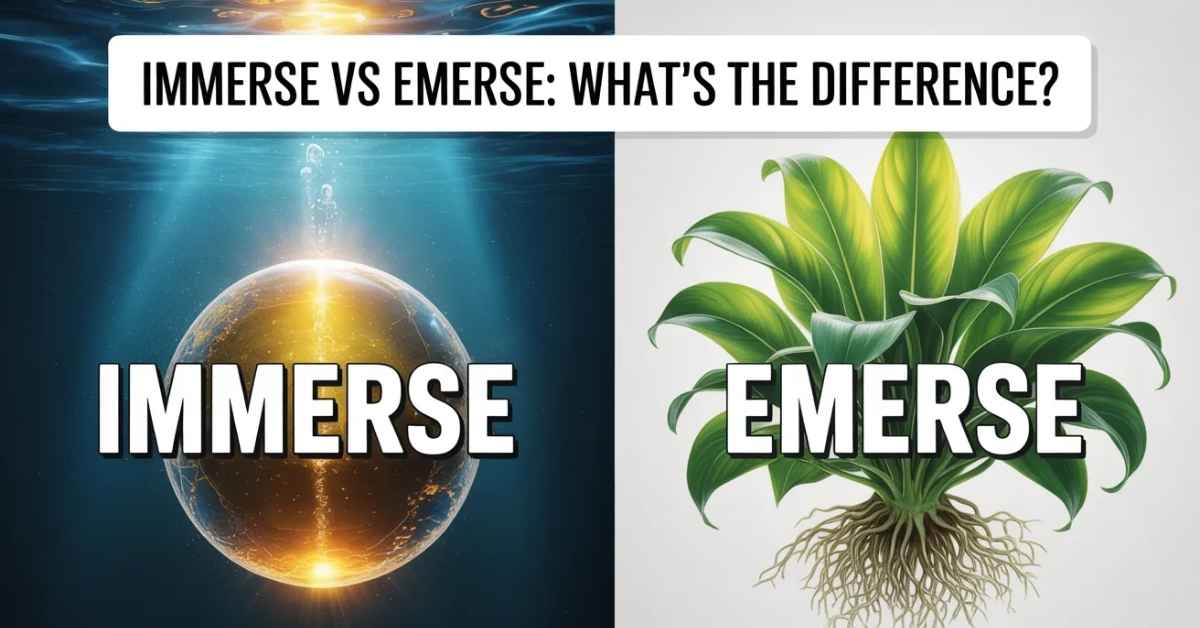
Writers often stumble over immerse and emerse because the difference feels subtle at first glance. Both words deal with liquids, both sound nearly identical, and both come from the same linguistic roots. But here’s the truth — they describe completely opposite actions. One means going fully in, while the other refers to coming out or remaining partly above the surface. Using them incorrectly can quietly weaken your writing.
This guide breaks it down in a clear, practical way so you can confidently choose the right word every time and avoid common mistakes that trip up even experienced writers.
What Does Immerse Actually Mean?
Immerse means to put something completely into a liquid. Full submersion. The whole object goes under.
Think of dropping your phone in the sink (worst day ever). That phone is fully immersed. No part of it is sticking out above the water.
The word also works beyond liquids. You can immerse yourself in a book, a culture, or a job. It means total involvement, not just a little bit.
What Does Emerse Mean?
Emerse is the opposite action. It means to come out of liquid, or to be in a state where part of something is above the surface.
You see this word most often in biology and botany. When a plant grows in water but its leaves or stems stick out above the surface, scientists describe it as emersed.
It is a technical term. You will not hear it in everyday conversation, which is partly why people forget it exists.
The Simple Way to Remember Both
Here is the easiest trick. Think of the prefix.
- Im sounds like “in.” Immerse means to go IN.
- Em sounds like “exit” or “emerge.” Emerse means to come OUT or be partially above.
Once that clicks, you will never mix them up again.
Real-Life Examples of Immerse
You will see immerse used constantly in daily life:
- “She immersed the vegetables in boiling water.”
- “He was completely immersed in the documentary.”
- “Immerse the dye cloth for 20 minutes.”
It fits any situation involving total submersion, whether physical or mental. Language learners also hear phrases like immersive learning or language immersion programs, where you surround yourself completely with a new language.
Real-Life Examples of Emerse
Emerse is mostly found in scientific writing:
- “The emersed portions of the plant were exposed to direct sunlight.”
- “Lotus leaves are emersed aquatic structures.”
- “The rocks emersed from the low tide.”
If you are writing a biology paper or describing aquatic plants, this is your word. In casual writing, you almost never need it.
Why People Confuse Immerse and Emerse
Part of the confusion comes from a third word: emerge. People sometimes write “emerse” when they mean “emerge,” especially when describing something rising out of water.
Emerge means to come out or become visible. It is the common, everyday word. Emerse is its more technical cousin with a narrower meaning in botany and biology.
So if a submarine rises from the ocean, it emerges. If a water lily has leaves sitting above the pond surface, those leaves are emersed. Different situations. Different words.
Is Emersed a Real Word?
Yes, absolutely. It is an accepted botanical and biological term. Emersed describes aquatic plants or plant parts that grow above the waterline while their roots stay submerged below.
Common emersed plants include cattails, bulrushes, and many types of reeds. Their roots sit underwater, but their tall stalks and leaves push above the surface. That above-water growth is the emersed part.
How Immersed Is Used in Education
Immersion became a big deal in education over the past few decades. Language immersion programs put students in an environment where they hear and speak only the target language all day. No translation. No shortcuts.
Research consistently shows this method works. When learners are fully immersed in a language, they pick it up faster because the brain has no choice but to adapt.
You also see immersive technology showing up everywhere now. VR headsets, 360-degree videos, interactive simulations. The idea is always the same: surround the user completely, leave no room for distraction.
Using the Words Correctly in Writing
If you are writing for a general audience, you will almost always use immerse or its variations. It is the versatile word that works in any context.
Emerse belongs in technical or scientific writing. Using it in a casual blog post or email will just confuse your reader.
Quick guide:
- Immerse: everyday use, full submersion, total involvement
- Emerse: scientific use, partial emergence above a liquid surface
- Emerge: everyday use, coming out or becoming visible
What About Grammar and Forms?
Both words follow standard conjugation rules.
- Immerse forms: immerse, immersed, immersing, immerses, immersion, immersive.
- Emerse forms: emerse, emersed, emersion. Less common forms because it sees far less use.
- Immersion is probably the form you will write most often. Language immersion, cultural immersion, full immersion baptism, immersion heaters. The word shows up across very different fields.
Which One Should You Actually Use?
Unless you are writing a botany textbook or a marine biology paper, immerse is almost certainly the word you want.
It fits personal essays, how-to guides, marketing copy, academic writing (outside science), and everyday conversation. The flexibility of immerse makes it one of those words that earns its place in your vocabulary.
Emerse is worth knowing. It signals scientific literacy when you use it in the right context. But reaching for it outside that context will make readers pause, and not in a good way.
Frequently Ask Question
What is the main difference between immerse and emerse?
Immerse means to put something fully underwater, while emerse means to rise or exist partially above a liquid surface.
Is emerse a real word?
Yes, emerse is a real word used mainly in botany and biology to describe plants growing above water.
Can immerse be used in non-liquid situations?
Yes, you can immerse yourself in work, culture, or a language, meaning full mental involvement.
Which word is more commonly used in everyday writing?
Immerse is far more common; emerse is mostly limited to scientific or technical writing.
What is the difference between emerse and emerge?
Emerge means to come out or become visible in general, while emerse specifically describes something rising above a liquid surface.
One Last Thing Worth Knowing
Both words share the same Latin root: mergere, meaning to plunge or dip. That shared ancestry explains why they look so similar and deal with the same general concept of liquid and submersion.
Immergere meant to plunge into. Emergere meant to rise out of. English borrowed both and built from them.
So next time you reach for one of these words, ask yourself one question: is something going fully under, or is part of it coming up above the surface? That answer tells you exactly which word to use. Immerse: in, under, total. Emerse: out, above, partial. That is really all there is to it.

I’m Daniel Carter, founder of wordwix.com, a creative space focused on powerful and meaningful words. I explore ideas, meanings, and inspiration to help you find the perfect words for any purpose with clarity and creativity.