You know the feeling. You’re writing an email, a caption, or a simple message, and you pause mid-sentence because you’re not sure whether to write “sale” or “sell.” It trips up native speakers too, not just learners.
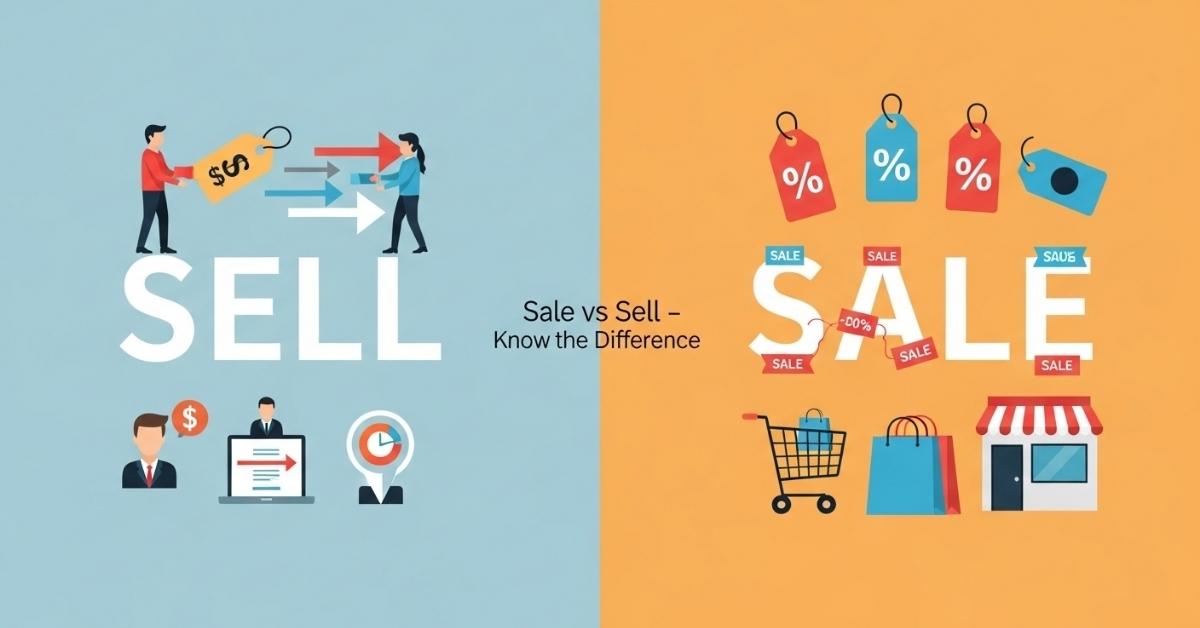
The good news is the difference is simple once you see it clearly. Sale is a noun (a thing). Sell is a verb (an action). That’s the core of it.
The Simplest Explanation You’ll Find
Here it is in one sentence:
- Sell is what you do.
- Sale is the event or result of doing it.
You sell something. That act creates a sale.
Think of it this way: a store sells products every day. When a customer buys one, that transaction is called a sale. The word “sell” is the action happening. The word “sale” is what that action produces.
What Does “Sell” Mean?
Sell is a verb. It describes the act of exchanging something for money. You use it when someone is actively doing the work of trading goods or services.
It changes form depending on tense:
- Present: I sell handmade bags.
- Past: She sold her car last month.
- Future: They will sell the house next year.
- Continuous: He is selling tickets at the gate.
Notice how “sell” always shows movement or action. Someone is doing something.
What Does “Sale” Mean?
Sale is a noun. It refers to the act or instance of selling something, or a period when prices are reduced.
It has two common uses:
Use 1: A transaction When someone buys something from you, that exchange is a sale.
- “We made three sales before noon.”
- “The sale of the property took two months.”
Use 2: A discount event When a store lowers its prices temporarily, that’s also called a sale.
- “Everything is 50% off during the sale.”
- “The winter sale starts on Friday.”
Both uses are correct. The context tells you which meaning applies.
Quick Comparison Table
| Feature | Sell | Sale |
| Word type | Verb (action) | Noun (thing/event) |
| What it describes | The act of trading for money | The transaction or discount event |
| Example sentence | “I sell vintage watches.” | “The sale ends tonight.” |
| Can follow “a” or “the”? | No | Yes (“a sale,” “the sale”) |
| Can follow “to”? | Yes (“to sell”) | Rarely |
| Past tense form | Sold | N/A (nouns don’t change tense) |
Real-Life Usage Examples
Sometimes seeing words in real situations locks in the meaning faster than any rule.
In everyday conversation:
- “Did you sell your old laptop?” (action, verb)
- “I got this jacket at a sale.” (discount event, noun)
In business writing:
- “Our goal is to sell 500 units this quarter.” (verb)
- “The sale of the company was finalized yesterday.” (transaction, noun)
In travel and experiences:
- “Street vendors sell fresh coconuts along the beach.” (verb)
- “The tour operator has a flash sale on weekend trips.” (noun)
In casual social media captions:
- “Just restocked! Selling out fast.” (verb)
- “Big sale happening this weekend only.” (noun)
In hiking and outdoor contexts:
- “Outdoor gear shops sell quality trail shoes year-round.” (verb)
- “The annual sale at the camping store saves hikers a lot.” (noun)
Common Mistakes People Make
These are the errors that show up most often, even in published writing.
Mistake 1: Using “sell” where “sale” belongs
Wrong: “Everything is on sell.” Right: “Everything is on sale.”
The phrase “on sale” is fixed. You never say “on sell.” This is one of the most common errors in English writing, especially on handwritten store signs.
Mistake 2: Using “sale” where “sell” belongs
Wrong: “I want to sale my bike.” Right: “I want to sell my bike.”
“Sale” cannot replace a verb. If you’re describing an action, you need “sell.”
Mistake 3: Confusing “for sale” with “for sell”
Wrong: “This house is for sell.” Right: “This house is for sale.”
“For sale” is a set phrase meaning something is available to be purchased. “For sell” is not standard English.
Mistake 4: Mixing up past tense
Wrong: “She selled it last week.” Right: “She sold it last week.”
The past tense of “sell” is “sold,” not “selled.”
The Phrases You Need to Remember
Some fixed phrases use one word and never the other. Memorize these and you’ll avoid most mistakes instantly.
Always use “sale”:
- On sale
- For sale
- Point of sale
- Sale price
- Yard sale / garage sale
- Flash sale
Always use “sell”:
- Sell out
- Hard sell / soft sell
- Sell off
- Upsell / cross-sell
- Sell by date (though “sell-by” acts as an adjective here)
How “Sold” Fits Into the Picture
“Sold” is simply the past tense of “sell.” It’s worth mentioning because people sometimes confuse it with “sale” when writing quickly.
- “The tickets sold out in minutes.” (past tense verb)
- “Sold!” (informal way of confirming a deal, short for “it is sold”)
You might also see “sold” used as an adjective:
- “The sold sign went up this morning.”
Which One Should You Use?
Ask yourself one simple question: Am I describing an action, or am I describing a thing/event?
If it is an action (someone doing something), use sell:
- “She sells jewelry online.”
- “They are trying to sell the business.”
If it is a thing, event, or result, use sale:
- “The sale brought in good revenue.”
- “There’s a sale at the bookstore.”
Still unsure? Try replacing the word with another verb. If it fits, use “sell.” If it doesn’t, use “sale.”
Example: “I want to ___ my car.” Try: “I want to drive my car.” That works, so it’s an action slot. Use sell: “I want to sell my car.”
Sale vs Sell in Grammar Terms (Without the Jargon)
You don’t need to be a grammar expert to get this right, but a simple explanation helps.
- Sell belongs to the same family as words like “run,” “write,” and “build.” These are all action words. They need a subject doing something.
- Sale belongs to the same family as words like “result,” “event,” and “transaction.” These are all thing words. They can follow articles like “a” or “the.”
One quick test: if you can put “the” in front of it and it sounds natural, it’s likely a noun. “The sale” sounds fine. “The sell” sounds off. That tells you which is which.
Related Words Worth Knowing
Once you understand sale vs sell, a few related words become easy to use correctly.
- Seller (noun): A person who sells something. “The seller agreed to lower the price.”
- Salesperson / sales rep (noun): Someone whose job involves selling. “She works as a salesperson for a software company.”
- Resell (verb): To sell something you previously bought. “He buys and resells vintage sneakers.”
- Wholesale vs retail sale (nouns): These describe the type of sale transaction. “They offer lower prices on wholesale orders.”
Understanding these connected words strengthens your writing and makes everything feel more natural.
FAQ: Sale vs Sell
What is the main difference between sale and sell?
“Sell” is a verb showing action, while “sale” is a noun showing a result.
Can I say “for sell” instead of “for sale”?
No, “for sell” is always wrong. The correct phrase is “for sale.”
Is “sold” the past tense of “sell” or “sale”?
“Sold” is the past tense of “sell” only. Nouns like “sale” never change tense.
How do I know when to use “sale” in a sentence?
Use “sale” when referring to a transaction, discount event, or the result of selling.
What does “on sale” mean compared to “for sale”?
“For sale” means available to buy. “On sale” means available at a discounted price.
A Quick Recap Before You Go
The sale vs sell confusion is one of those small things that makes a big difference in how professional your writing looks. The fix is easy to remember.
- Sell is the action. You sell something. Someone else sells something. A business sells a product.
- Sale is the result, the event, or the moment. A sale happens. A sale ends. You attend a sale.
Keep that core difference in mind, avoid the fixed-phrase traps like “on sell” and “for sell,” and you’ll never mix up sale vs sell again.

I’m Daniel Carter, founder of wordwix.com, a creative space focused on powerful and meaningful words. I explore ideas, meanings, and inspiration to help you find the perfect words for any purpose with clarity and creativity.