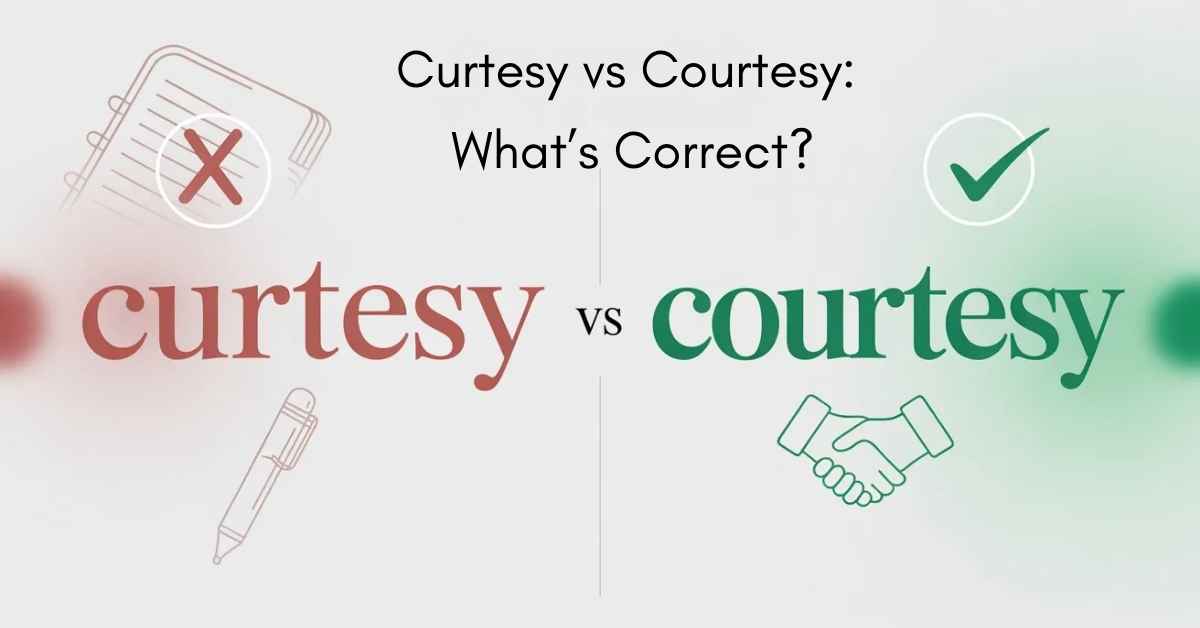
You typed one of these words and now you’re second-guessing yourself. Maybe autocorrect flagged it. Maybe a reader pointed it out. Either way, the confusion between curtesy vs courtesy is more common than you think, and getting it wrong can quietly hurt your credibility as a writer.
Here is the short answer: courtesy is the word you almost always want. It means polite behavior or a kind, respectful act. Curtesy is a real word too, but it belongs to old English property law, and almost nobody uses it outside of legal writing. If you are writing an email, a blog post, a travel guide, or anything meant for a general audience, courtesy is correct every single time.
What Does “Courtesy” Mean?
Courtesy (noun) refers to polite, considerate behavior toward other people. It also describes a kind act done out of respect or goodwill rather than obligation.
Think of it this way: when someone holds a door open for you, waves you through in traffic, or says “please” and “thank you,” that is courtesy in action.
Examples of courtesy in everyday sentences:
- “Please show courtesy to other passengers on the train.”
- “They offered us a free upgrade as a courtesy.”
- “A little courtesy goes a long way in the workplace.”
- “The hotel provided a courtesy shuttle to the airport.”
The word comes from the Old French word courtoisie, meaning the refined behavior expected at a royal court. Over centuries, it settled into everyday English as a word for basic good manners.
What Does “Curtesy” Mean?
Curtesy is a legal term rooted in English common law. It referred to a husband’s right to inherit a life estate in his deceased wife’s property, provided they had a child together who was born alive.
This concept has been largely abolished or replaced in modern law across most countries, which is why you almost never see this word outside of historical legal texts, property law courses, or old estate documents.
Examples of curtesy used correctly:
- “Under the old doctrine of curtesy, the widower claimed a life interest in the land.”
- “The estate attorney explained that curtesy had been abolished in that jurisdiction decades ago.”
So unless you are writing a legal history paper or drafting documents about 19th-century property law, you will likely never need this word.
Quick Comparison Table
| Feature | Courtesy | Curtesy |
| Correct for general use | Yes | No |
| Meaning | Polite behavior, a kind act | A husband’s legal right to a wife’s estate (old law) |
| Part of speech | Noun (also used as adjective) | Noun (legal term only) |
| Common in everyday writing | Yes | No |
| Found in legal/historical texts | Rarely | Yes |
| Example | “Thank you for your courtesy.” | “The doctrine of curtesy was abolished.” |
How to Use “Courtesy” in Real Life
Courtesy shows up in more situations than most people realize. Here are some natural, real-world examples across different contexts.
In travel and hospitality:
- “The airline provided a courtesy meal during the delay.”
- “Guests received a courtesy call from the front desk.”
- “Please extend courtesy to fellow travelers by keeping noise to a minimum.”
In casual writing and messaging:
- “Just sending this as a courtesy reminder about tomorrow’s meeting.”
- “He waved as a courtesy, even though they barely knew each other.”
In the workplace:
- “Professional courtesy means responding to emails within 24 hours.”
- “She sent a courtesy copy of the report to the whole team.”
On the trail or outdoors:
- “Trail courtesy means yielding to hikers coming uphill.”
- “Pack out your trash. It’s basic hiking courtesy.”
Notice how naturally the word fits into all of these situations. That flexibility is what makes it one of the most useful words in polished, everyday writing.
Common Mistakes People Make
Most writers make one of three errors with these words.
Mistake 1: Using “curtesy” when they mean “courtesy.” This is by far the most common error. It usually happens because the two words look so similar. The writer types curtesy thinking it is just an alternate spelling. It is not.
Mistake 2: Confusing courtesy with “curtsy.” A curtsy (also spelled curtsey) is the bowing gesture made by bending the knees, traditionally performed as a sign of respect. This is a completely different word with a completely different meaning.
- Wrong: “She gave a courtesy to the queen.”
- Right: “She gave a curtsy to the queen.”
- Right: “She showed courtesy to everyone she met.”
Mistake 3: Using “courteous” and “courtesy” interchangeably. Courteous is the adjective form (“She was courteous to the staff”), while courtesy is the noun form (“She showed great courtesy”). They are related but not interchangeable.
Courtesy as an Adjective
One thing competitors rarely explain: courtesy doubles as an adjective in some phrases.
When you say “courtesy call,” “courtesy bus,” or “courtesy copy,” you are using courtesy as a modifier. This is standard English and perfectly correct.
- “The dealership provided a courtesy vehicle while my car was being repaired.”
- “HR sent a courtesy email before the policy changed.”
This adjective form is common in business and travel writing, so it is worth knowing.
The Memory Trick That Actually Works
Here is a simple way to never mix these up again.
- Courtesy contains the word our. Courtesy is something we do for each other, for our shared community. It is a social word.
- Curtesy sounds like court without the “o” and carries a very old-fashioned, legal flavor. If you are not writing about medieval property law, it is not the word you need.
Another way to think of it: if Emily Post or a modern etiquette guide would use the word, you want courtesy. If a Victorian property lawyer would use the word, you want curtesy.
Related Words Worth Knowing
Understanding the full word family around courtesy will make your writing stronger.
- Courteous (adjective): “She was always courteous with difficult customers.”
- Courteously (adverb): “He spoke courteously even under pressure.”
- Discourteous (adjective): “Interrupting people is discourteous.”
- Discourtesy (noun): “The rudeness was an act of pure discourtesy.”
- Curtsy / Curtsey (noun/verb): The gesture of respect, unrelated to courtesy.
These related terms and variations all connect to the same root concept of respectful behavior. Using them naturally in your writing signals that you have a genuine command of the language.
Which One Should You Use?
Use courtesy in almost every situation you can think of. It is the correct word for polite behavior, kind acts, professional etiquette, travel writing, casual communication, and formal correspondence.
Use curtesy only if you are writing specifically about old English common law and the historical doctrine by that name.
A simple test: if you could replace the word with “politeness” or “a kind gesture” and the sentence still makes sense, you want courtesy.
Why This Confusion Happens in the First Place
English has a long history of absorbing words from French, Latin, and Old Norman law. Many legal terms that entered English through Norman French look almost identical to common words used in everyday speech.
Curtesy entered English through legal channels, specifically as a property law doctrine from medieval Norman practice. Courtesy entered through social use, describing the behavior expected at a royal court.
Over time, legal writing preserved curtesy in its narrower technical sense, while courtesy expanded into everyday life. The overlap in spelling is purely historical coincidence, not evidence that they are the same word.
FAQ: Curtesy vs Courtesy
Is “curtesy” just another spelling of “courtesy”?
No. Curtesy is an old legal term. Courtesy means polite behavior. They are two completely different words.
Which spelling is correct for everyday use?
Always use courtesy. It is the correct spelling for polite behavior, kind acts, and everyday writing.
What is the difference between “courtesy” and “curtsy”?
Courtesy means polite behavior. A curtsy is a physical gesture of respect, like bending your knees.
Can “courtesy” be used as an adjective?
Yes. Phrases like “courtesy call” and “courtesy shuttle” use courtesy as a modifier meaning a free extra.
What does “professional courtesy” mean?
Professional courtesy means treating colleagues and clients with respect, promptness, and consideration in any workplace setting.
Conclusion
The curtesy vs courtesy debate really comes down to one simple fact: courtesy is the word for polite behavior, and curtesy is an old legal term almost nobody uses today. In nearly every piece of writing you will ever produce, courtesy is the right choice.
Getting small spelling distinctions right is one of the quietest ways to build trust with your readers. They may never notice when you get it right, but they will definitely notice when you get it wrong. Choose courtesy, write with confidence, and move on.

I’m Daniel Carter, founder of wordwix.com, a creative space focused on powerful and meaningful words. I explore ideas, meanings, and inspiration to help you find the perfect words for any purpose with clarity and creativity.