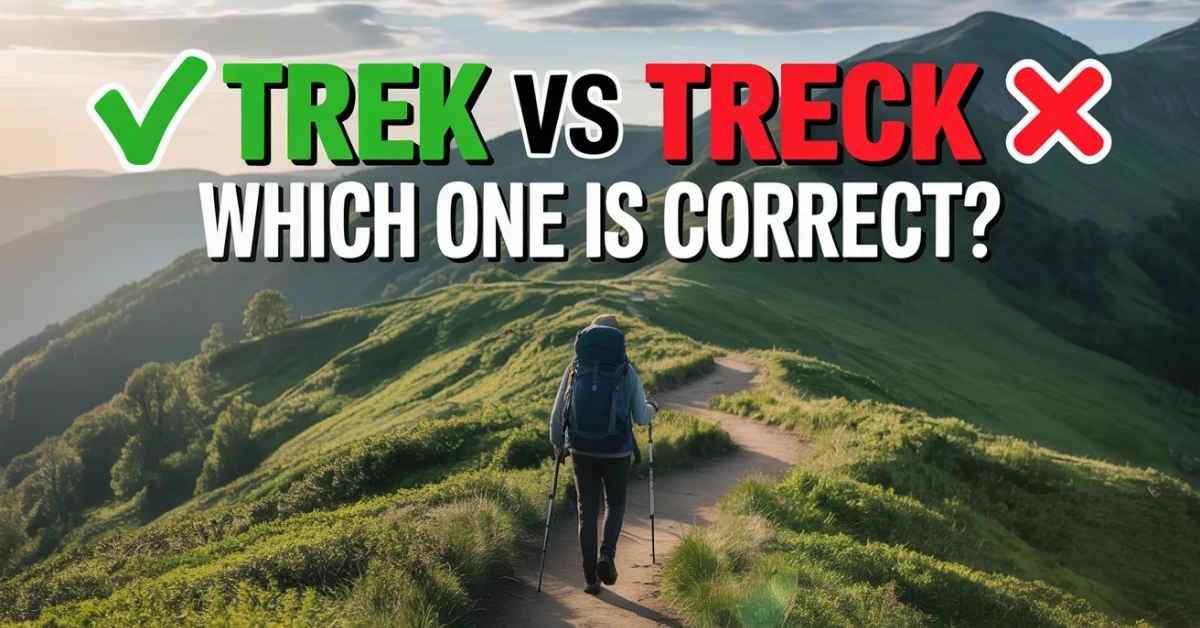
Ever found yourself second-guessing whether to write “trek” or “treck”? You’re not alone. These two spellings look almost identical, sound the same, and often confuse even experienced writers. But here’s the truth. Only one is correct, and the other is a common mistake that slips into emails, captions, and travel posts all the time.
In this quick guide, we’ll break down the real difference, where the word comes from, and why it matters more than you think. By the end, you’ll never hesitate again when describing a long journey or adventurous trip. Let’s clear up the confusion once and for all.
The Simple Answer: It’s “Trek,” Not “Treck”
Trek is the correct spelling. “Treck” is a common misspelling that shows up everywhere, from social media posts to travel blogs.
It looks plausible, which is why so many people use it without realizing it’s wrong. One letter makes the difference. That extra “c” in “treck” doesn’t belong there.
Where Does the Word “Trek” Actually Come From?
The word trek comes from the Afrikaans language, spoken in South Africa. It originally meant “to travel by ox wagon,” used by Dutch settlers called the Boers during long, grueling journeys across southern Africa.
Over time, it traveled into English and took on a broader meaning. Today it means any long, difficult, or adventurous journey, whether on foot, by vehicle, or even figuratively through life.
How “Trek” Is Used in Real Life
You’d use trek in situations where the journey feels like an effort. It carries weight. It implies distance, challenge, or commitment.
Some real examples:
- “We went on a trek through the Himalayas for five days.”
- “The daily trek to work in rush-hour traffic is exhausting.”
- “Hiking this trail is a serious trek for beginners.”
Notice how each example involves either physical distance or a sense of difficulty. That’s the core feel of the word.
Why People Keep Writing “Treck” by Mistake
Blame phonetics. When people hear the word spoken, they naturally think about how it sounds. The “ck” combination at the end of a word (like “check,” “deck,” “wreck”) is super common in English. So the brain assumes “treck” must follow the same pattern.
But trek is a borrowed word. It didn’t follow the typical English spelling rules because it came into the language already formed. The original Afrikaans spelling was “trek,” and that’s the version English adopted directly.
Common Phrases Where “Trek” Appears
Once you start noticing the word, you’ll see it used in many familiar phrases and proper nouns.
Star Trek is probably the most globally recognized example. The entire franchise is built on that word, representing long space journeys into the unknown. If the creators had spelled it “Star Treck,” it would’ve looked instantly wrong.
Other common uses include:
- Trekking poles (used by hikers for balance and support)
- Trek bikes (a well-known bicycle brand)
- Trekking route (a mapped trail for long-distance walking)
- Trek to base camp (a famous Everest hiking experience)
Is “Treck” Ever Acceptable?
No. There’s no context, dialect, or regional variation where “treck” is accepted as a correct spelling. It doesn’t appear in any standard English dictionary as an alternate spelling.
If you find it in published content, it’s a typo that slipped past editing. It happens, but it’s still wrong.
How to Remember the Correct Spelling Forever
Here’s a simple trick. Think of the word “trek” as short and lean, just like the journeys it describes. A trek is tough and stripped down. No extra letters, no fluff.
You can also link it to Star Trek. Everyone knows that brand. The moment you associate “trek” with that famous franchise, the correct spelling sticks. You’d never write “Star Treck,” right?
Another method: remember that “trek” rhymes with “check” but doesn’t spell like it. That contrast is the point worth memorizing.
How “Trek” Works as Both Noun and Verb
This is where the word gets flexible. Trek functions as both a noun and a verb in English, and it’s used the same way in either form.
- As a noun: “The trek up the mountain took seven hours.”
- As a verb: “We trekked through the forest without stopping.”
Notice the past tense adds a “k” before the “ed”: trekked. Same with the continuous form: trekking. The base word stays clean and consistent, just three letters doing real work.
Trekking as a Sport and Travel Activity
Trekking as an activity has exploded globally. It’s not just hiking anymore. Countries like Nepal, Peru, Patagonia, and New Zealand have built entire tourism industries around trekking culture.
The difference between hiking and trekking is mostly duration and terrain. Hiking is usually a day trip. Trekking spans multiple days, often through remote or challenging landscapes without easy access to roads or services.
Popular trekking destinations include:
- Annapurna Circuit in Nepal (roughly 160 km)
- Inca Trail in Peru (leading to Machu Picchu)
- Overland Track in Tasmania, Australia
- Camino de Santiago in Spain
Each of these is a real trek, not a casual walk. They take preparation, the right gear, physical fitness, and often a guide.
LSI Keywords Worth Knowing Around “Trek”
If you’re writing about trekking or searching for related content, a few related terms come up naturally: hiking trail, backpacking journey, long-distance walking. These terms often appear alongside “trek” in travel writing and outdoor content.
Understanding these related words helps you find better content online and write more naturally when describing your own adventures.
When to Use “Trek” in Writing
Use trek when you want to describe something that involves real effort or a long journey. It works in travel writing, storytelling, casual conversation, and even metaphor.
“Getting through that stack of reports was a mental trek.” That’s a perfectly valid figurative use. The word stretches beyond physical travel.
Avoid using it for short or easy trips. “It was a quick trek to the mailbox” sounds odd because the word implies effort. For short distances, “walk” or “trip” fits better.
Frequently Ask Question
Is “treck” ever the correct spelling?
No, “treck” is always a misspelling; the only correct spelling is “trek.”
What does trek mean?
It means a long, difficult, or adventurous journey, usually on foot.
Where did the word trek come from?
It came from the Afrikaans language, originally meaning to travel by ox wagon.
Can trek be used as a verb?
Yes, you can say “we trekked through the mountains” and it works perfectly.
What is the difference between hiking and trekking?
Hiking is usually a short day trip, while trekking covers multiple days through challenging terrain.
Quick Summary Before You Go
Trek is correct. Treck is not. The word comes from Afrikaans, it means a long or difficult journey, and it works as both a noun and a verb. The most famous example in popular culture is Star Trek, which is also the easiest way to lock the correct spelling into your memory.
Whether you’re planning an actual Himalayan adventure, writing a travel blog, or just posting a caption about your morning commute, now you know exactly which spelling to use. No more second-guessing. It’s trek, always.

I’m Daniel Carter, founder of wordwix.com, a creative space focused on powerful and meaningful words. I explore ideas, meanings, and inspiration to help you find the perfect words for any purpose with clarity and creativity.