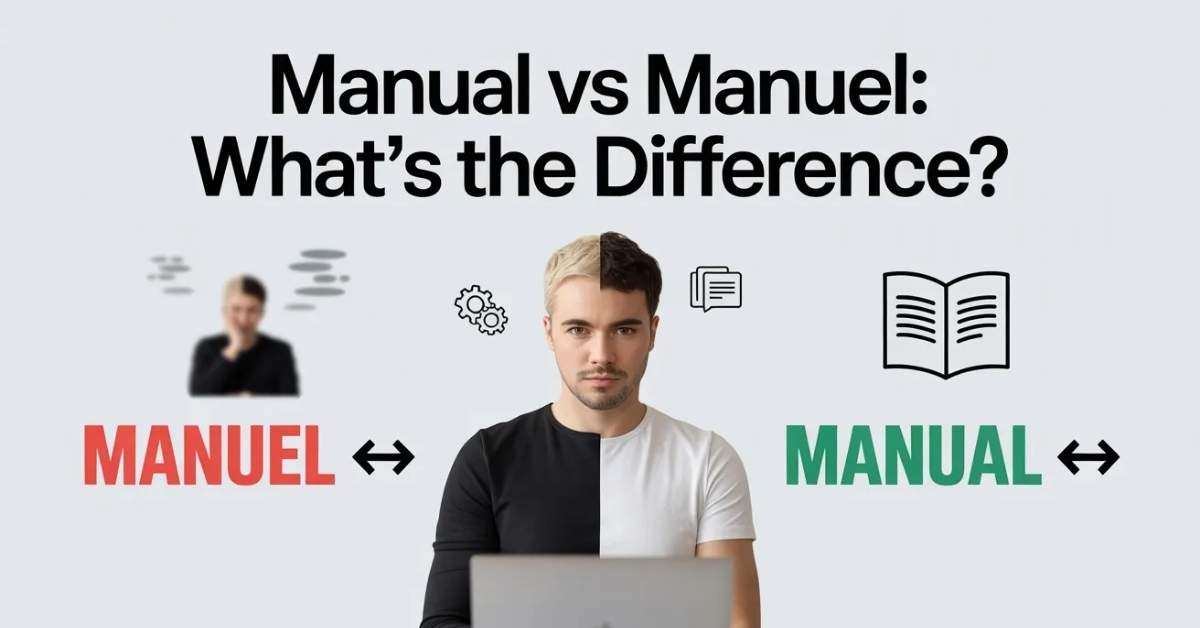
You’re in the middle of writing an email, guide, or blog post when one tiny word trips you up—manual or Manuel? It looks like a small detail, but it can quietly affect how professional, clear, and trustworthy your writing feels. These two words may sound similar, yet they belong in completely different contexts. One is a common English term used in everyday writing, while the other is a personal name.
Understanding the difference isn’t just about spelling—it’s about using the right word at the right time so your message lands exactly the way you intend.
The Short Answer: Only One Is a Real Word
Manual is the correct English word. It means something done by hand, a physical or instructional guide, or not automatic. “Manuel” is not an English word at all. It’s a proper name, common in Spanish and Portuguese-speaking cultures.
If you’re writing a user guide or describing a process, manual is what you need.
What Does “Manual” Actually Mean?
The word manual comes from the Latin word “manus,” which means hand. It carries two main meanings in everyday use.
First, it describes something operated or done by a person rather than a machine. Think manual labor, manual transmission, or a manual pump.
Second, it refers to a written guide or handbook that explains how to use something. A car manual, a software manual, an employee manual. These are documents that walk you through a process step by step.
Common Uses of “Manual” in Daily Life
You’ll find this word everywhere once you start noticing it:
- Employee manual: A company handbook that explains rules, leave policies, and procedures
- User manual: Comes packed with every appliance, gadget, or software you buy
- Manual transmission: A car where the driver changes gears themselves instead of letting the car do it
- Manual process: Any task that a human does without automation help
A good example: “I had to read the entire manual before I could figure out how to reset the router.”
Who Is Manuel? (When It’s Actually a Name)
Manuel is a masculine given name. It’s widely used in Spain, Portugal, Latin America, and other regions. It’s the equivalent of “Emmanuel” in English, originally meaning “God is with us” in Hebrew.
So if you’re talking to a person named Manuel, that spelling is correct. But if you’re writing about a process, a guide, or a hands-on task, you want manual every single time.
Quick example: “Manuel followed the manual step by step to fix the machine.” Both words in one sentence, different meanings entirely.
Why Do People Confuse These Two Words?
Autocorrect is one big reason. Some systems flag “manual” as a typo and suggest “Manuel” depending on your device language settings or your contact list. If you have a contact named Manuel, your phone may swap the words without you noticing.
Also, non-native English speakers who speak Spanish or Portuguese grow up hearing “Manuel” as a common name. The brain sometimes writes what it hears most, especially when typing fast.
How to Remember the Difference
Here’s a simple trick that works every time.
- Manual ends in “al.” Think of “al” as standing for “all instructions.” A manual contains all the instructions.
- Manuel ends in “el.” That’s a person’s name ending, similar to Daniel, Rafael, Samuel. If it ends in “el,” it’s a person.
That one mental note saves you from the mistake repeatedly.
“Manual” as an Adjective vs a Noun
This is where the word gets slightly more flexible, and it’s worth knowing.
- As a noun: “Did you read the manual?” Here it’s a physical document or guide.
- As an adjective: “This is a manual process.” Here it describes the nature of the task.
Both uses are completely correct. The word just changes its role in the sentence depending on context.
SEO and Writing: Why Spelling This Right Matters
If you’re a content writer, blogger, or business owner creating web pages, spelling errors like “manuel” instead of “manual” can hurt your credibility. Readers notice these things faster than you think.
Search engines also pick up on content quality signals. A page full of misspelled common words can subtly impact how search engines evaluate your content’s trustworthiness.
When writing product pages, how-to guides, or any instructional content, always double-check that you’re using manual and not “manuel.”
Real-Life Sentences Using “Manual” Correctly
Here are a few natural examples to show you how the word fits into writing:
- “The new employee spent her first week going through the manual for the billing software.”
- “He prefers driving a manual car because he feels more in control.”
- “We still process these refund requests through a manual system because we haven’t automated it yet.”
- “There was no manual included in the box, so she looked for the PDF version online.”
Each of these uses “manual” in a different context, but all are correct.
When You’re Writing About a Person Named Manuel
If you’re writing someone’s name, biography, or quoting a person, then “Manuel” with a capital M and that “el” ending is exactly right.
- “Manuel Garcia is the lead engineer on the project.”
- “I asked Manuel to check the wiring before we restarted the system.”
The name deserves its correct spelling just as much as the word does. Getting a person’s name wrong, especially in professional writing, is a different kind of mistake but an equally important one to avoid.
A Quick Checklist Before You Use the Word
Before you hit publish or send, run through this fast check:
- Am I talking about a person? Use “Manuel” (capital M, ends in “el”)
- Am I talking about a document, guide, or handbook? Use “manual”
- Am I describing something done by hand or without automation? Use “manual”
- Did my autocorrect change it without me noticing? Check again
That 10-second pause before submitting has saved many writers from unnecessary embarrassment.
Frequently Ask Question
Is “manuel” a correct English word?
No, “manuel” is only a proper name, not an English word.
What does “manual” mean in simple terms?
It means either a written guide or something done by hand, not by machine.
Why does autocorrect change “manual” to “Manuel”?
Because if you have a contact named Manuel, your device suggests it automatically.
Can “manual” be used as both a noun and adjective?
Yes, “read the manual” is a noun and “manual process” is an adjective.
How do I remember the correct spelling every time?
Think of “al” in manual as “all instructions” and “el” in Manuel as a person’s name ending.
Final Thought
The confusion between manual and “manuel” is small but common. Now you know exactly when to use each one. The word “manual” belongs in your everyday writing whenever you’re talking about guides, hand-operated processes, or anything that runs without automation. “Manuel” belongs only when you’re addressing or referring to a person by that name.
Simple, clean, and now you won’t second-guess it again.

I’m Daniel Carter, founder of wordwix.com, a creative space focused on powerful and meaningful words. I explore ideas, meanings, and inspiration to help you find the perfect words for any purpose with clarity and creativity.