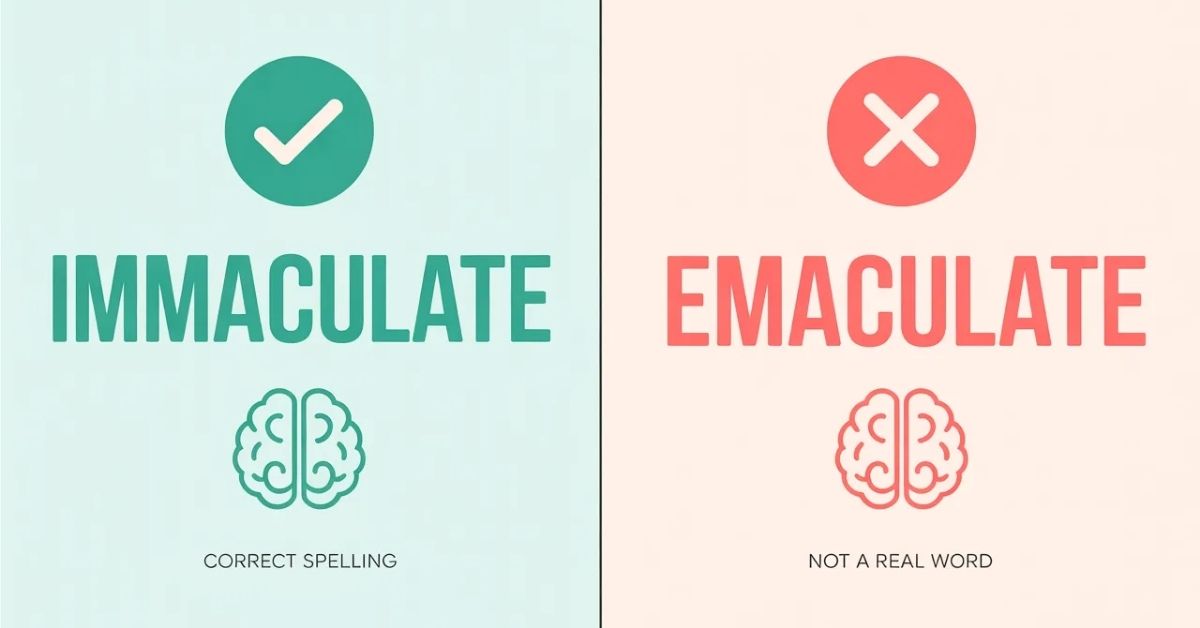
If you’ve ever typed “emaculate” and wondered whether that’s actually a word — you’re not alone. It’s one of those spelling traps that catches people all the time. The short answer is this: immaculate is the correct word. “Emaculate” doesn’t exist in standard English dictionaries.
Let’s break it down properly so you never confuse the two again.
What Does Immaculate Mean?
Immaculate means completely clean, spotless, or without any flaw or mistake. It describes something that is perfect in condition or appearance.
Think of a freshly ironed white shirt with zero stains. Or a car that looks brand new even after five years. That’s immaculate.
Is “Emaculate” a Real Word?
No, it’s not. You won’t find “emaculate” in Merriam-Webster, Oxford, or any major English dictionary. It’s simply a misspelling that has spread through common usage, especially online.
People sometimes mix it up with “immaculate” because the spoken sounds are similar. But in writing, only one version is correct — and it starts with “imm.”
Where Does the Word Immaculate Come From?
The word comes from the Latin “immaculatus,” which means “unstained.” It’s made up of “in-” (meaning not) and “macula” (meaning spot or stain).
So immaculate literally means “not stained” — and that’s exactly how we use it today.
How Is Immaculate Used in Everyday English?
You’ll hear and see this word in many real situations. Here are some natural examples:
- “Her handwriting was absolutely immaculate.”
- “The kitchen was immaculate after the deep clean.”
- “He showed up to the interview in an immaculate suit.”
- “The project was delivered in immaculate condition.”
It’s commonly used to describe appearance, cleanliness, presentation, and even moral purity in religious contexts.
The Religious Use of Immaculate
In religious language, especially in Catholicism, “immaculate” carries a spiritual meaning. The phrase “Immaculate Conception” refers to the belief that the Virgin Mary was born free from original sin.
This is one of the oldest and most well-known uses of the word — and it reinforces the core meaning of “without stain or fault.”
Common Mistakes People Make With This Word
The most common error is writing “emaculate” instead of “immaculate.” Another mistake is confusing it with “emaciated,” which is a completely different word meaning extremely thin or undernourished.
These words sound vaguely similar, but they have no connection in meaning. If you’re describing cleanliness or perfection, use immaculate. If you’re describing a dangerously thin appearance, that’s emaciated.
Tips to Spell Immaculate Correctly Every Time
Spelling “immaculate” is easier once you know how to remember it. Here’s a simple trick: think of it starting with “imm” — like “impossible” or “immense.” It begins with a double-m, not an “e.”
Another way to remember: “I Must Make A Clean Uniform, Look Amazing, Then Exit.” A little silly, but the first letters spell I-M-M-A-C-U-L-A-T-E.
Synonyms You Can Use Instead
If you want variety in your writing, here are some related words that carry a similar meaning:
- Spotless
- Flawless
- Pristine
- Perfect
- Unblemished
- Pure
All of these are useful alternatives, but “immaculate” still carries a stronger, more elevated feel — especially in formal writing.
When Should You Use Immaculate in Writing?
Use it when you want to express a high level of perfection or cleanliness. It works well in professional writing, descriptions, and situations where you want to emphasize something is completely without fault.
It’s especially powerful in contrast — describing something as immaculate in a messy environment, or calling out a single perfect detail in an otherwise chaotic scene.
Is There Any Context Where “Emaculate” Might Appear?
In very rare academic or archaic texts, you might encounter “emaculate” used as a verb form meaning “to free from spots.” But this usage is so outdated and obscure that it has no place in modern English.
For all practical purposes — personal writing, professional emails, school work, or social media — forget that form exists. Use immaculate.
Frequently Ask Question
Is “emaculate” a real English word?
No, “emaculate” is not a recognized word in modern English dictionaries. It is simply a common misspelling of “immaculate” and should always be avoided in writing.
What is the correct spelling — immaculate or emaculate?
The correct spelling is always “immaculate.” It comes from the Latin word “immaculatus,” meaning unstained or spotless, and has been standard in English for centuries.
What does immaculate mean in simple terms?
Immaculate means perfectly clean, flawless, or free from any defect. You can use it to describe anything from a tidy room to a perfectly written document or even a person’s appearance.
Can immaculate be used in formal and religious writing?
Yes, immaculate works in both everyday and formal contexts. In religious language, it is famously used in the phrase “Immaculate Conception,” referring to purity from sin, while in daily use it simply means spotless or perfect.
How can I remember not to write “emaculate” by mistake?
A simple trick is to remember that immaculate starts with “imm” — just like “impossible” and “immense.” Thinking of that double-m at the start will keep you from writing the incorrect “emaculate” version.
Quick Summary
“Immaculate” is the correct, real, widely-used English word meaning spotless or without flaw. “Emaculate” is not a standard word and should be avoided entirely.
If you’re ever in doubt, just run a quick spell check or think back to that double-m rule. Your writing will look sharper — and yes, more immaculate — for it.

I’m Daniel Carter, founder of wordwix.com, a creative space focused on powerful and meaningful words. I explore ideas, meanings, and inspiration to help you find the perfect words for any purpose with clarity and creativity.