You typed “window sill or window seal” into Google, and now you’re staring at results that either confuse the two or barely explain them. You just want a clear, simple answer.
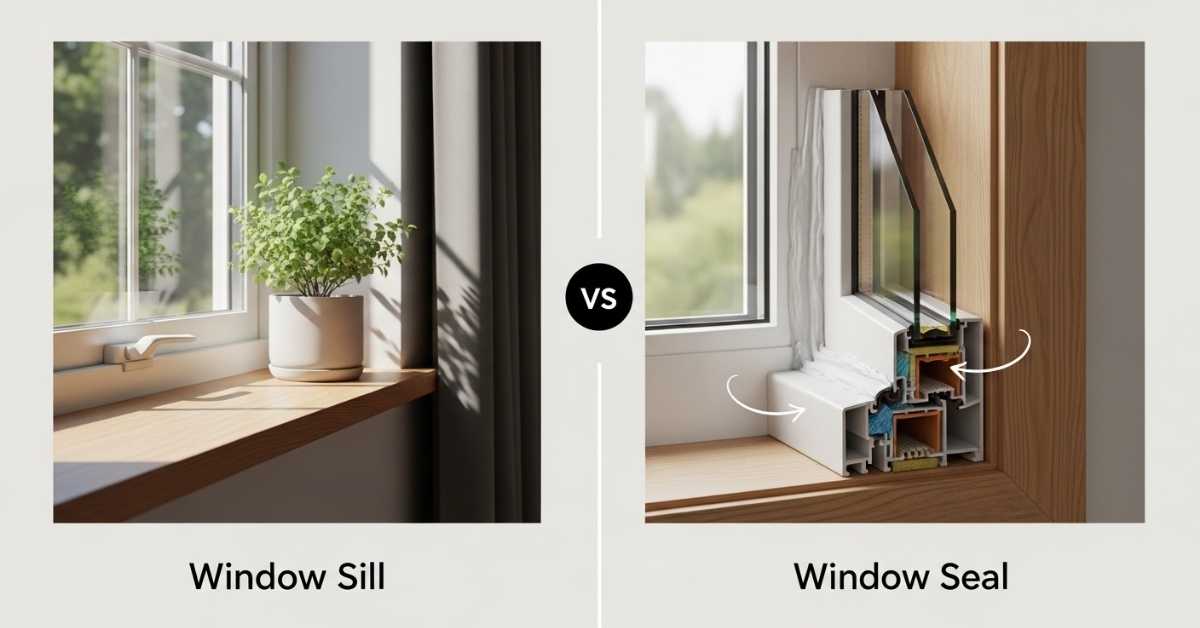
Here it is: a window sill is the physical ledge at the bottom of a window frame, and a window seal is the invisible barrier that blocks air, water, and drafts from sneaking through the frame. One supports. The other protects.
They are not the same thing, and mixing them up can cause real problems, especially when you’re buying materials, describing a repair, or writing something that needs to be accurate.
The Quick Answer (Featured Snippet Version)
Window sill = the visible ledge at the bottom of a window, both inside and outside your home.
Window seal = the hidden airtight barrier, usually made of weatherstripping, caulk, or foam, that keeps air and moisture out.
Think of it this way: the sill is the structure you can see and touch. The seal is the protection you cannot see but absolutely need.
What Is a Window Sill, Exactly?
A window sill (sometimes called a window ledge or window board) is the flat, horizontal surface that sits at the very base of a window frame. It extends outward slightly on the exterior, and on the interior, it’s the part where people commonly place plants, books, or decorative items.
Structurally, the exterior sill is angled downward just a little. That slope is not an accident. It’s designed to direct rainwater away from the wall and prevent water from pooling. Without that drainage angle, water would sit against the frame and slowly rot the wood or crack the masonry.
Here are the key things a window sill does:
- Provides structural support to the bottom of the window frame
- Directs rain and water away from the exterior wall
- Adds a decorative interior surface inside the room
- Protects the wall below the window from weather exposure
Example in real life: “My cat knocked the plant off the window sill again.” Or in a construction context: “The exterior window sill needs repainting before winter.”
What Is a Window Seal, Exactly?
A window seal is an airtight barrier layer that sits between the window frame and the wall opening, or between the glass panes themselves. You typically cannot see it once a window is installed. Its entire job is to stop air leakage, block moisture, and keep your energy bills from skyrocketing.
Window seals come in a few forms:
- Weatherstripping: A foam or rubber strip running along the edges of the frame
- Caulk or sealant: A flexible compound applied around the outer edge of the frame
- Insulated glass unit (IGU) seal: A seal between the panes in double or triple-glazed windows
- Foam backer rod: Used in wider gaps between the frame and the rough opening
Example in real life: “The window seal on our bedroom window has failed. There’s condensation forming between the panes.” Or: “We need to apply fresh caulk because the window seal around the frame is cracking.”
Window Sill vs Window Seal: Side-by-Side Comparison
| Feature | Window Sill | Window Seal |
| Visibility | Clearly visible | Hidden or invisible |
| Location | Base of the window frame | Edges of frame, between panes |
| Material | Wood, stone, PVC, concrete | Rubber, caulk, foam, silicone |
| Function | Structural support and drainage | Airtight and moisture barrier |
| Replaces easily? | Yes, with some work | Yes, fairly straightforward |
| What fails? | Rot, cracks, paint peeling | Air leaks, condensation, drafts |
| Cost concern | Aesthetic and structural | Energy efficiency and comfort |
One is visible support. The other is invisible protection.
Why People Confuse These Two Terms
The confusion is completely understandable. Both words sound similar when spoken quickly. And in casual conversation, people sometimes say “window seal” when they mean the sill, just because the word “seal” sounds like it implies something solid and physical.
There is also a regional factor. In some parts of the world, particularly outside North America, “sill” is used less commonly and people default to other terms like “window ledge” or “window board.” This can make the terminology feel even more muddled.
Here is where most people go wrong:
- Searching for “cracked window seal” when they actually mean the window sill is cracked or chipped
- Asking to “replace the window seal” when the weatherstripping (part of the sealing system) needs replacing
- Using “window seal” to describe the interior ledge because it “sounds right”
If you’re talking to a contractor, always clarify which part you mean. Pointing is sometimes the clearest communication.
Common Spelling Mistakes to Avoid
Search engines have seen millions of people type variations like:
- “window seel” (misspelling of both words)
- “window cill” (old British spelling of sill, now rarely used)
- “window sil” (dropped letter)
- “windoe sill” (typo)
The correct spellings are window sill (two l’s) and window seal (like “seal” as in waterproof). Neither spelling is interchangeable. If you’re writing a home improvement article, a construction report, or even a real estate listing, using the wrong term signals to the reader that you might not know what you’re talking about.
Real-Life Usage Examples
Let’s look at how both terms show up in everyday situations, so you can feel confident using them correctly.
- In a home improvement context: “Before winter, we resealed the window frames with fresh silicone caulk. The window seal had started to crack, and we could feel a draft near the living room sill.”
- In a real estate listing: “Large bay window with a wide interior window sill. All window seals are intact and double-glazed.”
- In a casual conversation: “I put a cutting board on the window sill to catch the drips from my herb pots. But honestly, I think the window seal has gone because there’s moisture between the panes.”
- In a DIY repair scenario: “I noticed the exterior window sill was soft and spongy. When I looked closer, the window seal along the top of the frame had failed, and water had been getting in for months.”
Signs Your Window Sill Needs Attention
Your window sill is giving you signals. Here’s what to watch for:
- Paint is peeling or bubbling on the exterior sill
- The wood feels soft or spongy when you press it (early rot)
- Visible cracks or chips in stone or concrete sills
- Water stains on the wall below the window
- The sill is visibly sagging or pulling away from the frame
These are structural and aesthetic problems. Left alone, they get worse and let water travel into the wall.
Signs Your Window Seal Has Failed
A failed window seal has its own set of symptoms, and they’re quite different:
- Condensation or fog trapped between double-pane glass (that you cannot wipe away)
- Noticeable draft or cold air near a closed window
- Higher than usual heating or cooling bills
- A faint whistling sound when the wind picks up
- Visible gaps or cracks in the caulk around the frame
These are energy efficiency and comfort problems. A failed seal does not look dramatic, but it costs you money every single month.
Which One Should You Use? (Choosing the Right Word)
Here is the simplest decision guide you will find anywhere:
Use “window sill” when you’re talking about:
- The ledge where you put things
- A physical part of the window you can touch
- Repainting or replacing a damaged surface
- The exterior drainage ledge on your home’s facade
Use “window seal” when you’re talking about:
- Stopping drafts or air leaks
- Condensation appearing between glass panes
- Applying caulk or weatherstripping
- Energy efficiency and insulation performance
Still unsure? Ask yourself: “Can I see it and touch it as a flat surface?” If yes, it’s the sill. “Does it stop something from getting through?” If yes, it’s the seal.
How Window Sills and Window Seals Work Together
Here’s something competitors rarely explain: the two parts depend on each other.
A healthy exterior window sill slopes water away from the frame. That protects the window seal from constant water pressure. If the sill is cracked and water pools against the frame, the seal deteriorates faster. If the seal fails, water gets behind the frame and rots the sill from the inside out.
They protect each other. Neglect one, and the other suffers. This is exactly why, when a contractor inspects your windows, they check both at the same time.
Quick Tips for Homeowners
A few practical things worth knowing:
- Repaint or reseal exterior window sills every 3 to 5 years in wet climates
- Check window seals (caulk lines) every autumn before cold weather arrives
- If you see fog between double-pane glass, the insulated glass seal has failed and the pane unit typically needs full replacement, not just resealing
- Use paintable silicone caulk for interior window seal work and exterior-grade caulk for outside
- A window sill replacement is a beginner-level DIY job. A failed insulated glass unit is usually a job for a glazier
Conclusion
The confusion between window sill or window seal is one of those small language mix-ups that can lead to real-world problems, especially when you’re trying to describe a repair, hire a contractor, or write accurate content. The sill is the visible support ledge. The seal is the hidden moisture-blocking barrier.
One supports. The other protects. Now that you know the difference, you can use both terms with confidence, whether you’re doing a home inspection, writing a property listing, or just explaining to someone why your heating bill is too high.

I’m Daniel Carter, founder of wordwix.com, a creative space focused on powerful and meaningful words. I explore ideas, meanings, and inspiration to help you find the perfect words for any purpose with clarity and creativity.