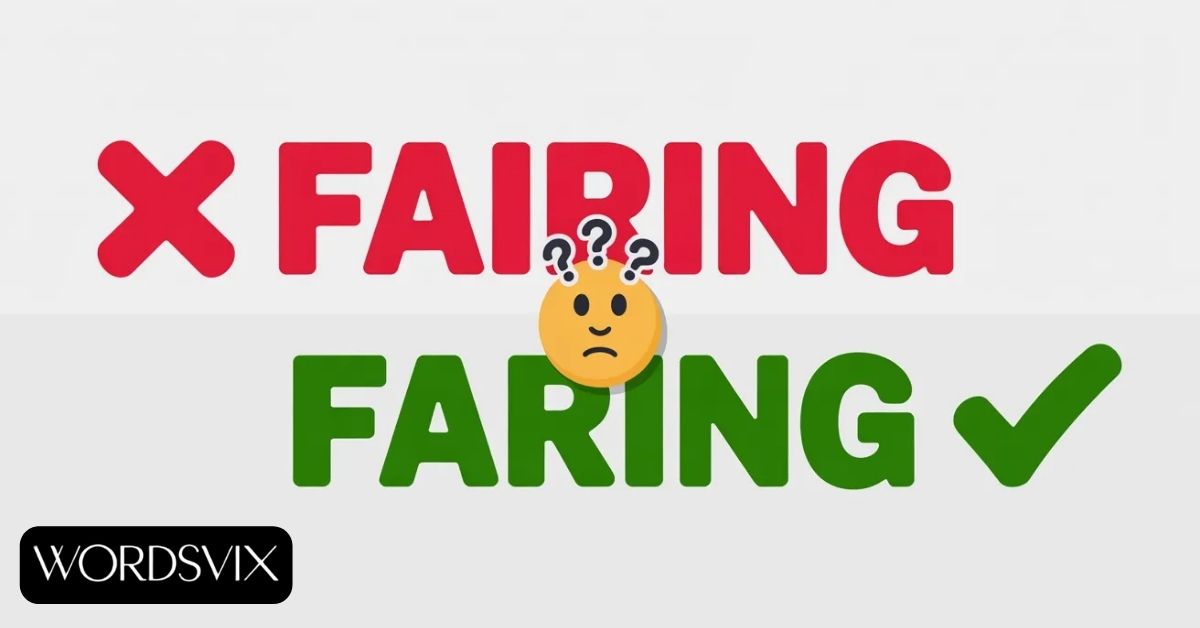
You are typing a message to a friend or colleague and you pause. Is it “how are you fairing” or “how are you faring”? Both look right. Both sound the same out loud. But only one is actually correct, and using the wrong one in a professional email can make you look careless.
This is one of the most common spelling mistakes in English, and you are definitely not alone in making it. By the end of this article, you will know exactly which word to use, why, and how to never mix them up again.
Understanding “Faring”
Faring is the present participle of the verb fare. And no, fare here does not mean the price of a bus ticket. In English grammar rules, “fare” as a verb means to get along, to progress, or to do in a certain situation.
So when someone asks “how are you faring,” they are asking how you are getting along or managing in life. It is a slightly formal but totally correct way to check in on someone. Think of it like asking “how are things going for you?”
- “How are you faring in your new job?”
- “She is faring well after the move.”
- “They fared better than expected in the competition.”
This is grammatical usage at its cleanest. Simple, clear, and correct.
Understanding “Fairing”
Now here is where the spelling confusion kicks in. Fairing is a real English word, but it is a noun, not a verb. A fairing is a structure added to a vehicle, aircraft, or motorcycle to reduce wind resistance. It is an English vocabulary term mostly used in engineering and aeronautics.
So if you write “how are you fairing,” you are technically asking someone how they are… being a wind-reduction structure. Which makes zero sense in normal conversation.
The word meaning difference is huge here. Faring describes progress or wellbeing. Fairing describes a physical object. That is the core of this confusing word pair.
Which One Is Correct: How Are You Fairing or Faring?
The correct phrase is always “how are you faring.” Full stop. This is not debatable in English grammar rules.
“How are you fairing” is a spelling mistake in English that happens because both words sound identical when spoken out loud. They are essentially homophones in English, which is exactly why so many people get tripped up. But in writing, the difference matters a lot, especially in professional writing.
Use “faring” when you want to ask about someone’s wellbeing or progress. Never use “fairing” in that context.
Understanding the Difference
The easiest way to understand the grammar distinction is this: one is a verb, one is a noun.
- Faring = verb, means progressing or getting along
- Fairing = noun, means a streamlined cover on a vehicle
When you are asking about a person’s situation or sentence structure in conversation, you always need the verb. That means faring wins every single time in this context.
Common Mistakes and Clarifications
The most common grammar mistakes in writing happen because people write the way things sound. Since faring and fairing sound identical, fingers type the wrong one without the brain catching it. Here are the mistakes people make most often:
- Writing “how are you fairing up?” instead of “how are you faring up?”
- Using “fairing well” instead of “faring well”
- Typing “she is fairing better now” instead of “she is faring better now”
All three are wrong. All three are easy to fix once you understand the grammar explanation behind the two words.
Tips for Remembering the Difference
Here are some quick proofreading tips to lock this into your memory for good:
- Remember that fare means to get along, just like in the phrase “fare well,” which eventually became the word “farewell.”
- If you are talking about a person’s progress, think of the word “welfare.” Both share the idea of how someone is doing.
- Fairing has an extra “i” just like the word “machine,” which is a hint that it belongs to the world of mechanical things.
These small mental tricks make correct word usage much easier to recall under pressure.
Decoding the Variations: “How Are You Fairing” versus “Faring” Differences and Usage
In English language learning, variations and context matter. “How are you faring” works in both formal and casual settings. You can use it in an email to your boss or in a text to a friend. It fits both perfectly.
“How are you fairing” does not work in either setting because it is simply not the correct phrase when asking about wellbeing. The grammar learning guide here is straightforward: check whether you need a verb or a noun, and the answer tells you exactly which spelling to pick.
Some people also write “how are you faring on” or “how are you faring with,” both of which are completely fine in present continuous tense usage.
Unraveling the Meaning: “How Are You Fairing” or “Faring”? Examples and Clarifications
Let us break this down with real examples so the language clarification becomes crystal clear.
Correct Examples Using “Faring”
These sentences all use correct English phrases with faring:
- “How are you faring with the new project deadlines?”
- “He is faring much better since starting therapy.”
- “How did the team fare in the championship?”
- “She fared well in the interview despite being nervous.”
- “How are you faring after the big move to a new city?”
Every single one of these is grammatically clean and natural to read.
Incorrect Examples Using “Fairing”
These are common English errors you want to avoid:
- “How are you fairing with your health lately?” (Wrong)
- “She is fairing well at her new school.” (Wrong)
- “How did he fair in the exam?” (Wrong)
None of these make grammatical sense because fairing is not a verb describing personal progress.
Correct Examples Using “Fairing”
To be fair to the word fairing, here is where it actually belongs:
- “The motorcycle fairing was cracked after the accident.”
- “Engineers designed a new fairing for the rocket nose cone.”
- “The car’s fairing improved its aerodynamic performance significantly.”
See the difference? Fairing lives in the world of English vocabulary related to engineering and vehicles, not human wellbeing.
Exploring the Nuances: “How Are You Fairing” versus “Faring” Examples and Insights
Here is a nuance worth noting. In older English communication skills and classic literature, “fare” was used very broadly to describe how someone lived, traveled, or got through life. That is why we still say “farewell” when saying goodbye, or “fair weather” to describe good conditions.
This historical context actually makes “faring” feel more elegant and thoughtful than simply asking “how are you doing.” It carries a sense of genuine curiosity about someone’s journey, not just their current mood.
Understanding this deeper meaning helps you use the word with more confidence and correct English phrase awareness.
Comparing the Phrases: “How Are You Fairing” or “Faring”? Differences and Real-life Examples
Scenario Comparisons
Here are side-by-side comparisons to make the grammar distinction even clearer:
- Checking on a sick friend: “How are you faring after the surgery?” (Correct) vs. “How are you fairing after the surgery?” (Incorrect)
- Work check-in email: “How are you faring with the new workload?” (Correct) vs. “How are you fairing with the new workload?” (Incorrect)
- Asking about someone’s move: “How are you faring in your new city?” (Correct) vs. “How are you fairing in your new city?” (Incorrect)
Real-life Communication Examples
In professional writing and everyday English writing tips, using “faring” correctly signals that you have a strong grasp of the language. It shows attention to detail. It tells the reader you care about correct word usage.
A hiring manager who reads “I hope you are faring well” in a cover letter will notice that polish. Someone who writes “fairing well” might not get the same reaction.
Mastering the Correct Phrase: “How Are You Fairing” or “Faring”? Differences and Usage Guidelines
Core Usage Rules
Here are the core English grammar rules to keep on hand:
- Always use faring when asking about someone’s wellbeing or progress.
- Use fairing only when referring to a physical, structural component on a vehicle or aircraft.
- In present continuous tense, the correct form is always “faring,” as in “how are you faring today?”
- Never swap one for the other in conversation or writing.
Practical Application Tips
These English writing tips will help you apply everything you just learned:
- Before hitting send on any email or message, do a quick scan for the word “fairing.” If it is not talking about a physical structure, change it to “faring.”
- Use the farewell trick: if “farewell” makes sense in the sentence context, then “faring” is your word.
- When proofreading, flag any word that ends in “-airing” and double-check whether it should actually be “-aring.”
These small habits will save you from common English errors in your daily writing.
20 Key Points About Using “How Are You Fairing” or “Faring”
Here are 20 quick facts to lock everything in:
- Faring is the correct word when asking about someone’s wellbeing.
- Fairing is a noun used in engineering contexts.
- Both words are homophones in English, meaning they sound identical.
- “How are you faring” is grammatically correct in both formal and casual settings.
- “How are you fairing” is one of the most common English errors in writing.
- The verb fare means to progress or get along in life.
- “Faring” follows present continuous tense rules naturally.
- “Farewell” comes from the same root as “faring,” meaning to travel or do well.
- Spelling confusion happens because spoken English does not reveal the difference.
- A fairing on a motorcycle reduces drag. It has nothing to do with emotions.
- “She is faring well” is correct. “She is fairing well” is not.
- Grammar mistakes in writing like this one are very common among native speakers too.
- Context always tells you which word belongs: person or machine?
- Professional writing demands the correct spelling every time.
- Using “faring” correctly shows strong English communication skills.
- You can say “how did you fare” in past tense. Never “how did you fair.”
- “Fair” as a verb is also technically an archaic usage and is mostly considered informal or incorrect today.
- The best proofreading tip is to ask: am I describing a person or a vehicle part?
- English vocabulary learning improves dramatically when you study confusing word pairs like this one.
- Once you learn this difference, you will never mix them up again.
Conclusion
So here is the simple truth. How are you faring is correct. How are you fairing is not, at least not when you are talking about a person’s life or progress. The difference comes down to one being a verb and the other being a noun, and understanding that one grammar distinction fixes the confusion forever.
This is one of those confusing word pairs that trips up even confident writers, so do not feel bad if you have been getting it wrong. Now you know better, and knowing better means writing better.
Did this clear things up for you? Drop a comment below and share which one you have been using. Let us see how many of us have been “fairing” when we should have been “faring” all along!

I’m Daniel Carter, founder of wordwix.com, a creative space focused on powerful and meaningful words. I explore ideas, meanings, and inspiration to help you find the perfect words for any purpose with clarity and creativity.