One small spelling choice separates correct English from a grammar mistake that editors, teachers, and even Google’s content systems notice.
Should you write other than or other then? The answer is clear, and this guide explains everything in plain language so you never mix them up again.
Other Than vs Other Then: What’s the Difference?
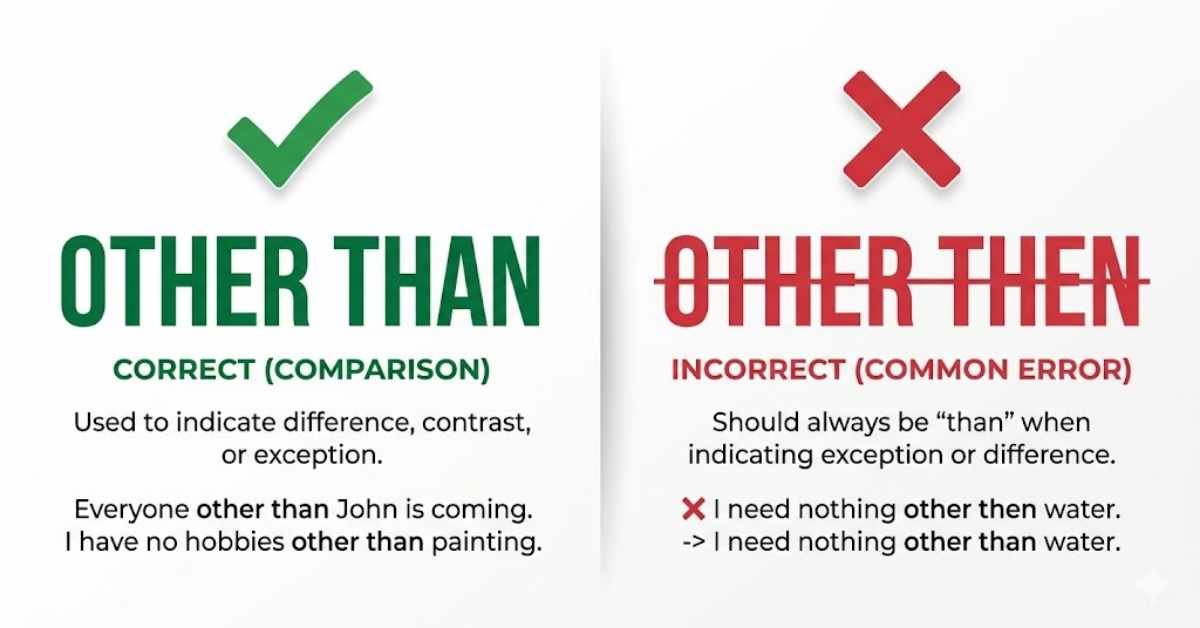
The core difference is simple. Other than is a real, grammatically correct English phrase. Other then is not.
Part of Speech
Other than works as a prepositional phrase or a conjunction. It connects ideas and signals an exception or exclusion.
Then is an adverb of time or sequence. It tells you when something happens or what comes next. It cannot pair with “other” to form a meaningful phrase.
Comparison Table
| Feature | Other Than | Other Then |
| Grammatically correct | Yes | No |
| Meaning | Except for, besides, apart from | No standard meaning |
| Part of speech | Preposition or conjunction | Not applicable |
| Used in formal writing | Yes | Never |
| Used in academic writing | Yes | Never |
| Common mistake | Rare | Very common |
Mini Recap
Other than = except for or besides. Always correct. Other then = a spelling error. Always avoid it.
Is Other Than vs Other Then a Grammar, Vocabulary, or Usage Issue?
This is primarily a grammar and usage issue, not a vocabulary gap. Most people already know what “than” and “then” mean individually. The confusion happens when they write quickly or rely on sound alone.
Are They Interchangeable?
No. They are never interchangeable. Other than has a defined grammatical role. Other then has no role at all in standard English. Swapping one for the other does not produce an alternative meaning; it produces an error.
Formal vs Informal Usage
In formal writing, only other than is acceptable. Using “other then” in a business email, legal document, or professional report signals carelessness.
In informal writing such as text messages or social posts, the mistake appears often but still weakens credibility.
Academic vs Casual Writing
Academic writing demands other than without exception. Style guides including APA, MLA, and Chicago Manual of Style all follow standard grammar rules, and none recognize “other then” as valid.
Using Other Than Correctly
Other than is used to show contrast, exception, or exclusion. Replace it with “except for” or “besides” and the sentence should still make sense. If it does, you have used it correctly.
Workplace Example
The report was ready on time, other than a missing chart in section three.
Academic Example
No sources were cited other than the two references listed in the bibliography.
Technology Example
The software ran smoothly other than a minor bug in the login screen.
Everyday Example
She eats everything other than spicy food.
Usage Recap
Ask yourself one question before writing: Am I describing an exception or exclusion? If yes, use other than.
Why Other Then Is Incorrect
Then refers to time or sequence. Sentences like “First we study, then we rest” show its correct role. The word “other” creates a comparison or exception, which needs than, not then.
When someone writes “other then,” they are pairing a comparison word with a time word. That combination has no logical or grammatical support in English. It does not describe time. It does not create a comparison. It simply does not work.
Spell checkers and grammar tools like Grammarly and Microsoft Word flag “other then” as an error because no dictionary or grammar rule recognizes it as correct.
When You Should NOT Use Other Than or Other Then
There are specific situations where neither phrase fits. Knowing these helps you choose more precise language.
1. When You Mean “Besides”
Use “besides” directly when adding information rather than creating an exception. “Besides coffee, I also enjoy tea” sounds more natural than forcing “other than.”
2. When You Mean “Afterward”
If you are describing a sequence of events, use then on its own. “We finished the meeting, then went to lunch” needs only “then,” not “other than” or “other then.”
3. When You Need a Direct Comparison
For straight comparisons, use than alone. “She runs faster than her brother” does not need “other” in front of it.
4. When Referring to Time
Any sentence about when something happens needs then, standing alone. “Back then, things were simpler.”
5. When Listing Items in Sequence
Use ordinal language or “then” for step-by-step lists. “First, add flour. Then add sugar.” Adding “other” here creates confusion.
6. When Meaning “In Addition”
Use “in addition to” or “also” when you want to add information without implying exception. “In addition to English, she speaks French” is cleaner than forcing “other than.”
7. When You Want “Except”
Sometimes “except” alone is cleaner and more direct. “Everyone came except Maria” is simpler than “Everyone came other than Maria,” though both are grammatically fine.
8. When the Sentence Needs a Clear Subject
If the sentence structure already implies contrast through other words, adding “other than” can create redundancy. Keep sentences tight and purposeful.
Common Mistakes and Decision Rules
The most common mistake is typing “other then” because “than” and “then” sound nearly identical in fast speech. Another mistake is using “other than” when a simpler word like “except” or “besides” would communicate more clearly.
Decision Rule
Ask this question every time:
Is the sentence about time or sequence? Use then alone. Is the sentence about an exception or contrast? Use other than. Are you combining “other” with “then”? Stop. It is always wrong.
Other Than or Other Then in Modern Technology and AI Tools
AI writing assistants and grammar checkers recognize “other than” as correct and flag “other then” as an error. Tools like Grammarly, ProWritingAid, and even autocorrect systems on mobile phones have been trained on standard grammar rules and treat “other then” as a typo.
Voice recognition software sometimes transcribes speech incorrectly because “than” and “then” sound nearly the same in natural conversation. Always proofread AI-generated or voice-typed content for this specific error before publishing or sending.
Word Origins and Etymology
Than comes from Old English “thonne” or “thanne,” which was used for comparisons as far back as the 9th century. Over time, its role became fixed as the word that introduces the second element of a comparison or exception.
Then also comes from Old English “thonne,” meaning “at that time.” The two words were once written identically but gradually developed separate spellings and distinct meanings as the English language evolved. This shared origin explains why native speakers and learners alike still confuse them today.
Expert Insight
Grammar specialists consistently point out that than and then represent one of the most persistent confusing word pairs in modern English. The confusion is not a sign of low intelligence; it is a result of the words sharing almost identical pronunciation in casual speech. Linguists describe this as a phonemic overlap, where two distinct words become indistinguishable in sound.
The key professional advice is always the same: slow down when writing, read sentences aloud, and ask whether the word relates to time or comparison before choosing.
Case Study 1: Academic Editing
A university student submitted an essay draft containing the phrase “other then” in four places. The faculty editor corrected each instance to “other than” before submission.
The student had strong content but the repeated error reduced the perceived quality of the writing. After correction, the essay scored higher on language clarity criteria. The lesson: one repeated grammar error can influence how an entire piece of work is judged.
Case Study 2: Corporate Communication
A marketing team sent a client proposal containing “other then” twice in the executive summary. The client flagged the errors before signing. The team revised the document. The episode prompted the company to add grammar checks as a required step before any client-facing document is sent. Small errors in professional writing carry real professional consequences.
Error Prevention Checklist
Always Use Other Than When
You are describing an exception, exclusion, or contrast in a sentence. You can replace the phrase with “except for” or “besides” and the sentence still makes sense. You are writing formally, academically, or professionally.
Never Use Other Then When
You are writing about anything other than time or sequence. You are writing for a professional, academic, or public audience. You want your writing to be taken seriously.
Use Then Only When
You are referring to a point in time, a sequence of events, or a consequence. Examples: “First this happens, then that happens.” or “Back then, it was different.”
Related Grammar Confusions You Should Master
Mastering other than vs other then is a great starting point. Several related word pairs follow the same logic and trip up writers for identical reasons:
- Than vs Then on their own remain the most common confusing word pair in English.
- Rather than follows the same rule as “other than” since it also uses “than” for contrast, not time.
- More than and less than both use “than” for comparison, never “then.”
- Better than works identically.
- No other than is a formal phrase meaning precisely and only.
All of these depend on a clear understanding that than belongs to comparison and other than belongs to exception, while then stays firmly in the territory of time.
FAQs
Is “other then” ever correct in English?
No. “Other then” is not recognized as correct in any standard variety of English. It is always a spelling or grammar error.
What does “other than” mean?
Other than means “except for” or “besides.” It signals that something is excluded or different from the main subject.
Can I use “other than” at the start of a sentence?
Yes. Other than can open a sentence. Example: “Other than a few minor issues, the project was a success.”
What is the difference between “other than” and “rather than”?
Both use “than” and both signal contrast, but rather than expresses preference or choice, while other than expresses exception or exclusion.
How do I remember the difference between “than” and “then”?
Think of then as a time word, linked to “when.” Think of than as a comparison word, linked to “different.” When in doubt, try replacing with “except for” and if it fits, use than.
Conclusion
The difference between other than and other then comes down to one letter, but that letter matters. Other than is the only correct form. It means “except for” or “besides” and works as a preposition or conjunction in both formal and informal English. Other then is a grammatical error with no valid use in any form of standard writing.
The simplest test is this: if your sentence is about time, use “then” on its own. If your sentence is about an exception, use “other than.” There is no situation where “other then” is the right choice.
Strong writing builds trust. Grammar accuracy is part of that foundation. Every time you choose other than correctly, you protect your credibility and communicate with clarity.

I’m Daniel Carter, founder of wordwix.com, a creative space focused on powerful and meaningful words. I explore ideas, meanings, and inspiration to help you find the perfect words for any purpose with clarity and creativity.