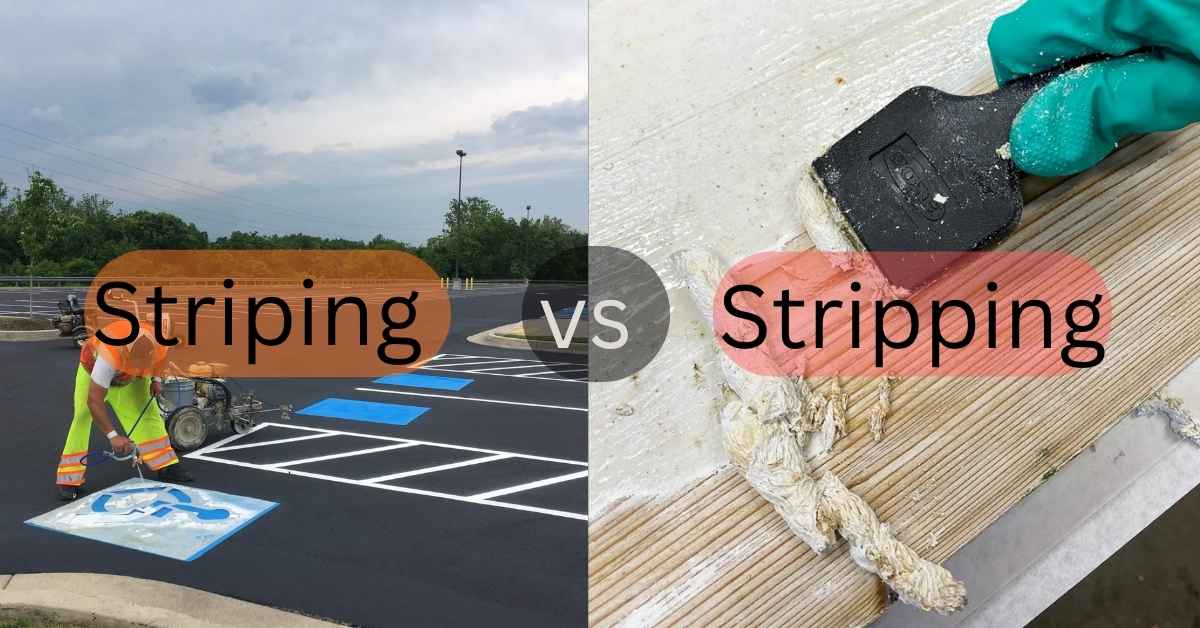
Most people type one when they mean the other. One extra “p” changes everything. Striping means adding stripes or lines to a surface. Stripping means removing something completely, whether that is paint, clothing, data, or permissions.
These two words sound nearly identical, but their meanings point in completely opposite directions. If you have ever second-guessed yourself mid-sentence, you are in the right place. Let us clear this up once and for all.
What Does Striping Mean?
Striping (one “p”) is the act of applying stripes, lines, or bands to something. Think of the white lines painted on a road, the yellow markings on a parking lot, or the colorful stripes on a sports jersey. When you add a visual pattern of lines to any surface or object, you are striping it.
The word comes directly from the noun stripe, meaning a long, narrow band of color or material. You simply add the suffix “-ing” and drop the final “e,” following standard English spelling rules.
Here is where it also gets interesting: striping has a major technical meaning in computing. In RAID striping (Redundant Array of Independent Disks), data is split across multiple storage drives to speed up read and write performance. So when a data engineer says “we are striping data across four drives,” they are not removing anything. They are organizing it efficiently.
What Does Stripping Mean?
Stripping (two “p”s) means the act of removing, peeling away, or taking off something. You strip paint from a wall. You strip wires to expose their copper core. A soldier can be stripped of rank. A website can have its formatting stripped away.
The base word here is strip, which means to take something off or away. When you add “-ing” to a word that ends in a single consonant preceded by a short vowel, you double that final consonant. That is why “strip” becomes stripping, not “striping.”
This doubling rule is not random. It is a core spelling pattern in English that distinguishes the short vowel sound in “strip” from the long vowel sound in “stripe.” One “p” keeps the long sound. Two “p”s lock in the short sound.
The Spelling Rule Behind the Confusion
Here is the grammar rule that explains everything, and it is simpler than it looks.
When a word ends in a consonant-vowel-consonant pattern and the vowel is short, you double the final consonant before adding “-ing.”
- Strip (short “i” sound) becomes stripping
- Stripe (long “i” sound, ends in silent “e”) becomes striping after dropping the “e”
So the difference between these two words is not just one letter. It reflects a different base word entirely, with a different vowel sound, and a different meaning.
This is the kind of rule English teachers love and students quietly resent. But once you understand it, you will never mix these words up again.
Quick Comparison Table
| Feature | Striping | Stripping |
| Base Word | Stripe | Strip |
| Spelling | One “p” | Two “p”s |
| Core Meaning | Adding lines or bands | Removing or peeling away |
| Common Usage | Road markings, RAID, jerseys | Paint removal, wire work, permissions |
| Vowel Sound | Long “i” (like “ripe”) | Short “i” (like “rip”) |
| Example | “Striping the parking lot” | “Stripping the old wallpaper” |
How Each Word Is Used in Real Life
Understanding the meaning is one thing. Seeing it in action makes it stick.
Striping in real life:
- “The crew finished striping the highway before noon.”
- “We offer lane striping services for warehouses and factories.”
- “The jersey’s striping design gives it a classic look.”
- “RAID striping improved our server’s read speed significantly.”
Stripping in real life:
- “She spent the weekend stripping paint off the wooden floors.”
- “The contractor started stripping the old tiles from the bathroom.”
- “The electrician was careful when stripping the wire insulation.”
- “The software was stripping all the HTML tags from the input.”
Notice how the context changes completely. One is about creating a visual pattern. The other is about removing something that already exists.
Where These Words Show Up in Technical Fields
Both words carry weight in professional and technical contexts, and mixing them up there can cause real confusion.
In construction and road maintenance, striping is the proper term for painting lane lines, parking spots, crosswalks, and safety zones. Companies that specialize in this work are called “striping contractors,” not “stripping contractors.” If you accidentally call a road striping company a “stripping” business, expect at least one raised eyebrow.
In data storage and IT, striping refers to the technique of distributing data across multiple disk drives for improved performance and reliability. It is a foundational concept in RAID technology. A systems administrator who says “we are stripping data” instead of “striping data” is technically communicating something very different, though their colleagues will likely figure it out from context.
In electrical work, stripping is the correct term for removing the plastic insulation from a wire before connecting it. No one is adding stripes here. They are peeling away the outer layer.
In woodworking and home renovation, stripping refers to removing old paint, varnish, or finish from a surface so it can be refinished. This is a completely separate process from striping, which would mean painting stripes onto that surface afterward.
Historical and Linguistic Context
The word stripe has roots in the Middle Dutch word “stripe” and the Middle Low German “stripe,” both meaning a streak or line. It entered English usage around the 15th century and carried that same visual meaning of a distinct band of color or material.
The word strip, meaning to peel or remove, also has Germanic origins, coming from the Old English “bestrypan” and related Low German forms. This word carried the sense of robbing, plundering, or removing covering as far back as the 13th century.
Even in early Biblical translations and historical texts, the concept of stripping carried significant weight. In the Old Testament, the phrase of being stripped of garments or stripped of honor appears repeatedly as a symbol of humiliation or punishment. Joseph, famously, had his coat stripped from him by his brothers. The act of stripping always implied a loss or removal of something that once belonged to a person.
Striping, by contrast, appeared more in decorative and functional contexts. Heraldic designs, military uniforms, and road surfaces all used striping as a way to mark, signal, or designate. The two words have always pointed in opposite directions, even historically.
Common Mistakes and How to Avoid Them
The most common error is using striping when the writer means stripping, or writing stripping when they are describing the application of stripes.
Here are the most frequent slip-ups:
- Writing “striping the wire” when you mean removing the insulation (correct word: stripping)
- Writing “stripping the parking lot” when you mean painting lane lines (correct word: striping)
- Using “data stripping” in IT documentation when you mean distributing data across drives (correct term: data striping)
- Writing “acid striping” in chemistry contexts when describing a process of adding stripe patterns (correct word: striping)
A quick trick to keep them straight: if you are adding something (paint, lines, data), use striping. If you are removing something (paint, insulation, permissions), use stripping. Add one letter to add things. Double up to take things away.
Which One Should You Use?
The answer depends entirely on what action you are describing.
Use striping when you are talking about:
- Painting lines on roads, floors, or parking lots
- Adding stripe patterns to fabric, jerseys, or surfaces
- Distributing data across storage drives (RAID technology)
- Any action where something is being marked with bands or lines
Use stripping when you are talking about:
- Removing paint, varnish, or old finishes from surfaces
- Peeling the insulation off electrical wires
- Taking away someone’s rank, title, or access rights
- Removing formatting, tags, or code from digital content
When in doubt, ask yourself: am I adding stripes, or am I removing something? That single question will point you to the right word every time.
Related Words Worth Knowing
While we are in this territory, a few related terms are worth clearing up:
- Stripe (noun): A single band or line of color or material. “There is a red stripe on the uniform.”
- Strip (noun): A long, narrow piece of something. “Cut a strip of tape.” It can also refer to a comic strip or a landing strip.
- Strip (verb): To remove or peel away. “Strip the paint before repainting.”
- Striped (adjective): Marked with stripes. “A striped shirt.”
- Stripped (adjective/past tense): Having had something removed. “The stripped wire was ready for connection.”
Each of these follows the same doubling pattern, so once you understand the base rule, the whole word family becomes easy to navigate.
FAQ: Striping vs Stripping
What is the main difference between striping and stripping?
Striping adds lines or patterns; stripping removes layers, coatings, or coverings entirely.
Is “road striping” or “road stripping” the correct term to use?
Road striping is correct because it means painting lane lines on surfaces.
Does RAID striping delete or remove any data from the drives?
No, RAID striping distributes data across multiple drives to improve overall system speed.
Why does stripping have two p’s while striping only has one?
Strip has a short vowel sound, so the consonant doubles before adding ing.
Can striping and stripping ever be used in the same sentence correctly?
Yes: “After stripping the old floor, the crew began striping the fresh surface.”
Conclusion: One Letter, Two Completely Different Worlds
Striping and stripping look almost identical on the page, but they describe actions that could not be more different. One adds. The other removes. One creates visible patterns. The other peels things away.
The spelling rule that separates them, the double consonant for short vowels, is one of the most practical grammar rules in English. Once it clicks, you will catch yourself the moment you are about to write the wrong one.
Whether you are a road contractor painting lane markings, a data engineer setting up RAID arrays, an electrician working with wires, or just someone trying to write clearly, the right word matters. Use striping when you are putting something on. Use stripping when you are taking something off. Simple, clear, and now impossible to forget.

I’m Daniel Carter, founder of wordwix.com, a creative space focused on powerful and meaningful words. I explore ideas, meanings, and inspiration to help you find the perfect words for any purpose with clarity and creativity.