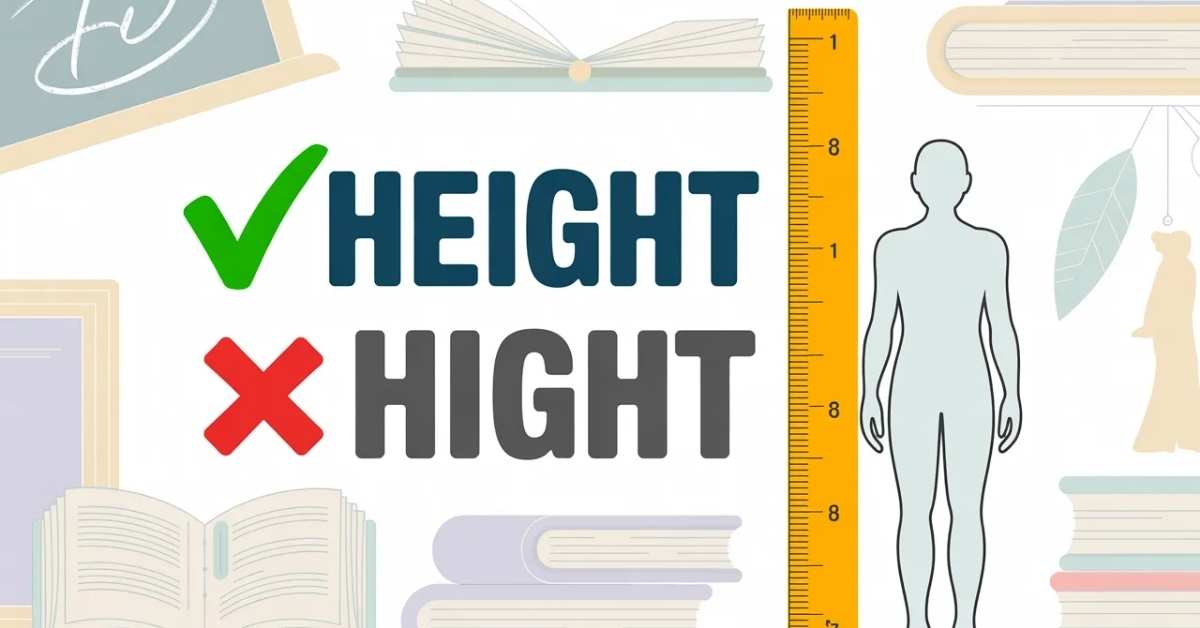
Height vs Hight — this tiny spelling dilemma trips up more people than you would expect. You type fast, autocorrect blinks, and suddenly you are not sure which version is right.
So let us settle this immediately: height is the correct spelling. Hight is a misspelling in modern English, plain and simple.
But there is a surprisingly rich story behind this confusion, and understanding it will make sure you never second-guess yourself again.
What Does Height Mean?
Height refers to the measurement of something from its base to its top. It tells you how tall a person, object, building, or mountain is. It can also describe a high place or an elevated position.
Here are a few everyday ways the word shows up:
- “The height of the Eiffel Tower is 330 meters.”
- “She reached the height of her career at age 35.”
- “Standing at the height of the cliff, the view was breathtaking.”
Notice how height works in all three sentences — measuring distance, describing peak success, and referring to a physical elevation. It is a flexible and commonly used word.
Is ‘Hight’ a Real Word at All?
Here is where things get interesting. Hight is not just a typo born from lazy fingers. It is actually an archaic English word that meant “was called” or “was named.” You might come across it in old poetry or medieval literature.
For example, an old text might say: “He was hight Arthur, King of Camelot.” That sentence means Arthur was called or named the King of Camelot.
So technically, hight existed in historical English. But it dropped out of common use centuries ago. Today, if someone writes “hight” in a modern sentence about measuring something tall, it is simply a spelling error. If you are not writing a historical novel set in the 1300s, height is always the word you need.
Why Do So Many People Misspell Height as Hight?
This is a fair question, and the answer is all about how English words usually behave. Think about these common words: light, night, right, sight, fight, might. Every single one of them ends in “-ight.”
So our brains naturally expect height to follow the same pattern and become “hight.” It feels logical. The only problem is that English does not always play by its own rules.
The “-eight” ending in height is shared by very few words, making it stand out as unusual. This is why even skilled writers occasionally slip up and type hight by accident. Your brain fills in the familiar pattern before you even realize it.
The Historical and Biblical Context of Height
The word height has roots in Old English, tracing back to the word “hiehthu” and later “heahth,” both meaning “tallness” or “elevated position.” It evolved through Middle English before arriving at the spelling we use today.
In the Bible, height appears frequently as both a physical and spiritual concept. Romans 8:39 in the King James Version reads: “Nor height, nor depth, nor any other creature, shall be able to separate us from the love of God.” Here, “height” is used as a metaphor for the highest point imaginable, showing how deeply the word is embedded in both language and thought.
Old English texts and early translations also used variations like “heighte” and “hight” interchangeably during the medieval period. This historical crossover is a big reason why the misspelling still feels so natural to many readers today.
Height vs Hight: A Quick Comparison Table
| Feature | Height | Hight |
| Correct Spelling? | Yes | No (modern English) |
| Meaning | Measurement of tallness | Archaic: was named/called |
| Time Period | Old English to present | Medieval English only |
| Used Today? | Every day | Almost never |
| Example | “She is 5 feet in height.” | “He was hight a knight.” |
| Risk of Error? | Low if memorized correctly | High if used in modern text |
How to Pronounce Height Correctly
This one surprises many learners. Height is pronounced “hyte” — it rhymes with “kite,” “bite,” and “write.” The “-gh” in the middle is completely silent.
Some people mistakenly pronounce it as “heighth” (adding a soft “th” sound at the end). This is a very common spoken error, especially in American English. The pronunciation is simply one syllable: hyte.
If you remember that it sounds like “kite” but spelled with an “h” at the front, you will nail both the pronunciation and the spelling every time.
Common Mistakes People Make with Height
Beyond swapping height for hight, here are a few other errors that show up regularly:
- Heighth: Adding an extra “h” at the end, likely by analogy with “width” and “breadth.”
- Hieght: A simple letter transposition that autocorrect usually catches.
- Heigth: Another transposition that is easy to type in a hurry.
- Highth: Influenced by the word “high,” leading people to insert an extra letter.
The good news is that height follows a small but memorable group of “-eight” words. If you can spell weight, freight, and eight, you already have the pattern down.
Real-Life Examples of Height Used Correctly
Seeing a word in context is often the fastest way to lock in the correct spelling. Here are clean, real-world examples:
- “The maximum height allowed on this ride is 6 feet 2 inches.”
- “At the height of summer, the temperatures reached 45 degrees Celsius.”
- “Building codes specify the minimum height for each floor.”
- “Fear of heights is one of the most common phobias in the world.”
- “The drone was flying at a height of 200 meters above the ground.”
You will notice that height works whether you are talking about physical measurement, peak performance, or elevated location. It is a versatile, everyday word.
Which One Should You Use: Height or Hight?
The answer is almost always height — no matter the context. Whether you are writing a school assignment, a business report, a text message, or a creative story set in the present day, height is the correct word.
The only situation where hight might appear is in a piece of historical fiction or academic discussion about archaic English. Even then, you would typically explain what the word means to avoid confusing your reader.
A good rule to carry with you: if you can replace the word with “tallness” or “how tall,” you always want height. No exceptions in modern English.
A Simple Memory Trick to Always Spell Height Right
Here is a trick that works remarkably well: think of the word EIGHT hiding inside hEIGHTt. The number eight is spelled out in the middle of the word.
So the next time you hesitate, just remember: h + EIGHT + t = height. You count to eight, and you spell it right. (Yes, that rhyme was completely intentional.)
Another approach is to associate it with weight, since both words end in “-eight” and both measure something physical. If you can spell weight, you can spell height.
Related Words That Often Cause the Same Confusion
Once you understand why height is tricky, you will start noticing a pattern in other English words that follow irregular spellings. A few worth knowing:
- Eighth: Follows the same “-eight” root and often gets misspelled as “eigth” or “eith.”
- Weight: Sounds like “wait” but carries the silent “-gh” that confuses many learners.
- Freight: Another “-eight” word that looks unusual but follows the same rule.
If you take a moment to memorize the “-eight” family of words together, you will find that spelling all of them becomes much easier. Group learning beats memorizing each word in isolation.
Frequently Asked Questions
Is hight ever correct in modern English?
No. In modern English, hight is a spelling error. Use height always.
Why does height have a silent “gh”?
Old English used that sound. Over time it disappeared, but the spelling remained.
What is the plural of height?
The plural is heights. As in: great heights, dizzying heights, or mountain heights.
Does height mean only physical measurement?
No. Height also means the peak or climax of something, like “height of fame.”
How do I remember the correct spelling quickly?
Remember: h + EIGHT + t. The number eight hides inside the word height.
Final Word
By now, the debate is settled. Height is the correct, modern, universally accepted spelling. Hight belongs to a different era of English, one that most of us will never write in.
The confusion is completely understandable given how English works, and you are not alone in having questioned it. But now that you know the history, the spelling trick, the pronunciation, and the common mistakes to avoid, you have everything you need.
Spell it right. Say it right. And the next time someone types “hight” in your group chat, you will know exactly what to say — with all the calm confidence of someone who looked it up.

I’m Daniel Carter, founder of wordwix.com, a creative space focused on powerful and meaningful words. I explore ideas, meanings, and inspiration to help you find the perfect words for any purpose with clarity and creativity.