You are typing a report, an email, or maybe a school essay. You write the word “benefit” and then add “-ing” — and suddenly your brain freezes. Is it benefiting or benefitting? You type one, stare at it, delete it, type the other, and still feel uneasy. That two-second pause has happened to every writer at least once.
The good news is this confusion has a perfectly logical explanation. English spelling, for all its quirks, is not completely random. There is a rule here, and once you understand it, you will never second-guess this word again in any form, past or present tense.
Let’s walk through it step by step, starting with the simplest possible explanation and building from there.
Quick Answer:
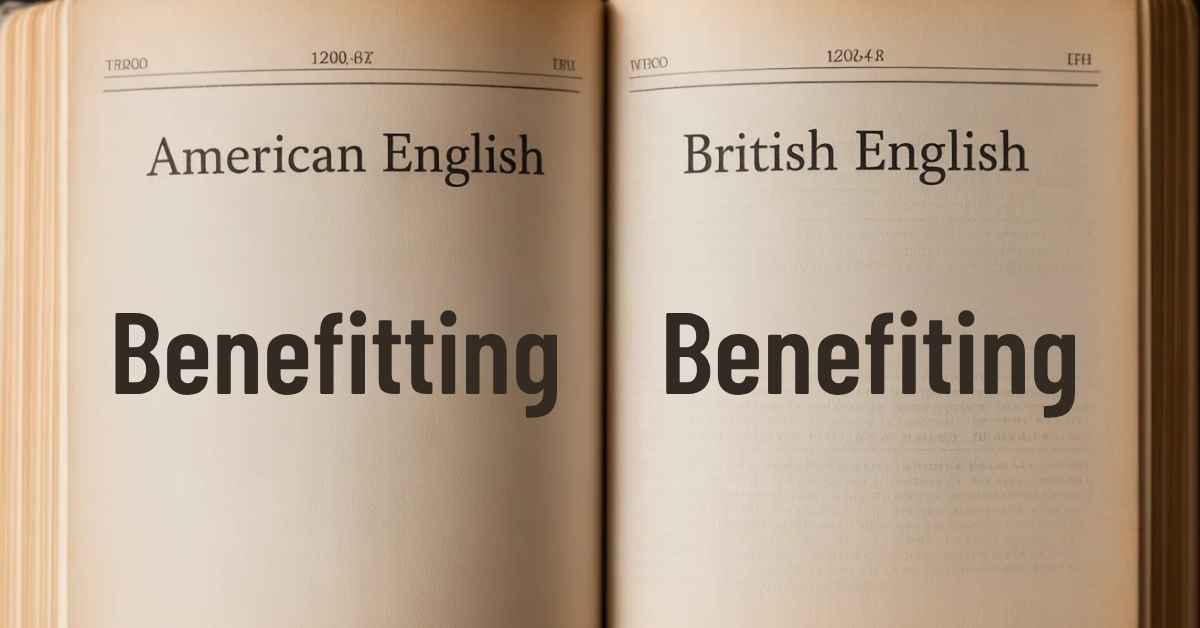
Both spellings are correct, but they belong to different dialects.
- Benefiting (one “t”) is the standard in American English.
- Benefitting (double “t”) is common in British English. The meaning is identical.
Your choice simply depends on your audience — and after reading this, you will always know which one to pick.
What Does “Benefiting” Actually Mean?
Before worrying about the spelling, it helps to know what the word is doing. Benefiting (or benefitting) is the present participle of the verb benefit. It describes the act of receiving, gaining, or drawing an advantage from something.
You use it when someone or something is in the process of gaining a positive outcome. The student is benefiting from extra tutoring. The community is benefitting from the new park. Both sentences carry the exact same meaning. The only thing that changes is the spelling convention of the writer’s region.
Think of it this way: the word is doing the same job either way. The extra “t” is a regional passport stamp, not a change of destination.
Where Did the Word “Benefit” Come From?
Understanding the origin of benefit actually helps explain the spelling debate. The word traces back to the Latin phrase bene facere, meaning “to do good.” That evolved and eventually entered English through Old French.
What is interesting is that none of those early historical forms of the word ever included a double “t.” The double consonant was never part of the word’s original structure. It showed up later as a side effect of how British English handles consonant doubling when adding suffixes, a rule we will look at in the very next section.
So in a way, the British double “t” is a well-intentioned grammatical addition, while the American single “t” is the more historically faithful version. Both are reasonable. Neither is wrong.
Why Does English Double Consonants at All?
Here is the part most grammar guides bury in technical jargon. Let’s keep it simple.
When you add a suffix like -ing or -ed to a verb, English has a rule about whether to double the final consonant. The key factor in American English is where the stress falls in the word. American words that end in a consonant do not double that consonant when adding a suffix if the stress is on the first syllable. American words that end in a consonant do double that consonant when adding a suffix if the stress falls on a syllable other than the first.
Say the word “benefit” out loud: BEN-e-fit. The stress is clearly on the first syllable. Because the stress does not fall on the final syllable, American English keeps a single “t” when adding “-ing.” Result: benefiting.
Now compare that with a word like commit: com-MIT. The stress lands on the last syllable, so the “t” doubles when you add “-ing,” giving you committing. This is exactly why the rule feels inconsistent. Different words, different stress patterns, different spelling outcomes.
British words that end in a consonant generally double that consonant when adding a suffix, regardless of stress placement. That is why benefitting with two “t”s feels natural to British writers even though the stress does not fall on the final syllable.
American English vs. British English: The Full Picture
This spelling split is not unique to “benefiting.” The same American vs. British pattern shows up across many verbs. Here is a clean comparison so you can see everything at a glance.
| Feature | American English | British English |
| Present participle | benefiting | benefitting |
| Past tense | benefited | benefitted |
| Consonant doubling rule | Only when stress is on final syllable | Often doubles regardless of stress |
| Reference dictionaries | Merriam-Webster | Oxford, Cambridge |
| Global writing default | More widely accepted | Correct for UK/Commonwealth audiences |
| Similar pattern words | traveling, canceled, focused | travelling, cancelled, focussed |
Notice those similar-pattern words in the final row. The benefiting/benefitting divide is part of a much larger family of American vs. British spelling differences. This difference is not about grammar — it is about spelling convention. Once you see the pattern, it starts to feel less like a quirk and more like a consistent regional dialect choice.
Real Sentences That Show Both Spellings in Action
Seeing a word used in actual sentences is always more helpful than reading a definition. Here are clear, natural examples of both spellings across different contexts.
American English (benefiting):
- The new scholarship program is benefiting hundreds of first-generation college students this year.
- Regular physical activity is clearly benefiting his recovery faster than the doctors expected.
- The company benefited enormously from the early adoption of remote work policies.
British English (benefitting):
- Local farmers are benefitting greatly from the government’s new agricultural subsidies.
- She argued that the entire community was benefitting from the council’s investment in public libraries.
- He benefitted from years of mentorship before launching his own business venture.
Each sentence reads naturally in its own regional context. A reader in New York and a reader in London would both find the version written for them completely correct and unremarkable — which is exactly the point.
The “Fit” Trap: Why So Many People Get This Wrong
There is one very specific reason American writers end up doubling the “t” when they should not. They think of the word fit.
“Fit” becomes “fitting” with a double “t.” That feels related to “benefit,” so the brain says: surely it should be “benefitting” too? But this is where the logic breaks down. The word “fit” is a one-syllable word that ends in a consonant, so the final consonant is doubled when adding the suffix. Many Americans add to the confusion by patterning the spellings of benefited and benefiting on the word fit, even though a different spelling convention governs the word benefit.
Benefit is three syllables with the stress on the first — BEN-e-fit — so the American rule says: no doubling needed.
A quick memory trick: benefit has three syllables and the stress is on the first one. Think of the word “beneficial.” Nobody writes “benneficial.” The same stress pattern and Latin root govern the whole family of words. Once you stop comparing “benefit” to “fit” and start noticing where the stress actually falls, the American spelling clicks into place immediately.
Common Spelling Mistakes to Avoid Completely
Beyond the single vs. double “t” question, there are a few genuinely incorrect spellings that no style guide accepts anywhere. These are errors, not regional alternatives.
Wrong in every dialect:
- benifiting — The first vowel is “e,” not “i.” This is a pure spelling error in any English dialect.
- benefitting in an American document alongside benefiting — Mixing both spellings in the same piece of writing looks careless and inconsistent.
Correct:
- benefiting — Correct American English spelling. Clear, consistent, and widely accepted globally.
- benefitting — Correct British English spelling. Appropriate for UK, Australian, and Canadian contexts.
The most important rule is consistency. Do not mix both spellings in the same document. Choose one style and use it throughout. Consistency is the mark of a careful, professional writer.
Which One Should You Actually Use?
This is the question most grammar articles take four paragraphs to not answer. Here is a direct answer.
Write for your audience. That is the entire principle in three words. If your readers are American, use benefiting. If your readers are British, Australian, Canadian, or broadly from outside the United States, benefitting is perfectly at home.
If you write for an international audience, stick with benefiting. It is understood everywhere and accepted globally.
Your style guide decides too. If your company, school, or publication uses AP Style, Chicago, or any American standard, the answer is benefiting. If you follow Oxford Style or a British house style guide, benefitting is the right call.
And if you genuinely have no audience preference and no style guide? Pick one. Write it down somewhere so you remember it. Use it every single time. That is the only rule that matters at that point.
Every Form of the Verb “Benefit” — Spelled Both Ways
The present participle is not the only form that gets caught in this spelling divide. The past tense and past participle follow the same regional pattern. Here is the full picture so you never have to wonder about any form of this word again.
| Verb Form | American English | British English |
| Base form | benefit | benefit |
| Present participle | benefiting | benefitting |
| Past tense | benefited | benefitted |
| Past participle | benefited | benefitted |
| Noun (person) | beneficiary | beneficiary |
| Adjective | beneficial | beneficial |
Notice that the base form, the noun, and the adjective are identical in both dialects. The only forms that diverge are those where you add a suffix starting with a vowel — the classic double-consonant trigger. Now you have the complete picture for every situation.
Other Words That Follow the Same Spelling Pattern
Once you understand the stress-based rule behind benefiting vs. benefitting, you will recognize the same logic at work in dozens of other common words.
| Base Word | American English | British English |
| travel | traveling, traveled | travelling, travelled |
| cancel | canceling, canceled | cancelling, cancelled |
| model | modeling, modeled | modelling, modelled |
| focus | focusing, focused | focussing, focussed |
| worship | worshiping, worshiped | worshipping, worshipped |
Every row in that table reflects the same regional principle: American English holds back on doubling; British English doubles more freely. If you ever wonder about any of these words, the same audience-based reasoning applies every time.
Why Your Spellchecker Might Be Disagreeing With You
Here is a situation many writers have experienced: you type benefitting and Word underlines it in red. Or you type benefiting and Google Docs flags it. Suddenly you doubt everything.
The reason is simple. Your spellchecker reflects the language settings on your device. A laptop set to UK English might accept “benefitting” while a phone set to US English rejects it.
This means a red squiggly line is not proof that you are wrong. It is proof that your spellchecker has a regional preference. If you are writing in British English on an American-language-set device, you and your spellchecker will simply disagree occasionally — and you will be the one who is right.
When in doubt, cross-reference Merriam-Webster for American spelling standards or the Oxford English Dictionary for British ones. Those two references are the final word on regional correctness.
Frequently Asked Questions
Is “benefitting” ever correct in American English?
No, American English prefers “benefiting” with one “t” as the standard spelling.
Which spelling is correct for academic or professional writing?
Follow your style guide — American uses “benefiting,” British uses “benefitting” consistently.
Does the same rule apply to “benefited” and “benefitted”?
Yes, “benefited” is American and “benefitted” is British — same regional rule applies.
Can I use “benefitting” on a global website or international audience?
Use “benefiting” globally — it is universally accepted and understood by all English readers.
Does my spellchecker decide which spelling of benefiting is correct?
No, spellcheck follows device language settings — always trust your audience over your spellchecker.
The Final Word
The debate between benefiting and benefitting is not really a debate at all. It is a geography lesson dressed up as a grammar question.
Both spellings are legitimate, both are recognized by major dictionaries, and both convey the exact same meaning. The only question is which side of the Atlantic your audience is reading from.
Remember the stress: BEN-e-fit. American English hears that first-syllable emphasis and keeps one “t.” British English follows its own doubling tradition and adds a second. Neither is wrong — they simply come from different rooms in the same house called English. Know your audience. Pick one spelling. Stay consistent.

I’m Daniel Carter, founder of wordwix.com, a creative space focused on powerful and meaningful words. I explore ideas, meanings, and inspiration to help you find the perfect words for any purpose with clarity and creativity.