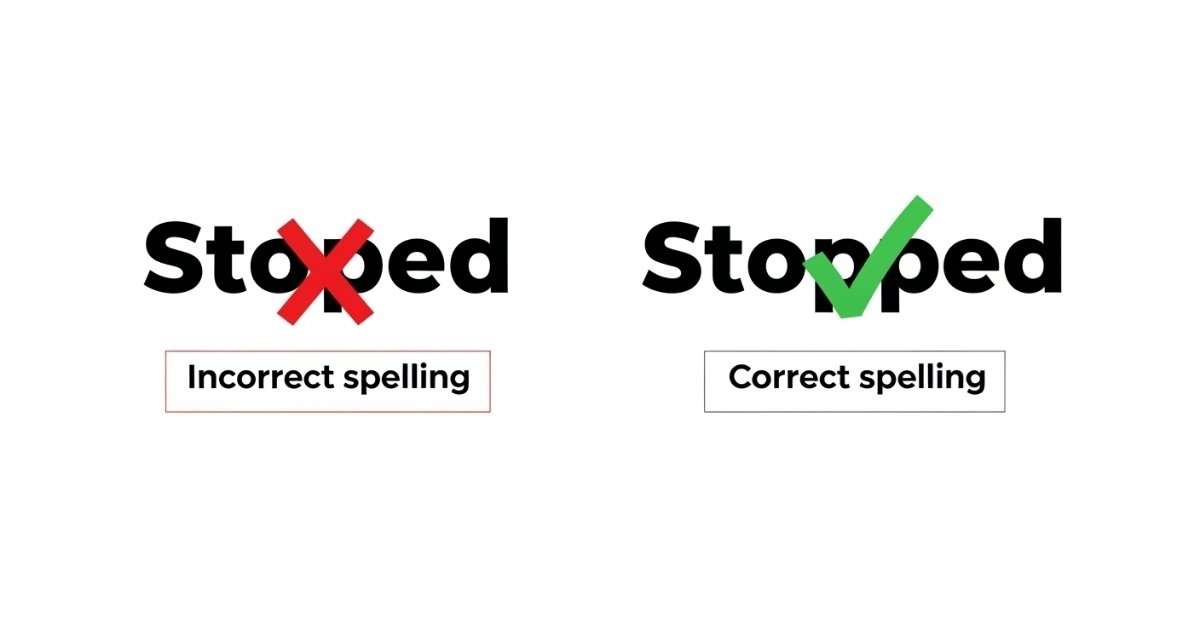
You typed a word, spell-check flagged it, and now you are staring at two options wondering which one is right. Stoped or stopped — the difference looks tiny, but the meaning gap is massive.
The short answer: “stopped” is the correct, everyday spelling you need 99% of the time. “Stoped” exists too, but only inside one very specific world. Let’s clear this up once and for all.
“Stopped” Is the Word You Are Looking For
When you want to say something came to an end, came to a halt, or was brought to a pause, “stopped” is your word. Full stop. No debate.
Example:
- “The car stopped at the light.”
- “She stopped talking mid-sentence.”
- “He stopped the clock.”
All of these are correct. Stopped is the simple past tense and past participle of the verb “stop.” It follows one of the most important spelling rules in English, which we will get to in just a moment.
If you came here because autocorrect gave you a hard time, you can relax. Stopped is right. Stoped is not a typo you accidentally made. It is actually a real word, just not the one you meant.
So What Does “Stoped” Even Mean?
Here is where things get genuinely interesting. “Stoped” is not a misspelling. It is a real English word used exclusively in mining terminology.
In mining, a “stope” is an underground cavity or step-like excavation created when miners dig out ore from a rock face. When miners have done that work, the area has been “stoped.”
So if you are a geologist, a mining engineer, or someone writing a technical report on underground excavation, stoped belongs in your vocabulary. For everyone else, it is a word you will probably never need to use in your lifetime.
Think of it this way: stoped is the word wearing a hard hat underground. Stopped is the word everyone else uses above ground.
The Spelling Rule That Explains Everything
This is where English actually makes sense for once, so enjoy the moment.
When a verb ends in a single consonant preceded by a single short vowel, you double the final consonant before adding “ed” or “ing.”
Stop follows this pattern perfectly:
- One final consonant: p
- One short vowel before it: o
- Result: stop + p + ed = stopped
This rule exists to protect the short vowel sound. Without the double consonant, “stoped” would suggest a long vowel sound, like the word “hope” becoming “hoped.” That would turn stop into something that rhymes with slope, which is not what you want.
So the double “p” in stopped is not random. It is doing real work. It is guarding the short vowel like a bouncer at the door.
Quick Comparison: Stoped vs Stopped at a Glance
| Feature | Stopped | Stoped |
| Correct everyday spelling | Yes | No |
| Part of speech | Past tense verb | Past tense verb |
| Meaning | Came to a halt | Excavated a mining stope |
| Used in daily writing | Always | Almost never |
| Field of use | General English | Mining/geology only |
| Spell-check approved | Yes | Only in technical contexts |
Real Sentences So You Can See the Difference Clearly
Sometimes the best way to understand a word is to see it working in real life. Here are both words doing their jobs:
Stopped in everyday use:
- “The train stopped three minutes late.”
- “She stopped herself from saying something she would regret.”
- “The medicine stopped the infection from spreading.”
- “They stopped at a small café on the way home.”
Stoped in its actual context:
- “The team stoped the eastern section of the mine last week.”
- “Once the area was fully stoped, the engineers reinforced the walls.”
Notice how naturally stopped fits into daily life, while stoped only makes sense when someone is talking about digging underground.
Historical and Biblical Context Worth Knowing
The verb “stop” has deep roots in Old English and Middle English, where it carried the meaning of blocking or plugging an opening. Early uses described stopping a hole, stopping a leak, or stopping a passage.
In biblical translations and older religious texts, “stopped” appears frequently in this original physical sense. In the King James Bible, for example, you find phrases describing wells being stopped up, mouths being stopped, and waters being stopped. The word carried a very literal, physical meaning of blocking something closed.
Over centuries, the meaning expanded. Stopped grew from meaning “plugged up” to meaning “ceased entirely,” which is the broad sense we use today.
Stoped, on the other hand, branched off as mining became an industrialized science. The underground excavation technique needed its own vocabulary, and stope filled that role in technical English.
Common Mistakes People Make With This Word
Most people do not confuse stoped and stopped because of meaning. They make mistakes because of typing speed, habit, or simple uncertainty about the double letter rule.
Here are the most frequent errors:
- Writing “stoped” when they mean “stopped” — usually a fast-typing mistake
- Writing “stoppd” — dropping a vowel under pressure
- Writing “stopt” — an archaic form that was used centuries ago but sounds strange today
- Confusing the rule and writing “droped” instead of “dropped,” or “runing” instead of “running” — the same doubling rule applies to many verbs
The fix for all of these is the same. Remember the rule: short vowel plus single consonant equals doubled consonant before a suffix.
Once that clicks, you will never second-guess stopped, dropped, running, shopping, or sitting again.
Other Words That Follow the Same Pattern
Understanding stopped actually teaches you a whole family of correctly spelled words. The doubling rule applies across English wherever the same short vowel plus single consonant pattern appears.
- Run becomes running and runner
- Drop becomes dropped and dropping
- Sit becomes sitting and sitter
- Shop becomes shopped and shopping
- Beg becomes begged and begging
- Plan becomes planned and planning
Every single one of these follows the exact same logic as stopped. If you understand one, you understand all of them. English rarely gives you that kind of deal, so take it.
Which One Should You Use?
The answer is almost certainly stopped.
- Use stopped every time you want to describe something that came to an end, a halt, a pause, or a conclusion. It works in formal writing, casual conversation, business emails, academic papers, and text messages.
- Use stoped only if you work in mining, geology, or a related technical field, and you are describing the excavation of underground rock. That is the only situation where this word belongs.
If you are not a mining engineer, you will probably go your entire life without ever needing to write stoped. And that is completely fine.
A Quick Note on Pronunciation
Both words are pronounced differently, which is actually a clue to their spelling.
- Stopped is pronounced with a short “o” sound, rhyming with “topped” or “dropped.”
- Stoped is pronounced with a long “o” sound, rhyming with “hoped” or “sloped.”
This is exactly why the double “p” matters. The spelling controls how you read the vowel. One “p” signals a long vowel. Two “p’s” signal a short vowel. English is using its own quiet logic here, and once you hear the difference, the spelling makes complete sense.
Stopped Across Different Tenses
Just so you have the full picture, here is how stop behaves across tenses:
- Present: I stop, she stops
- Present continuous: They are stopping
- Simple past: He stopped
- Past continuous: We were stopping
- Past participle: It has stopped
- Future: She will stop
The double “p” appears everywhere you add a suffix starting with a vowel: stopping, stopped, stopper. It disappears when no suffix is added or when the suffix starts with a consonant.
Think You Have Got It? Let’s Find Out Right Now
You have read the rules. You have seen the examples. Now your brain goes on the witness stand. Pick the correct word for each sentence below, then check your answers underneath. No pressure, but your English reputation is on the line.
Question 1: The bus _____ suddenly in the middle of the road. a) stoped b) stopped
Question 2: The miners _____ the eastern section of the cave last Monday. a) stoped b) stopped
Question 3: She _____ herself from laughing during the serious meeting. a) stoped b) stopped
Question 4: The engineers confirmed the area had been fully _____ overnight. a) stoped b) stopped
Answers:
- b) stopped — the bus came to a halt
- a) stoped — mining excavation context
- b) stopped — she held herself back
- a) stoped — technical mining language
Frequently Asked Questions
Is “stoped” a real word or just a spelling mistake?
Stoped is a real word used only in mining and geological excavation contexts.
Why does “stopped” have double “p” but “stoped” does not?
Double “p” protects the short vowel sound in stopped following standard English rules.
Can I use “stoped” in a school essay or formal writing?
Never use stoped in formal writing unless your topic specifically involves mining excavation work.
What is the easiest way to remember the correct spelling?
Remember: short vowel plus single consonant always doubles before adding any English suffix.
Does “stopped” follow the same rule as “dropped” and “shopping”?
Yes, dropped, shopping, running, and stopped all follow the exact same consonant doubling rule.
The Takeaway You Will Actually Remember
Stopped is the word. It has two “p’s,” a short vowel sound, and a history stretching back through centuries of English. It means something came to a halt, an end, or a pause.
Stoped is real but rare, lives underground in mining vocabulary, and has a long vowel sound that the single “p” quietly signals.
The doubling rule is your friend here. Short vowel plus single consonant plus suffix equals a doubled consonant. Once you own that rule, stopped will never give you trouble again, and neither will dropped, shopping, running, or any of their cousins. Now the only thing left to do is stop second-guessing yourself and start writing with confidence.

I’m Daniel Carter, founder of wordwix.com, a creative space focused on powerful and meaningful words. I explore ideas, meanings, and inspiration to help you find the perfect words for any purpose with clarity and creativity.