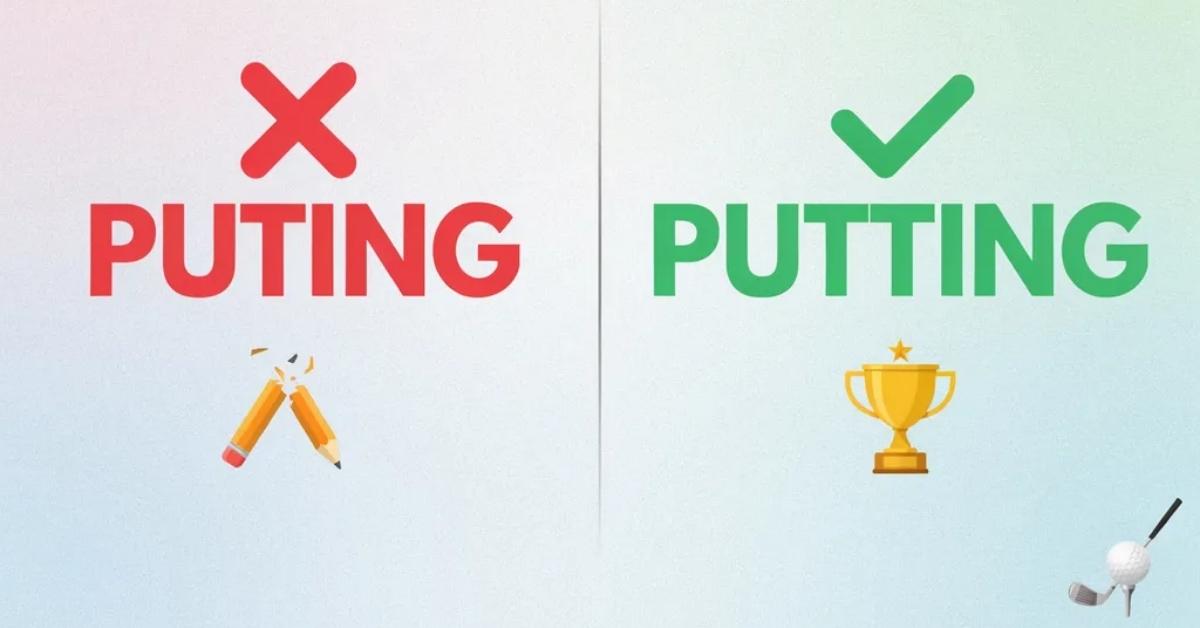
Ever typed a sentence, stared at the word “puting,” and felt something was off? You’re not imagining things. This tiny word trips up more people than it should, mostly because English loves to break its own rules.
The correct spelling is putting, with two T’s, and “puting” is simply a common misspelling. Let’s clear up exactly why, so you never second guess it again.
What Does “Putting” Actually Mean?
Putting is the present participle of the verb “put.” It describes the ongoing action of placing something somewhere.
You use it in sentences like “I am putting the keys on the table” or “She’s putting in extra hours this week.” It also shows up in golf, where “putting” means gently striking the ball toward the hole.
Notice the double T. That’s not decoration. It’s grammar doing its job.
Is “Puting” Ever a Real Word?
No, “puting” is not a word in standard English. It has no dictionary entry, no accepted usage, and no grammatical function.
It’s a spelling error that happens when someone forgets to double the consonant before adding “ing.” Autocorrect sometimes lets it slide in casual texting, but formal writing will always flag it.
Think of “puting” as the typo equivalent of showing up to a job interview in pajamas. Technically you showed up, but something’s clearly missing.
Why Does English Double the T in “Putting”?
Here’s the part most articles skip. English has a real spelling rule behind this, and it’s not random.
When a short verb ends in a single vowel followed by a single consonant, and the last syllable is stressed, you double that final consonant before adding “ing.” “Put” fits this pattern perfectly: one vowel (u), one consonant (t), one syllable.
Compare that to “hope,” which ends in a silent e and doesn’t double anything, becoming “hoping.” Different word shapes follow different rules, and that’s exactly why spelling in English feels like a moving target sometimes.
Quick Comparison Table: Puting vs Putting
| Feature | Puting | Putting |
| Correct spelling | No | Yes |
| Found in dictionaries | No | Yes |
| Grammar rule followed | No | Yes (consonant doubling) |
| Acceptable in formal writing | Never | Always |
| Common cause | Typo or rule confusion | Standard verb conjugation |
This table alone settles the debate. One column has a word. The other has a mistake.
Does This Word Have Any Historical Roots?
The verb “put” traces back to Old English and Middle English forms related to pushing or placing objects, evolving over centuries into the simple, sturdy verb we use today.
Interestingly, the Bible and older English texts use “put” constantly, in phrases like “put off,” “put away,” or “put your trust in.” These constructions have carried through generations of English speakers almost unchanged.
The spelling rule for doubling consonants developed as English standardized during the 18th and 19th centuries, when dictionaries and grammar guides started locking down consistent spelling patterns. Before that, spelling was honestly a bit of a free for all.
Real-Life Examples of “Putting” in a Sentence
Seeing the word in action helps it stick. Here are a few natural, everyday examples.
- “He’s putting his phone on silent during the meeting.”
- “We’re putting together a plan for next month.”
- “She kept putting off the dentist appointment.”
- “The golfer practiced her putting for an hour straight.”
Notice how none of these feel forced. “Putting” fits naturally into casual speech, business talk, and even sports commentary.
Common Mistakes People Make With This Word
Beyond just dropping a T, people mix up related forms too. Here’s what tends to go wrong.
- Writing “puting” instead of “putting” in emails or texts
- Confusing “putting” with “puting” when typing quickly on mobile
- Mixing up “putting” (verb) with “putt” (the golf noun and verb) in sports writing
- Forgetting that “put” stays the same in past tense, so people wrongly write “putted” for general use instead of golf context
That last one deserves a quick note. “Put” is irregular. Its past tense is still “put,” not “putted,” except specifically in golf, where “putted” is correct.
Puting or Putting: Which One Should You Use?
Always use “putting.” There’s no scenario, formal or informal, where “puting” is acceptable.
If you’re texting a friend, writing a school essay, or drafting a business proposal, the rule doesn’t change. English rarely gives you a break like this, so take the win.
Does Autocorrect Actually Help With This Word?
Most modern spell checkers and keyboards catch “puting” and suggest “putting” automatically. However, voice typing tools sometimes struggle with fast speech and can drop letters, including that second T.
If you’re dictating messages, it’s worth a quick glance before hitting send. A missing letter here won’t change your meaning, but it can make writing look less polished, especially in professional emails.
Is “Putting” Used Differently in British and American English?
No major difference exists here. Both British and American English spell it the same way, with the double T intact.
This is actually rare. Plenty of words split between “colour” and “color” or “organise” and “organize” depending on the region. “Putting” isn’t one of them, which makes it one less thing to worry about if you write for international audiences.
How Does “Putting” Compare to Similar Words?
Words like “sitting,” “hitting,” and “getting” follow the exact same doubling rule as “putting.” Once you notice the pattern, it becomes almost impossible to forget.
- Sit → Sitting
- Hit → Hitting
- Get → Getting
- Put → Putting
Short verb, single vowel, single ending consonant, stressed syllable. Double it up before adding “ing.” That’s the whole trick.
Why Do People Still Get Confused With Such a Simple Word?
Honestly, muscle memory and typing speed cause most of these slips. Your brain knows the word “put” so well that it sometimes forgets the extra letter belongs there too.
Add autocorrect inconsistencies, mobile typing, and the sheer speed of modern texting, and small errors like “puting” slip through more often than people realize. It’s not a sign of poor grammar skills, just a quick fingers moment.
Frequently Asked Questions
Is “puting” a real word in any dictionary?
No. “Puting” does not appear in any major English dictionary and is considered a spelling error, not an alternate form.
Why does “put” double the T but “hope” doesn’t?
“Put” ends in a single vowel and single consonant with a stressed syllable, which triggers doubling. “Hope” ends in a silent e, so it simply drops the e before adding “ing” instead of doubling anything.
Is “putting” the same word in golf and in regular grammar?
Yes, it’s the same verb form, but in golf it specifically refers to striking the ball on the green, while in general English it just means placing or positioning something.
Final Thoughts
“Puting” isn’t a stylistic choice or a regional variation. It’s simply a typo that slipped past the rules of English spelling. “Putting” is the correct, dictionary-approved form, and it follows a clear, learnable pattern shared by dozens of similar verbs.
Once you understand the doubling rule, you’ll never second guess this word again, and honestly, that’s one less thing cluttering your mind while you write.

I’m Daniel Carter, founder of wordwix.com, a creative space focused on powerful and meaningful words. I explore ideas, meanings, and inspiration to help you find the perfect words for any purpose with clarity and creativity.