You typed the sentence, then froze. Does a new law “take effect” or “take affect”? Get it wrong in an email to your boss or a school essay, and it quietly chips away at how polished you look. The good news: this mix up has a simple, permanent fix, and by the end of this article you will never second guess it again.
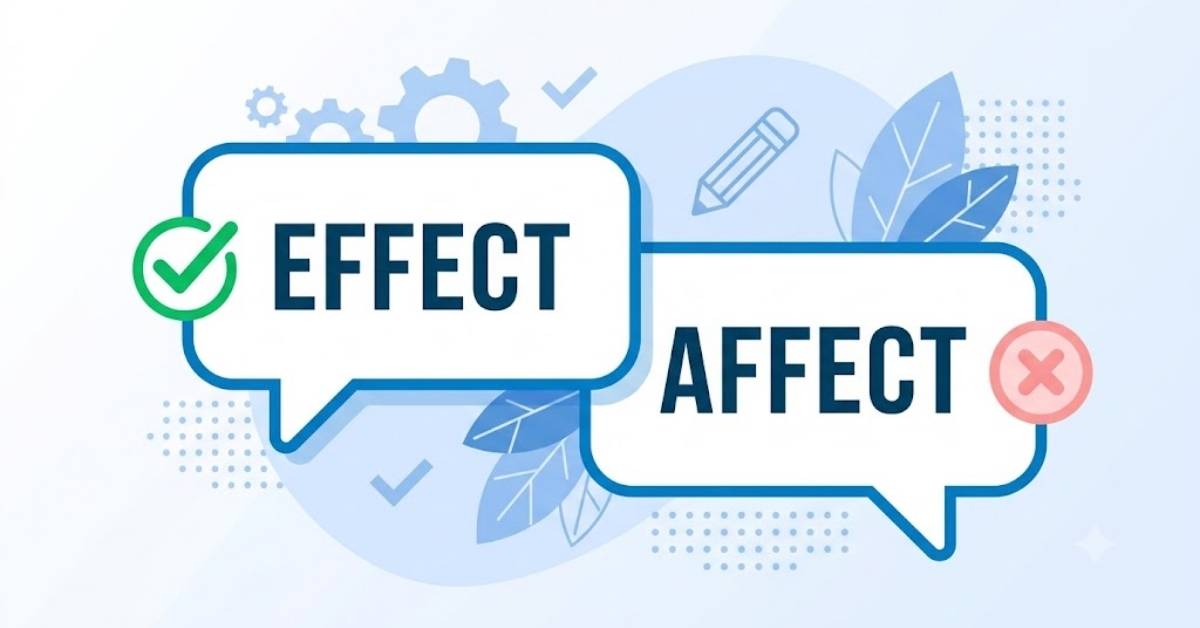
The correct phrase is “take effect,” not “take affect.” Effect is the noun that means a result or outcome, so when a rule, law, or change officially starts working, it “takes effect.” Affect is almost always a verb meaning to influence something, so it never pairs correctly with “take.”
Take Effect or Take Affect: Which One Is Correct?
Let’s settle it right away. “Take effect” is the only correct version of this phrase in standard English.
You will see it in contracts, news headlines, government notices, and everyday conversation. “Take affect” shows up often too, but only because affect and effect sound nearly identical when spoken. Sound alike does not mean interchangeable.
Think of “take effect” as a locked pairing, like “salt and pepper.” You would not say “pepper and salt” in a recipe title, and you should not swap effect for affect here either.
What Does “Take Effect” Mean?
“Take effect” means something officially begins or starts working. It usually applies to rules, laws, policies, contracts, or medications.
For example, when a company announces a new dress code, that policy “takes effect” on a specific date. Before that date, the old rules still apply. After it, the new one is active.
Doctors use it too. A painkiller “takes effect” once it starts working in your body. Notice the pattern: effect is a noun here, and it describes the moment a result becomes real.
What Does “Take Affect” Mean (And Why It’s Wrong)?
Here is the short version: “take affect” means nothing, because it breaks basic grammar.
Affect is a verb almost every time you use it, and verbs do not usually follow another verb like “take” without an object noun in between. You cannot “take” an action word the same way you “take” a noun like a seat, a break, or an effect.
So when people write “the new law will take affect Monday,” they have accidentally paired two verbs together in a spot that grammatically needs a noun. It reads wrong to anyone paying close attention, even if they cannot explain exactly why.
Effect vs Affect: The Core Difference
This is where most of the confusion starts, so let’s make it dead simple.
- Effect is usually a noun. It means the result of something. Example: “The medicine had a strong effect.”
- Affect is usually a verb. It means to influence or change something. Example: “The weather will affect our plans.”
A quick trick many teachers use: Affect starts with A for Action (it’s a verb, doing something), while Effect starts with E for End result (it’s a noun, the outcome).
Once that clicks, “take effect” makes perfect sense, because you are talking about a result kicking in, not an action being performed.
Where Did “Take Effect” Come From?
This phrase has been quietly doing its job in English for centuries, and its roots go back further than most people expect.
The word “effect” comes from the Latin “effectus,” meaning “accomplished” or “brought about,” from “efficere,” meaning “to work out” or “to bring to pass.” Legal and religious documents in Middle English started pairing “effect” with verbs like “come into” and “take” as far back as the 1400s and 1500s, describing laws, decrees, and covenants that officially began.
You can even spot the underlying idea in older English Bible translations, where phrases describing a promise or covenant “taking effect” or coming to pass appear in legal and theological writing about agreements becoming binding. The concept mirrors how ancient legal language described a decree moving from written word to active reality, which is precisely what “take effect” still communicates today.
Affect, on the other hand, comes from the Latin “affectus,” related to affecting or influencing something emotionally or physically. It kept its verb identity throughout its history, which is exactly why “take affect” never developed into a real phrase.
Take Effect or Take Affect: Quick Comparison Table
| Feature | Take Effect | Take Affect |
| Correct usage | Yes, standard English | No, grammatically incorrect |
| Part of speech | Effect = noun | Affect = verb |
| Meaning | A result starts working | Not a real phrase |
| Common context | Laws, policies, medicine, contracts | Rarely used correctly |
| Example sentence | “The new tax rule takes effect in July.” | Incorrect in almost every case |
Real Life Examples of “Take Effect” in a Sentence
Seeing the phrase in real context makes it stick better than any rule ever could.
- “The updated privacy policy will take effect on August 1st.”
- “Her resignation takes effect at the end of the month.”
- “The anesthesia should take effect within ten minutes.”
- “The new speed limit takes effect once the signs are installed.”
- “The ceasefire is set to take effect at midnight.”
Notice how every single example involves something starting, activating, or becoming official. That pattern never changes.
Common Mistakes People Make With Effect and Affect
Beyond “take affect,” a few other slip ups show up constantly in writing.
- Using “effect” as a verb when they mean “affect”: “This will effect my schedule” should be “This will affect my schedule.”
- Using “affect” as a noun when they mean “effect”: “The affect was immediate” should be “The effect was immediate.”
- Assuming the words are interchangeable because they sound alike in fast speech.
- Forgetting that “effect” can occasionally be a verb too, meaning to cause something, as in “effect change,” which is different from “take effect.”
That last one trips up even confident writers, so don’t feel bad if it catches you off guard.
Native speakers make these errors too, not just language learners. Autocorrect tools rarely flag “take affect” as wrong, since both words are spelled correctly on their own. That’s exactly why understanding the grammar rule matters more than relying on spell check to save you.
Simple Tricks to Remember the Difference
You do not need a grammar degree to get this right every time. Try one of these memory tricks.
- RAVEN rule: Remember Affect Verb, Effect Noun.
- Swap test: if you can replace the word with “result” or “outcome,” use effect. If you can replace it with “influence” or “change,” use affect.
- Say it out loud in a full sentence. “Take effect” flows naturally because your brain recognizes the noun pairing, even before you consciously analyze it.
Pick whichever trick sticks in your head, and it becomes automatic within a week or two of noticing it.
Which One Should You Use?
Use “take effect” every single time you are describing something officially starting, whether it’s a law, a policy, a contract clause, or a medication kicking in.
There is no scenario in standard, correct English where “take affect” is the right choice. If you are ever unsure mid sentence, pause and ask yourself: am I describing a result (effect) or an influence (affect)? Nine times out of ten in this specific phrase, you want the result, which means you want effect.
This matters more than it might seem. Business emails, resumes, legal notices, and news articles all get judged on small details like this one. A single misused phrase can make a reader question the accuracy of everything else you wrote, even if the actual content is solid.
Other Related Phrases You Might Confuse
A few close cousins of this phrase trip people up too, so it helps to clear them up while we’re here.
- “In effect” means something is currently active or essentially true, as in “the rule is currently in effect.”
- “Effective date” refers to the specific day a policy or law begins, closely related to when something “takes effect.”
- “Side effects” always uses effect, never affect, because it describes results of a medication or action.
Keeping these related terms straight reinforces the same noun versus verb logic you just learned.
FAQs
Is it “take effect” or “take affect” in legal documents?
Legal documents always use “take effect,” since it correctly describes when a law, contract, or policy officially becomes active and binding.
Can “affect” ever follow the word “take”?
No, standard English never pairs “take” with “affect,” since affect is a verb and this slot grammatically requires a noun.
What is an easy way to remember effect versus affect?
Remember that affect is usually an action verb, while effect is usually the noun naming the result of that action.
Conclusion
“Take effect” wins, every time, no exceptions. Effect is the noun for a result, affect is the verb for influence, and once that distinction locks in, this phrase stops being confusing forever. Next time a policy, law, or prescription needs to kick in, you will write it with total confidence, and honestly, that small win feels pretty good.

I’m Daniel Carter, founder of wordwix.com, a creative space focused on powerful and meaningful words. I explore ideas, meanings, and inspiration to help you find the perfect words for any purpose with clarity and creativity.