You typed “time flys” into a text message, stared at it for a second, and something felt off. That little red squiggly line under “flys” did not help either. You need a fast answer before you hit send.
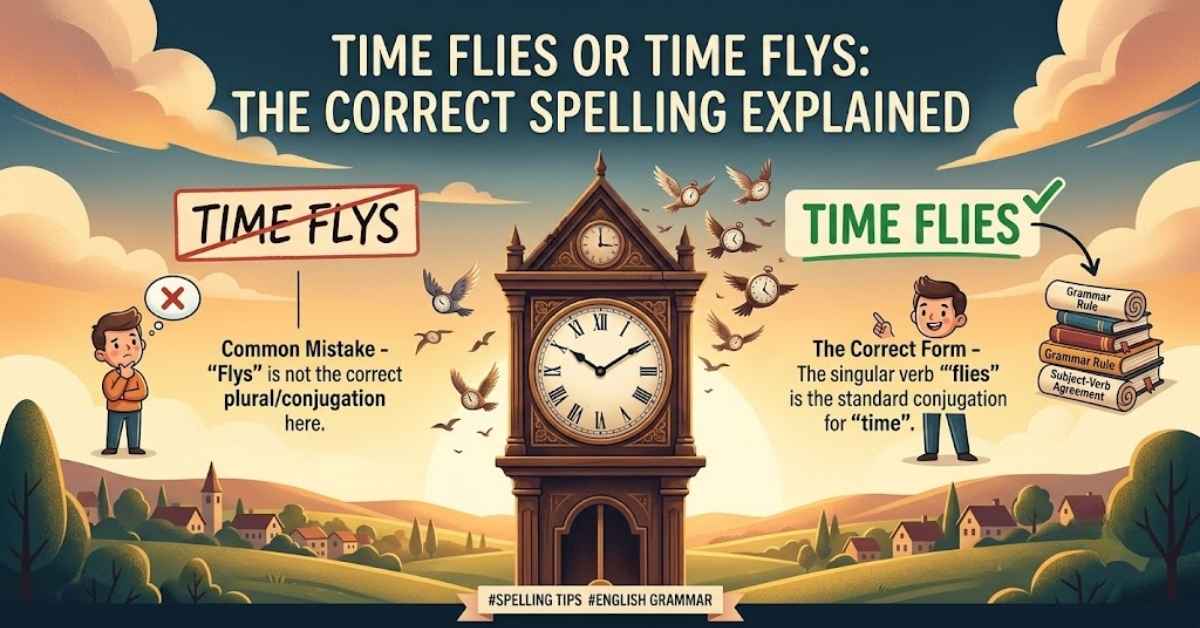
Here it is. The correct spelling is “time flies.” “Time flys” is a spelling mistake and it does not exist in standard English. The word “flies” is the verb “fly” doing its job in the third person, and English grammar has strict rules about that. Once you see the rule, you will never mix it up again.
Time Flys or Time Flies: Which One Is Correct?
Let’s settle this in one line. “Time flies” is correct. “Time flys” is always wrong.
There is no context, no dialect, and no casual exception where “flys” becomes acceptable. Autocorrect flags it for a reason. It simply is not a word in any English dictionary, formal or informal.
So if you remember nothing else from this article, remember this. Flies wins, every single time.
What Does “Time Flies” Actually Mean?
“Time flies” describes the feeling that time has passed faster than you expected. You blink, and suddenly a whole afternoon or a whole decade is gone.
It is not about literal flying. Time does not sprout wings. The phrase is figurative, painting a picture of moments slipping by quickly, especially during something fun or busy.
People usually say it with a mix of surprise and nostalgia. Think of finishing a great vacation and thinking, “Wait, that was a week already?”
Why Do So Many People Write “Time Flys” Instead?
Most English verbs form their third person singular by simply adding an s. Run becomes runs. Jump becomes jumps. So your brain naturally wants to add an s to fly and call it done.
The problem is that fly ends in a consonant followed by y, and that combination follows a different path. English loves exceptions, and this is one of them.
Add in the fact that “flies” also happens to be the plural of the insect, and confusion multiplies fast. Your brain sees two jobs for one word and starts second guessing itself.
The Grammar Rule Behind “Flies” (Consonant Plus Y Rule)
Here is the actual rule, and it is shorter than you think. When a verb ends in a consonant plus y, you drop the y, add ies, and that becomes the third person singular form.
Check the pattern with other verbs:
- Cry becomes cries
- Try becomes tries
- Dry becomes dries
- Fry becomes fries
- Fly becomes flies
Time is treated as a singular subject in this phrase, just like he, she, or it. So the verb has to match, and flies is the only grammatically correct choice.
Time Flies or Time Flys: Quick Comparison Table
| Feature | Time Flies | Time Flys |
| Grammatically correct | Yes | No |
| Found in dictionaries | Yes | No |
| Used in formal writing | Yes | Never |
| Matches verb conjugation rule | Yes | No |
| Recognized by spell checkers | Yes | Flagged as an error |
Whenever you compare the two side by side, “flys” does not have a single point in its favor. That should make the decision easy.
Where Did “Time Flies” Come From? (Tempus Fugit and History)
The phrase has old roots, and they run all the way back to Latin. The Roman poet Virgil wrote “fugit inreparabile tempus,” which roughly translates to “irretrievable time flies.”
That phrase was shortened over centuries into the well known Latin saying tempus fugit, meaning time flees or time escapes. English writers picked up the idea and reshaped it into “time flies” during the early modern English period, somewhere around the sixteenth and seventeenth centuries.
So this is not some modern internet phrase or a trendy shortcut. People have been marveling at fast moving time for roughly two thousand years, they just used different words for it.
Time Flies vs Flies the Insect: Don’t Confuse These
Here is a fun wrinkle. “Flies” is also the plural noun for those tiny buzzing insects that ruin picnics. One fly, two flies, same spelling as the verb in our phrase.
That overlap is a big reason people question the spelling in the first place. Your brain sees “flies” attached to bugs and starts wondering if the verb version needs its own separate spelling.
It does not. Both the insect plural and the verb form share the exact same spelling, flies. English just recycled the word for two completely different jobs.
Real-Life Examples of “Time Flies” in a Sentence
Seeing the phrase in action makes it stick faster than any rule ever will.
- Time flies when you’re having fun, and this weekend proved it again.
- I cannot believe it’s already December. Time really flies.
- Looking back at these old photos, time flies faster than I expected.
- Time flies during a good conversation, but it crawls during a boring meeting.
- Our kids grow up so fast. Time flies once you become a parent.
Notice how flexible the phrase is. It works in texts, emails, essays, and casual chats without ever changing form.
Common Mistakes People Make With This Phrase
Most errors with this expression fall into a few predictable traps.
- Writing “time flys” because it looks like a simple plural pattern
- Mixing it up with the insect plural and assuming a different spelling applies
- Using “time fly” without the s, forgetting that time is singular
- Assuming British English spells it differently, when it does not
None of these mistakes are embarrassing on their own. They are common precisely because English grammar rewards intuition less than most people expect.
Which One Should You Use?
Always choose “time flies.” There is no situation, audience, or writing style where “time flys” becomes the right pick.
Formal reports, casual texts, birthday cards, and business emails all follow the same rule here. Unlike words with British versus American spelling differences, this one has zero regional variation. Everyone everywhere writes it the same way.
Similar Phrases That Follow the Same Rule
Once you understand this rule, other phrases fall into place instantly.
- “The baby cries” not “the baby crys”
- “She tries her best” not “she trys her best”
- “The paint dries fast” not “the paint drys fast”
If you can remember one of these, you can remember all of them, including our original phrase about time.
Quick Memory Tricks to Never Get It Wrong Again
A few mental shortcuts can lock this rule in permanently.
Think about french fries. Nobody writes french frys, so fly should follow the same path and become flies. You can also picture actual flying insects landing on a clock, since flies (the bugs) share their spelling with flies (the verb).
Or just remember this short line: when in doubt about y, change it to ies and go.
FAQs About Time Flies or Time Flys
Is “time flys” ever correct in any context?
No. It is a misspelling with no valid use in standard, formal, or casual English writing.
Why does “fly” become “flies” instead of just adding an s?
Because fly ends in a consonant plus y, and English grammar rules require changing y to ies for third person singular verbs in that pattern.
Does British English spell it differently from American English?
No. Both dialects use “time flies” with zero variation, unlike words such as color and colour.
Summary
Time flies, not time flys, and now you know exactly why. The rule is simple: verbs ending in consonant plus y switch to ies for singular subjects, and time follows that pattern every time.
Whether you’re texting a friend or writing a formal email, stick with “time flies.” It’s grammatically correct, universally accepted, and one less spelling worry for your writing from here on out.

I’m Daniel Carter, founder of wordwix.com, a creative space focused on powerful and meaningful words. I explore ideas, meanings, and inspiration to help you find the perfect words for any purpose with clarity and creativity.