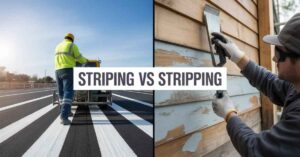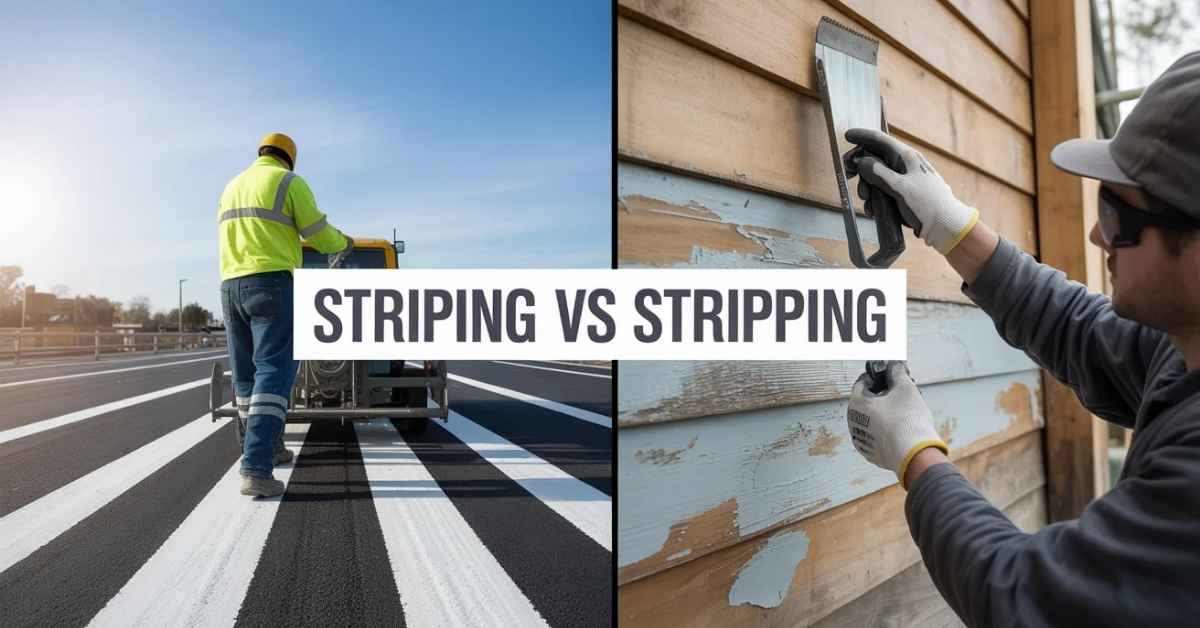
One extra letter. That is all it takes to completely change your meaning. Striping and stripping sound nearly identical when spoken aloud yet they describe opposite actions entirely. One builds something up.
The other tears it down. Whether you are writing project instructions, a renovation report, or a design brief, mixing these two up can cause real miscommunication. This guide breaks down the difference between striping and stripping clearly, once and for all.
Quick Difference Table: Striping vs Stripping
Before diving deep, here is your quick reference table. Bookmark it. You will want it later.
| Word | Root Word | Core Meaning | Action Type | Example |
| Striping | Stripe | Adding lines or markings | Add | “The crew finished striping the parking lot.” |
| Stripping | Strip | Removing a layer or coating | Remove | “He spent the afternoon stripping old paint.” |
The subtle differences between these two words come down to spelling, grammar rules, and context. One P means you are putting something on. Two P’s mean you are pulling something off. Simple as that.
Understanding the Stripe Family: Striped and Striping
The word stripe is the root of this entire family. A stripe is a band, line, or mark, usually decorative or functional. Think of a zebra, a barber pole, or a freshly painted highway lane. The stripe family follows the standard English silent-e spelling rule. When you add a suffix like “-ing” or “-ed,” you drop the silent e first.
Stripe minus the e equals strip. Then add “-ing” and you get striping. Add “-ed” and you get striped. This rule trips people up because “strip” is also a completely separate word with a different meaning. That overlap is exactly where the confusion between striping vs stripping begins.
Striped (Adjective)
Striped describes something that already has stripes on it. It functions as an adjective, modifying nouns. It is one syllable, rhyming with “typed,” not two. That surprises a lot of people.
Common examples of striped in context:
- “She wore a striped shirt to the interview.”
- “The tiger’s striped coat acts as natural camouflage.”
- “A bold striped pattern covered the accent wall.”
One common misspelling worth flagging: “stripeed” does not exist. Neither does “stripd.” Striped is the only correct form.
Striping (Verb / Gerund)
Striping is the act of applying stripes, lines, or markings to a surface. It works two ways inside sentences: as a gerund (acting like a noun) and as a present participle (acting like a verb).
- Gerund: “Striping is a specialized skill in road construction.”
- Present participle: “The crew was striping the warehouse floor all morning.”
Adding patterns, applying lines, creating decorative stripes, marking athletic fields — all of these fall under the striping umbrella. The action always involves putting something onto a surface, never removing it.
Industries That Use Striping Frequently
Striping shows up across more industries than most people realize. It is not just an art term. It is a professional process with real standards and real consequences when done wrong.
Road Construction and Transportation
Road striping is one of the most visible industrial applications in America. Every lane line, crosswalk, bike lane, and parking space you see on the road was applied through a striping process. Traffic markings follow strict federal guidelines set by the Federal Highway Administration. Road markings must meet specific width, reflectivity, and color standards to keep drivers safe.
Thermoplastic paint, applied under heat, is the material of choice for most road striping projects today. It bonds to asphalt more durably than regular paint and lasts far longer under heavy traffic.
Graphic and Digital Design
In design, striping refers to adding stripe patterns to backgrounds, UI elements, branding materials, and print layouts. Zebra striping is a well-known UX technique where alternating row colors in a data table improve readability. It is widely used in dashboards and spreadsheets.
Manufacturing and Industrial Settings
Factory and warehouse floors use striping for industrial safety markings. Yellow stripes mark pedestrian walkways. Red zones signal danger. Green areas indicate safe zones. OSHA provides color-coding standards that guide these striping decisions in manufacturing and production environments.
Textiles and Apparel
In textile manufacturing, striping refers to the process of weaving or printing stripe patterns onto fabric. The striping process controls stripe width, color sequence, and repeat. A finished garment described as “striped” is the end result of a carefully controlled striping process.
Sports and Field Marking
Sports field marking is a highly specific form of striping. Groundskeepers use dedicated field striping machines to mark football yardage lines, soccer boundaries, and baseball base paths. The visual mowing patterns you see on a baseball outfield? That is striping too, achieved through directional cutting rather than paint.
Examples of Striping in Everyday Sentences
Here are clear examples of striping used correctly in context:
- “The city approved a contract for striping six new bike lanes downtown.”
- “Striping the warehouse floor took the crew two full days.”
- “Digital designers rely on zebra striping to make data tables easier to read.”
- “The groundskeeper started striping the field at six in the morning.”
- “Wall striping is back in trend for modern interior decoration.”
- “Adding patterns through striping can completely transform a plain surface.”
- “The factory’s striping plan followed every OSHA color guideline.”
- “She learned striping techniques during her first graphic design internship.”
Notice how every single sentence involves creating or applying something. That is the striping rule: it always adds, never removes.
Understanding the Removal Family: Stripped and Stripping
Now let us flip directions. Strip as a verb means to remove, peel away, or take off. It is an entirely different root word from “stripe,” even though they look almost identical. The spelling difference is critical here. “Strip” ends in a short vowel followed by a consonant. Under English grammar rules, you double that final consonant before adding “-ing” or “-ed.” So strip becomes stripping and stripped.
Stripped (Past Tense Verb)
Stripped is the past tense of strip. It describes something that was already removed or taken away. It carries multiple meanings depending on context.
- Physical removal: “Workers stripped the old flooring before laying new tile.”
- Mechanical failure: “The bolt was stripped and could not be tightened.”
- Figurative use: “He was stripped of his professional license after the hearing.”
Stripped also functions as a past participle, appearing in passive constructions like “The walls had been stripped back to bare drywall.”
Stripping (Present Participle Verb)
Stripping describes the ongoing action of removing something. Like striping, it doubles as a gerund and a present participle.
- Gerund: “Stripping paint requires proper ventilation and protective gear.”
- Present participle: “She was stripping wallpaper when the pipe burst behind the wall.”
The figurative range of stripping is wide. You can strip away complexity from an argument. A court can strip an agency of its authority. A mechanic strips an engine down to its core components. The action always involves removing layers, whether physical or abstract.
Industries That Use Stripping Regularly
Construction and Home Renovation
Paint stripping, wallpaper removal, and flooring removal are the backbone of most renovation projects. Before any new surface goes on, the old one usually has to come off. Chemical strippers, heat guns, and mechanical scrapers are all tools of the trade. Surface preparation through stripping is what makes the finished renovation look professional.
Automotive Work
In automotive repair, stripping refers to removing body panels, interior components, or old paint before bodywork. Paint stripping ahead of a respray is standard practice. Technicians also strip vehicles for parts in salvage operations.
Electrical Work
Wire insulation stripping is one of the first skills any electrician learns. Every wire connection requires clean, exposed copper. Stripping the insulation off without nicking the wire beneath is a precision skill. Wire strippers are a basic tool in every electrician’s kit.
Metalworking and Manufacturing
Metal surfaces often carry coatings, anodizing, or chrome finishes that must be stripped before welding, re-coating, or finishing. Acid stripping and abrasive stripping are common methods in metalworking and industrial manufacturing.
Digital and Software Fields
In software, metadata removal is a form of digital stripping. Developers strip HTML tags from user-generated content to sanitize inputs. Data pipelines strip formatting fields before processing. It is a removal process, just applied to information rather than physical material.
Legal and Administrative Usage
Legal writing uses stripping frequently in a figurative sense. Courts strip defendants of rights. Legislatures strip provisions from bills. Committees strip powers from agencies. Precise writing in legal documents depends on using this term correctly.
Examples of Stripping in Everyday Sentences
- “The renovation team spent the week stripping wallpaper from every room.”
- “Stripping the engine down revealed a cracked gasket nobody had spotted.”
- “The electrician was stripping wire ends before connecting them to the panel.”
- “Stripping old paint off furniture is tedious but completely worth the result.”
- “The court ruling focused on stripping the department of its investigative powers.”
- “Stripping metadata from exported files is standard practice before client delivery.”
- “The metal shop spent two days stripping chrome from the restoration parts.”
- “Stripping flooring removal down to the subfloor took longer than expected.”
Every sentence removes something. That is stripping. Compare these to the striping examples above and the pattern is impossible to miss.
Why Striping vs Stripping Causes So Much Confusion
Several factors combine to make this one of the trickiest spelling pairs in English.
- Sound: Spoken aloud, striping and stripping are nearly identical. The ear barely catches the difference between one P and two.
- Autocorrect betrayal: Many spell-checkers flag “striping” as an error and auto-correct it to “stripping.” That means even careful writers get tripped up by their own tools.
- Context overlap: Some industries, like manufacturing, use both words. A factory floor might need striping for safety markings and stripping to remove old coatings. Same setting, opposite actions.
- Rare exposure: Most people write “stripping” far more often than “striping.” So when striping appears, it looks wrong even when it is completely right.
“The meaning of striping vs stripping is not ambiguous once you understand the roots. The confusion is purely a spelling and habit problem.” This is why attention to context matters more than spell-check alone.
Memory Tricks to Never Mix Them Up Again
The P Pattern Trick
One P means one stripe going on. Two P’s mean two hands pulling something off. Picture the letters as physical actions. “pp” looks like two hands gripping and yanking a layer free.
The Visual Cue Trick
Striping is lean and clean, like a single painted line on fresh pavement. Stripping is heavier and forceful, like peeling back layers of old wallpaper. Let the word shape guide your memory.
The Action Question
Ask yourself one question before writing: “Am I adding something or removing something?” Adding stripes means striping. Removing a layer means stripping. Binary. Foolproof.
The Double-P Strength Trick
Stripping takes effort. Removing layers is hard work. Double the P to match the effort. Striping is controlled and precise. One smooth motion, one P. A painter laying a clean line versus someone tearing wallpaper off a wall. That image is your memory cue.
Grammar Rules: How Striping vs Stripping Work Inside Sentences
Two specific English spelling rules explain this entire situation.
Striping in Grammar
Base word: stripe (ends in silent e) Rule: Drop the e, add “-ing” → striping
| Function | Example |
| Present participle | “They are striping the road.” |
| Gerund | “Striping requires precision equipment.” |
| Adjective modifier | “The striping crew arrived at dawn.” |
Stripping in Grammar
Base word: strip (short vowel plus consonant) Rule: Double the consonant, add “-ing” → stripping
| Function | Example |
| Present participle | “He was stripping the insulation off the wire.” |
| Gerund | “Stripping paint is tedious but necessary.” |
| Adjective modifier | “The stripping process took three days.” |
Quick Grammar Comparison Chart
| Feature | Striping | Stripping |
| Root Word | Stripe | Strip |
| Spelling Rule | Drop silent e plus add -ing | Double consonant plus add -ing |
| Core Meaning | Adding lines or markings | Removing a layer or covering |
| Action Type | Add | Remove |
| Gerund Example | “Striping is an art form.” | “Stripping is labor-intensive.” |
| Participle Example | “They were striping the lot.” | “She was stripping the floor.” |
| Common Mistake | Used when removal is meant | Used when application is meant |
When to Use Striping vs When to Use Stripping (Practical Guide)
Use Striping When Talking About Adding:
- Applying painted lines to roads, parking lots, or athletic fields
- Creating stripe patterns in fabric, branding, or digital design
- Marking safety zones and industrial walkways
- Adding decorative stripes to walls or surfaces
- Describing traffic markings being applied to pavement
Use Stripping When Talking About Removing:
- Removing paint, varnish, or protective coatings from any surface
- Pulling wire insulation off for electrical connections
- Dismantling vehicles or machinery for repair or salvage
- Taking down wallpaper or lifting floor coverings
- Revoking rights, titles, or administrative powers
Real-World Case Studies
Case Study: Road Construction
A project manager writing contract specifications typed: “The contractor will be stripping new lane markings along the interstate.” The word stripping implies removal. The actual task was applying new markings. The correct word was striping. In government contracts, that one-letter error can trigger confusion, delays, or disputes. Road striping contractors deal with this miscommunication regularly and often emphasize precise writing in their client-facing documentation.
Case Study: Interior Renovation
A home improvement blogger published a tutorial with the line: “Before painting, start by striping the old wallpaper from the walls.” Striping means adding markings. The blogger meant stripping, which means removing. Readers noticed and the correction appeared in the comments section. That single word made the instructions technically wrong and damaged the writer’s professional credibility. Attention to context in renovation projects matters enormously.
Case Study: Graphic Design
A UX designer wrote in a client report: “We applied stripping to the data table rows for improved readability.” The correct term is striping, specifically zebra striping, a recognized UX pattern. Using stripping here confused the development team who assumed something was being removed from the interface. One word swap turned a clear design decision into a team meeting nobody needed. Workflow clarity depends on precise writing.
FAQs: Striping vs Stripping
What is the main difference between striping and stripping?
Striping means adding lines or markings. Stripping means removing layers or coatings from surfaces.
Does striping use one or two P’s?
Striping uses one P. It follows the silent-e rule: stripe minus e plus ing.
When should I use stripping instead of striping?
Use stripping whenever something is being removed, like paint, wallpaper, wire insulation, or floor coverings.
Why does autocorrect change striping to stripping?
Autocorrect misreads striping as a spelling error because stripping appears far more frequently in everyday writing.
Can striping and stripping ever appear in the same sentence?
Yes. “The crew finished striping the floor after stripping the old coating off completely.”
Conclusion
Striping vs stripping is genuinely one of the most useful spelling distinctions to nail down because it crosses so many industries and writing contexts. The rule is simple: one P adds, two P’s remove.
Use the action question trick, trust the grammar rules, and keep this guide bookmarked as a quick reference. Whether you are writing road construction specs, a renovation walkthrough, or a design document, getting this right protects your professional communication every single time.

I’m Daniel Carter, founder of wordwix.com, a creative space focused on powerful and meaningful words. I explore ideas, meanings, and inspiration to help you find the perfect words for any purpose with clarity and creativity.