You’re typing a quick message to your manager. Fingers flying, coffee still brewing. You write “Goodmorning!” and hit send. Feels right, doesn’t it? Here’s the thing though: it’s wrong. The difference between good morning or goodmorning might seem tiny but in professional settings, tiny mistakes carry real weight.
Whether you’re crafting a business email or firing off a text, knowing the correct way to write good morning matters more than you’d think.
What’s the Real Difference Between Good Morning and Goodmorning?
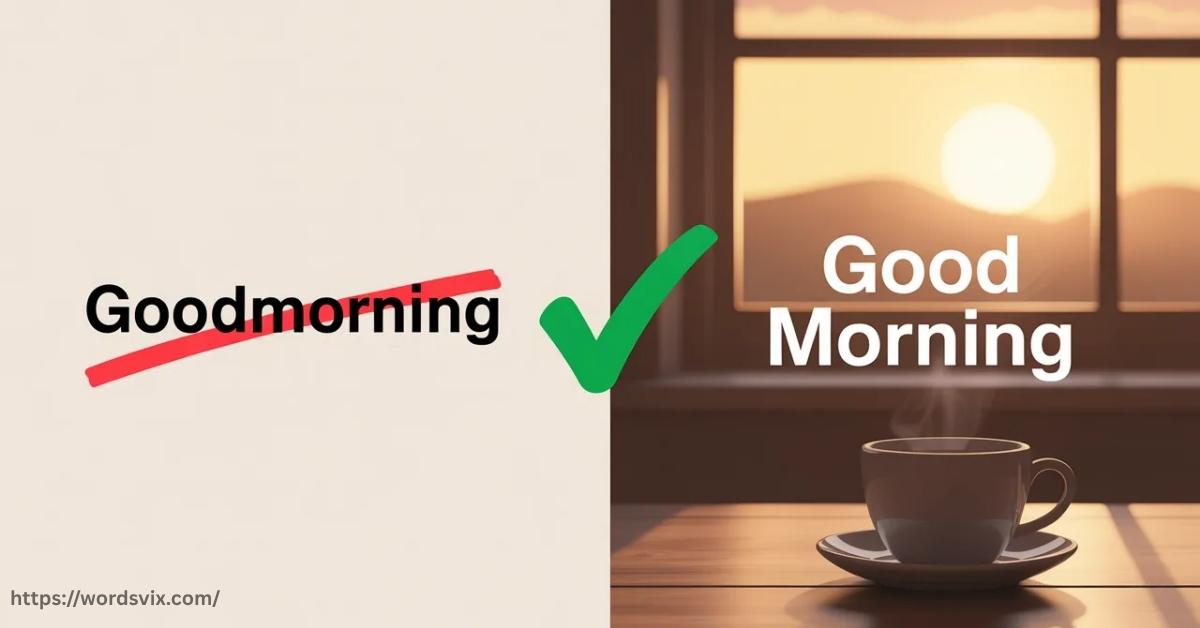
Let’s cut straight to it. Good morning is two words. Always. No exceptions. “Goodmorning” as a single fused word is simply a spelling error. It doesn’t appear in the Merriam-Webster dictionary or the Oxford dictionary. No major style guide recognizes it either.
Think of it this way: “good” is an adjective. “Morning” is the noun it describes. Smash them together and you break a basic English phrase structure rule. The good morning grammar rule is clear: adjective and noun stay separate.
Here’s a quick side by side:
| Version | Correct? | Notes |
| Good morning | Yes | Standard American English |
| Goodmorning | No | Common spelling mistake |
| good morning | Yes | Acceptable mid-sentence |
| Good Morning | Yes | Formal greeting or title use |
The difference between good morning and goodmorning really comes down to this: one is standard English. The other isn’t a word at all.
Why It’s Important to Get It Right
First impressions stick. Opening a client email with “Goodmorning, Mr. Davis” signals carelessness before you’ve even made your point. Writing professionally means sweating the small stuff. Grammar tools like Grammarly flag “goodmorning” instantly as an error.
Think of it like showing up to a job interview with untied shoes. Nobody might say anything but everyone notices.
Proper English usage isn’t about being stiff or formal. It’s about showing respect for your reader. And in American workplaces, schools, and professional circles, standard English spelling is still the expectation.
Is Good Morning One Word or Two?
This question drives more Google searches than you’d expect. The answer is simple: good morning is two words, always written separately.
Some people assume it should merge like “goodbye” did. But “goodbye” evolved over centuries from “God be with ye.” That’s a historical linguistic shift. Good morning hasn’t undergone that transformation. It remains an adjective-noun phrase. Full stop.
Similar two-word greetings follow the same rule:
- Good afternoon: two words
- Good evening: two words
- Good night: two words in formal writing
- Good morning: two words, no debate
Is good morning one word or two? Two. Every time. In every context.
Understanding the Grammar Behind Good Morning
Here’s where it gets interesting. Good morning in English grammar follows the adjective plus noun structure. “Good” modifies “morning,” describing the quality of it. Merging them defeats that grammatical relationship.
Compare these two examples:
“Goodbye” merged because it became a standalone exclamation over time. Its good morning meaning shifted from a descriptive phrase into a single ritualized farewell. “Good morning” never made that leap. It stayed descriptive.
Style guides agree across the board:
- The Chicago Manual of Style: two words
- The AP Stylebook: two words
- Merriam-Webster: two words
English grammar rules are consistent here. The good morning phrase meaning a warm, polite acknowledgment of someone at the start of the day. Two words, doing their jobs separately.
Common Scenarios Where People Get It Wrong
Smart people make this mistake constantly. Almost always in the same three situations.
1. Texting or Messaging Apps
Fast thumbs fuse words together. On WhatsApp, iMessage, or Snapchat, “goodmorning” floods in every day. Autocorrect doesn’t always catch it. Good morning text message greeting errors are the most common form of this mistake. Casual context makes it forgivable but it still isn’t correct.
Pro tip: Add a text replacement shortcut on your phone. Type “gm” and let it auto-expand to “Good morning.” Problem solved.
2. Social Media Posts
Scroll through Instagram on any weekday morning. “Goodmorning everyone!” shows up thousands of times. Influencers post it. Pages share it. Followers repeat it. Volume doesn’t equal correctness though. The correct greeting good morning stays two words even on social media.
3. Business Emails or Letters
This is where the mistake genuinely costs you. A good morning formal email should open cleanly and correctly. Here’s the contrast:
Correct: “Good morning, Sarah. I hope this message finds you well.”
Incorrect: “Goodmorning Sarah, hope your doing well.”
Notice two errors in that second line. “Goodmorning” fused together and “your” instead of “you’re.” In professional communication, details like these define your credibility.
Good Morning in Formal vs Informal Settings
Greeting etiquette shifts depending on context. The spelling doesn’t.
| Setting | Correct Usage | Example |
| Business email | Good morning (capitalized) | “Good morning, Mr. Lee.” |
| Text message | good morning (lowercase fine) | “good morning! you up?” |
| Speech or presentation | Good morning (capitalized) | “Good morning, everyone.” |
| Novel or story | good morning (mid-sentence) | He muttered good morning and left. |
Formal communication demands capitalization and precision. Casual greetings give you more flexibility in tone but how to spell good morning stays the same in both worlds.
Tips to Remember the Difference
Here’s what actually sticks:
- Think of “good afternoon.” You’d never write “goodafternoon.” Same rule applies here.
- Read it out loud. You naturally pause between “good” and “morning.” That pause is a space.
- Run spell-check. Microsoft Word, Google Docs, and Grammarly all flag the fused version.
- Picture the grammar. Good is the adjective. Morning is the noun. They work together, not as one.
- When unsure, check Merriam-Webster. It takes five seconds and settles the debate instantly.
Similar Expressions You Should Know
Morning greetings in English follow similar patterns. Here’s how they stack up:
| Expression | One Word or Two? | Notes |
| Good morning | Two words | Always |
| Good afternoon | Two words | Always |
| Good evening | Two words | Always |
| Good night | Two words (formal) | “Goodnight” appears informally |
| Goodbye | One word | Historical contraction |
| Goodwill | One word | Functions as a noun |
Notice that “goodwill” and “goodbye” merged into single words because their meanings evolved independently. Good morning greeting never took that path.
Good Morning in Other Languages
The USA is home to millions of speakers of other languages. Here’s how the morning greeting translates across some of them:
| Language | Greeting | Literal Meaning |
| Spanish | Buenos días | Good days |
| French | Bonjour | Good day |
| German | Guten Morgen | Good morning |
| Mandarin | 早上好 (Zǎoshang hǎo) | Morning good |
| Japanese | おはようございます | Honorable early rising |
| Arabic | صباح الخير | Morning of goodness |
| Tagalog | Magandang umaga | Beautiful morning |
Fun fact: Spanish follows the same two-word pattern. “Buenos días” stays separated. Polite greeting phrases across cultures often mirror this structure: descriptive adjective paired with a time-based noun.
Common FAQs
Is Goodmorning a Word?
No. “Goodmorning” is not recognized by any major English dictionary. It doesn’t appear in Merriam-Webster or the Oxford dictionary. It’s one of the most common English mistakes in digital communication. The correct spelling is always good morning, two words, no exceptions.
Can I Use Good Morning in a Business Email?
Absolutely. Business email greeting etiquette actually encourages it. Open with “Good morning, [Name],” followed by a comma. It’s warm, professional, and perfectly appropriate. Just never write it as one word in a professional setting.
Should Good Morning Be Capitalized?
It depends on placement:
- Start of a sentence: Good morning, how are you?
- Standalone greeting: Good morning!
- Mid-sentence: She said good morning and left.
- Email subject or heading: Good Morning, Team
Should good morning be capitalized? At the start of a sentence or as a standalone phrase, yes. Mid-sentence, lowercase works fine.
Conclusion: Always Go With Good Morning
So here’s the full picture. Good morning is always two words. “Goodmorning” is always wrong. Whether you’re texting a friend, opening a board meeting, or writing a client email, the correct way to write good morning never changes.
Small spelling habits shape how people see you. Getting this one right costs you nothing and earns you quiet credibility every single time you hit send.

I’m Daniel Carter, founder of wordwix.com, a creative space focused on powerful and meaningful words. I explore ideas, meanings, and inspiration to help you find the perfect words for any purpose with clarity and creativity.