Spell-check missed it. Your editor didn’t catch it. And now “nieve” is sitting right there in your professional email. Don’t worry — you’re not alone. The naive vs nieve confusion trips up thousands of English writers every single day.
Whether you’re brushing up on your English vocabulary or just double-checking before hitting send, this guide clears up the spelling confusion once and for all.
Naive vs Nieve: The Quick Answer
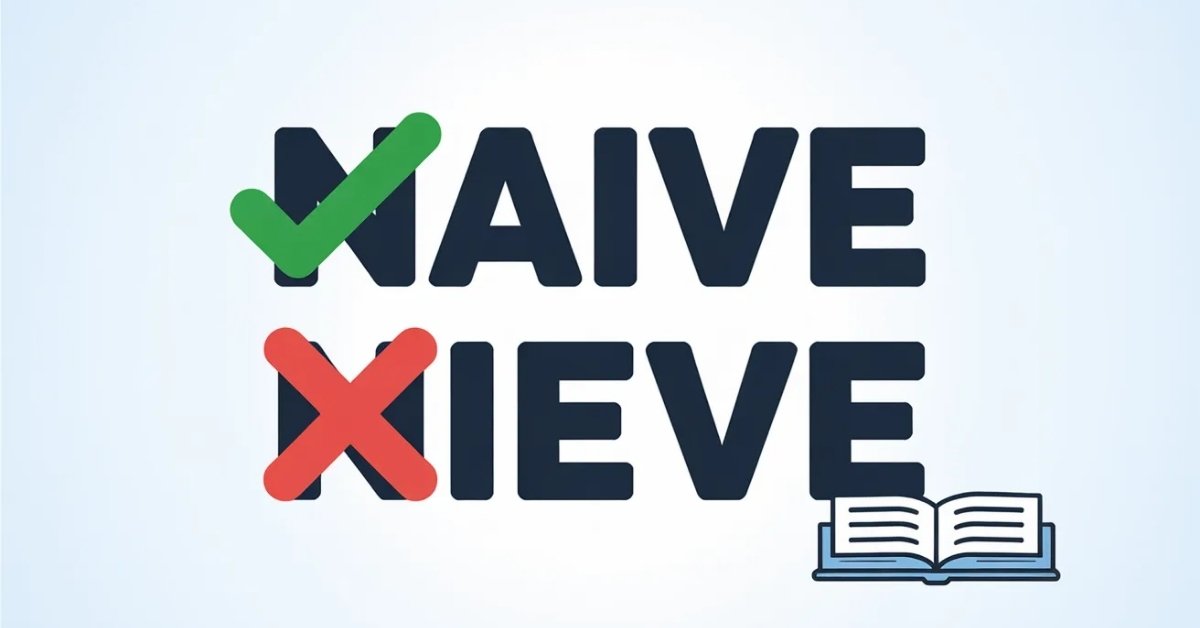
Naive is correct. Always.
In English, nieve is not a standard word. If you’re writing in English — whether casual, academic, or professional — naive is the only correct English word to use. Simple as that.
The naive vs nieve difference comes down to one thing: one is a legitimate English adjective and the other is a spelling mistake that sneaks past spell check tools more often than it should.
What Does Naive Mean?
The naive definition is straightforward. Naive is an adjective in English grammar that describes someone who lacks experience, judgment, or worldly knowledge. It often carries a sense of innocence — sometimes endearing, sometimes critical.
Here are the core forms of the word:
| Form | Example |
| Naive (adjective) | “She made a naive decision.” |
| Naively (adverb) | “He naively trusted everyone.” |
| Naivety (noun) | “His naivety cost him the deal.” |
| Naiveté (formal noun) | “Her naiveté was almost charming.” |
The naive adjective meaning covers a wide range. A child trusting every stranger is naive. So is an executive signing a contract without reading it. Same word. Very different weight.
How Naive Is Used in Everyday English
Naive shows up everywhere in daily language usage — conversations, news articles, business communication, academic writing, and fiction. Its flexibility is part of what makes it so useful.
In casual speech, you might hear:
- “Don’t be naive — that offer has strings attached.”
- In professional writing and formal writing rules, it appears as:
- “The team operated under naive market assumptions that ignored competitor pricing.”
In academic writing, researchers use phrases like “naive interpretation” or “naive approach to problems” when describing oversimplified thinking. It signals a lack of critical analysis without being unnecessarily harsh.
Naive thinking isn’t always a character flaw, though. Sometimes it’s a starting point — the place every expert once stood before experience reshaped their perspective.
Is Naive an Insult?
Context decides everything here. Calling a child naive usually sounds gentle. Calling a colleague naive in a boardroom meeting? That stings.
Naive personality traits — openness, trust, optimism — can read as either refreshing or foolish depending on who’s watching. A naive belief that people are fundamentally good might be seen as wisdom in one room and weakness in another.
Here’s a quick breakdown:
- Positive context: “Her naive enthusiasm inspired the whole team.”
- Negative context: “His naive expectations led to a failed product launch.”
- The word itself isn’t an insult. The delivery is what bites.
How to Pronounce Naive (And Why It Causes Confusion)
This is where a lot of the spelling confusion starts. Naive pronunciation in English trips people up because the word doesn’t follow standard phonetic spelling rules.
Correct pronunciation: nah-EEV (two syllables, stress on the second)
IPA notation: /naɪˈiːv/
| Word | Sounds Like |
| Naive | “nah” + “eve” |
| Naively | “nah-EEV-lee” |
| Naiveté | “nah-eev-TAY” |
The word pronunciation feels foreign because it is — naive is a French loanword. English grammar rules don’t govern it the way they would a native English word. That disconnect between how naive sounds and how it’s spelled is exactly why people guess nieve when writing from memory.
The Origin and History of Naive
Understanding the naive word origin clears up a lot. Naive came into English directly from French in the mid-1600s. The French word was naïf (masculine) or naïve (feminine) — note the diaeresis spelling over the “i” in the original French, which signals two separate vowel sounds.
That French word traces back to the Latin nativus — meaning “native” or “natural.” Originally, naive carried a positive charge. Natural. Unaffected. Pure. Over centuries, the naive meaning in English shifted toward something closer to inexperienced or overly trusting.
French language influence on English is enormous. Words like café, résumé, and naive entered English through language borrowing and brought their unpredictable spellings with them. That’s why English spelling rules feel inconsistent — because sometimes they aren’t rules at all.
Is Nieve a Real Word?
Here’s the honest answer: No — not in standard American English.
Is nieve a word you’ll find in Merriam-Webster? No. Is nieve correct spelling in English for what you’re trying to say? Also no. Nieve does not exist as a common English dictionary entry. It won’t pass grammar tools in formal writing contexts and it’ll raise a red flag for any careful editor.
There’s one footnote worth knowing. Nieve did exist as an archaic term in old Scottish and Northern English dialects — meaning “fist” or “hand.” But that usage is centuries old and completely unrelated to naive. Nobody uses it today. So when you’re asking “can nieve be used in English?” — the short answer is: not if you mean naive.
What Nieve Means in Other Languages
Here’s where things get interesting. Nieve meaning in Spanish is simply “snow.” It’s a common, everyday Spanish word — the kind bilingual Americans might use without thinking twice.
Examples:
“Está nevando” means “It is snowing” — from the same Spanish root as nieve.
Nieve is also a proper name in Spanish-speaking cultures — used as a given name, a place name, and even brand names. That’s a big reason spell check tools sometimes let nieve slide. The system reads it as a proper noun and doesn’t flag it.
So why do people confuse naive and nieve? Often because Spanish-speaking or bilingual writers have nieve stored as an active vocabulary word. When they reach for a similar-sounding English word, the brain sometimes substitutes a known pattern. It’s called phonetic spelling error through language interference — and it’s more common than people realize.
Naive vs Nieve: Side-by-Side Comparison
| Feature | Naive | Nieve |
| Correct in English | Yes | No |
| Found in English dictionary | Yes | No |
| Part of speech | Adjective | N/A in English |
| Meaning | Lacking experience or judgment | “Snow” in Spanish |
| Used in formal writing | Yes | No |
| Common misspelling | No | Yes — of “naive” |
The naive vs nieve grammar explanation is simple: one belongs in your writing and one doesn’t. Keep this table bookmarked and you’ll never mix them up again.
Correct Examples of Naive in Sentences
Seeing naive examples in sentences is one of the fastest ways to lock in proper usage. Here are ten varied examples:
- “It was naive of her to assume the contract protected both sides.”
- “His naive belief that hard work always gets noticed cost him two promotions.”
- “Don’t be naive — investors want data, not ideas.”
- “Her naive perspective charmed everyone in the room.”
- “The startup’s naive strategy ignored every competitor in the market.”
- “He naively handed over his password to a phishing email.”
- “Naive public opinion shaped policy in ways experts never anticipated.”
- “Their naive approach to problems led to repeated budget overruns.”
- “The naive characters in fiction often drive the most compelling story arcs.”
- “A naive interpretation of the data led to flawed conclusions.”
Notice how how to use naive in a sentence changes based on who’s speaking and what they’re describing. The word is flexible — but always an adjective when modifying a noun or pronoun.
Incorrect Examples Using Nieve (With Corrections)
| Incorrect | Correct |
| “She was nieve about the risks.” | “She was naive about the risks.” |
| “His nieve trust cost him everything.” | “His naive trust cost him everything.” |
| “Don’t be so nieve.” | “Don’t be so naive.” |
| “That’s a nieve assumption.” | “That’s a naive assumption.” |
These spelling mistakes are easy to make and equally easy to fix once you know what to look for. Grammar accuracy starts with catching the small stuff.
Why This Mistake Keeps Happening
Three reasons explain why the naive vs nieve confusion persists:
1. Phonetic confusion. Naive pronunciation English doesn’t match standard phonetic spelling. People spell it how it sounds — and “nieve” feels like a reasonable guess.
2. Language interference. Spanish speakers know nieve as a real, meaningful word. That familiarity bleeds into English writing without the writer even noticing.
3. Spell check failure. Many grammar tools read nieve as a proper noun — a name, a place — and skip right over it. The error hides in plain sight.
Writing clarity suffers every time. And unlike glaring errors, this one looks almost right — which makes it harder to catch on revision.
How to Remember the Correct Spelling of Naive
Here are four memory tricks that actually stick:
- The AI trick: Naive contains “ai” — like the word “aid.” You need aid (help) if you’re naive.
- Rhyme it: Naive rhymes with “believe.” Both end in the same sound. Both use an “e” at the end.
- The vowel count: Naive has five letters and three vowels (a, i, e). It’s vowel-heavy. Remember that.
- Connect the root: Naive comes from Latin nativus — meaning natural. Nature. Native. Chain those words together and the spelling locks in.
How to remember the spelling of naive gets easier once the word has a story attached to it. Memory works through connection, not repetition alone.
Naive vs Similar Words People Confuse
Understanding naive vs gullible, naive vs innocent, and naive vs ignorant sharpens how you use each word in professional writing and everyday conversation.
| Word | Core Meaning | Tone |
| Naive | Lacks experience or worldly knowledge | Neutral to mildly critical |
| Gullible | Easily tricked or deceived | More critical |
| Innocent | Free from guilt or moral wrongdoing | Often positive |
| Ignorant | Lacking knowledge or education | Often harsh |
You can be naive without being gullible. Naive decision making comes from inexperience — not stupidity. Gullible implies a failure to question even when warning signs exist. Innocent leans moral. Ignorant hits harder because it often implies willful disregard. Choose carefully. Each word lands differently depending on your audience.
Where You’ll Commonly See Naive Used
Naive shows up across nearly every form of communication:
- Politics: Politicians call opposing policies “naive” as a rhetorical move — implying the idea is disconnected from reality.
- Business: Phrases like naive startup strategy, naive market assumptions, and naive expectations appear regularly in business journalism and case studies.
- Fiction: Naive characters in fiction are storytelling staples. The fish-out-of-water, the wide-eyed newcomer, the idealist — all carry naive energy that drives plot forward.
- Data science: Naive Bayes is a legitimate machine learning algorithm. Naive forecasting is a baseline prediction model used in finance and analytics.
- Psychology: Naive realism describes the tendency to believe we see the world objectively while others are biased. It’s a recognized cognitive phenomenon.
Case Study: Naive Assumptions in Business
Consider a fictional startup — call them BrightLaunch. They built a strong product and assumed it would sell itself. No marketing budget. Minimal customer research. A naive belief that quality alone drives sales.
Six months in, their burn rate was unsustainable. Competitors with inferior products were outselling them because those competitors actually talked to their customers.
The naive business assumptions BrightLaunch made:
“Our product is so good, people will find us.” “Paid advertising is for companies without a strong offer.” “We don’t need customer feedback yet.”
Every one of those beliefs sounds reasonable until reality arrives. Naive startup strategy isn’t always the result of ignorance — sometimes it’s optimism without data. The fix isn’t cynicism. It’s curiosity. Ask questions before assuming answers.
“The most dangerous phrase in business is: we’ve always done it this way — or its close cousin: we assumed it would work itself out.”
Naive assumptions in business cost time, money, and momentum. The fastest path out of naive thinking is feedback — real, unfiltered, sometimes uncomfortable feedback.
FAQs: Naive vs Nieve
What is the correct spelling, naive or nieve?
Naive is always correct in English. Nieve is a spelling mistake and does not belong in standard English writing.
What does naive mean in English?
Naive means lacking experience or worldly judgment. It describes someone overly trusting or uninformed about how things actually work.
Is nieve a real English word?
No. Nieve is not a standard English dictionary word. It means “snow” in Spanish and causes common spelling confusion.
How do you pronounce naive correctly?
Pronounce naive as “nah-EEV” with two syllables. Stress falls on the second syllable. It rhymes perfectly with “believe.”
Why do people confuse naive and nieve so often?
Phonetic spelling errors, Spanish language interference, and unreliable spell check tools combine to make this mistake surprisingly common.
Conclusion
The naive vs nieve debate has a clean answer — naive is always correct in English. Nieve belongs in Spanish, not your professional emails or academic papers.
Understanding the naive meaning, origin, and usage gives you a real edge in writing clarity and grammar accuracy. One small spelling fix can change how polished your writing feels. Get it right and your words carry more weight every single time.

I’m Daniel Carter, founder of wordwix.com, a creative space focused on powerful and meaningful words. I explore ideas, meanings, and inspiration to help you find the perfect words for any purpose with clarity and creativity.