Ever typed “crain” into a sentence and then paused, wondering if your fingers just betrayed you? You are not alone. This tiny mix up trips up more writers than you would think, and it usually happens because the word sounds simple but looks tricky.
The good news? There is only one correct spelling, and once you see the reason why, you will never second guess it again.
Crain or Crane: The Quick Answer
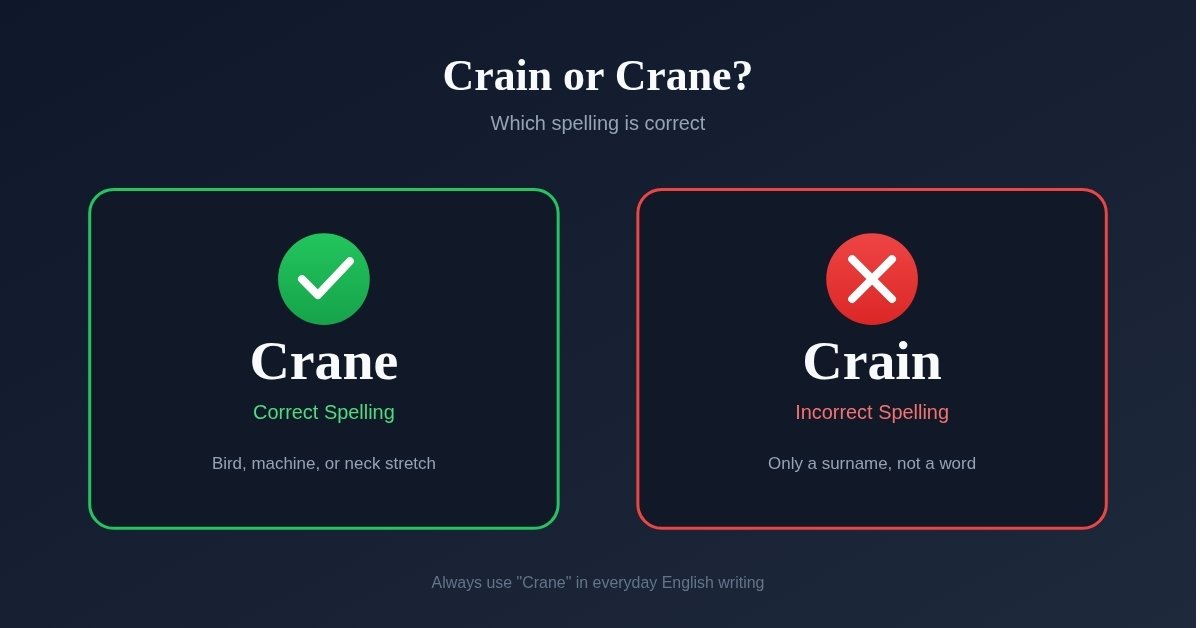
Crane is the correct spelling. It is the only version recognized as a proper English word by every major dictionary, including Merriam Webster and Oxford.
Crain is not a standard English word. It shows up mostly as a surname or a misspelling, never as a noun or verb with its own meaning.
So if you are naming the tall bird or the towering construction machine, crane is your word. End of confusion.
What Does “Crane” Actually Mean?
Crane carries two everyday meanings, and both are common in American English.
First, it is a large wading bird known for its long legs, long neck, and elegant, almost dance like movements.
Second, it is a mechanical machine used to lift and move heavy objects, the kind you see towering over construction sites in every major city.
There is also a third, smaller use. To “crane your neck” means to stretch it forward to see something better, like craning your neck to spot a parking spot in a packed lot.
Is “Crain” a Real Word?
No, and this is where a lot of the confusion starts. Crain does exist, just not as a dictionary word.
It pops up as a last name, as in author James Crain or various people named Crain across the country. It also appears sometimes as a shortened nickname or a business name.
But if you are writing a sentence and need a noun for the bird, the machine, or the neck stretching action, crain simply does not work. It is a name, not a word.
Where Does the Word “Crane” Come From?
The word crane has old roots. It traces back to Old English “cran,” which itself connects to older Germanic and Latin words describing the long necked bird.
Interestingly, the machine got its name because early lifting devices resembled the bird’s long neck and beak, stretching up and reaching down the same way a crane bird does when it feeds. Someone centuries ago looked at a bird and a machine and thought, close enough, same name works for both.
That single observation is why one word does double duty today for a wetland bird and a steel giant on a job site.
Crane in the Bible and Old Texts
The crane bird shows up in several old religious and literary texts, often symbolizing vigilance, migration, or a mournful cry. In the Book of Isaiah, the crane is mentioned alongside the swallow as birds known for their distinctive chatter and seasonal movement.
Ancient writers were drawn to the crane because of its size, its loud call, and its habit of flying in disciplined formations. That reputation for order and awareness carried into folklore across many cultures, not just biblical texts.
Crain vs Crane: Quick Comparison Table
| Feature | Crane | Crain |
| Word type | Standard English noun and verb | Surname, not a dictionary word |
| Meaning | Bird, lifting machine, neck stretch | Person’s last name only |
| Dictionary listed | Yes | No |
| Correct spelling | Yes | No |
| Common usage | Everyday writing and speech | Names, brands, rare exceptions |
How to Use “Crane” in a Sentence
Using crane correctly is simple once you know which meaning fits your sentence.
- For the bird: “The sandhill crane migrated south before the first snowfall.”
- For the machine: “The construction crew used a crane to lift the steel beam onto the fifteenth floor.”
- For the verb: “She had to crane her neck to see the stage over the crowd.”
Each version uses the exact same spelling, just applied to a different situation.
Real Life Examples of Crane
Cranes show up more often in daily life than most people notice.
- Construction sites in nearly every US city rely on tower cranes to build skyscrapers.
- Bird watchers travel to places like Nebraska’s Platte River just to see thousands of sandhill cranes gather during migration.
- Origami artists often fold paper cranes, a design tied to the Japanese legend that folding a thousand grants a wish.
- Sports commentators use “craning” when a player stretches to catch a ball just out of reach.
These examples prove the word is not just textbook trivia. It lives in construction reports, nature documentaries, and casual conversation alike.
Common Mistakes People Make With Crain and Crane
The most frequent error is autocorrect confusion, where crane gets typed as crain simply because someone is typing fast or mishears the word.
Another common slip happens when writers assume crain is a shortened or informal spelling of crane, similar to how some words get casual spellings online. It is not. Crane has no accepted shorter form.
People also confuse crane with “crayon” when writing quickly, especially in casual texting, though the two words share almost nothing beyond a few letters.
Why Do People Confuse Crain With Crane?
Part of the mix up comes from how English handles vowel sounds. The “ai” and “a_e” patterns can look deceptively similar, especially to non native speakers or fast typists.
Another reason is exposure. Since Crain is a fairly common surname, people see it in emails, business names, or social media profiles, and their brain quietly files it away as a valid spelling option.
Add autocorrect suggestions and muscle memory from texting, and the error becomes an easy habit rather than a knowledge gap.
Which One Should You Use?
If you are describing the bird, the machine, or the action of stretching your neck, always use crane.
Only use Crain if you are referring to a specific person’s last name, a business named Crain, or a brand that has chosen that spelling intentionally.
When in doubt, picture the bird. Long neck, long legs, one clear spelling. That mental image alone solves the mixup for most writers permanently.
Crane as a Verb (Bonus Meaning)
Beyond the bird and the machine, crane also works as a verb describing stretching movement, and this use is more common than many people realize.
“He craned forward to read the fine print” is a perfectly natural sentence, and it shows how flexible this single word really is across nouns and verbs.
This verb form is especially useful in storytelling and descriptive writing, since it paints a clear physical image without extra words.
FAQs
Is crain ever correct in formal writing?
No. In standard American English writing, crain is not accepted as a word. Only crane is correct for the bird, the machine, or the neck stretching action.
Why do construction workers call the machine a crane?
The machine earned its name because its long arm and lifting motion resemble the long neck of a crane bird reaching down to feed.
Is Crain only used as a last name?
Mostly yes. Crain appears almost exclusively as a surname or business name, not as a common noun or verb in everyday English.
Final Thoughts
Crane is the correct spelling, whether you are talking about the elegant bird, the powerful construction machine, or the simple act of stretching your neck to see something better. Crain, on the other hand, belongs to names and businesses, not everyday vocabulary.
Next time your fingers hesitate between the two, just picture that long necked bird, and the right spelling will follow naturally.

I’m Daniel Carter, founder of wordwix.com, a creative space focused on powerful and meaningful words. I explore ideas, meanings, and inspiration to help you find the perfect words for any purpose with clarity and creativity.