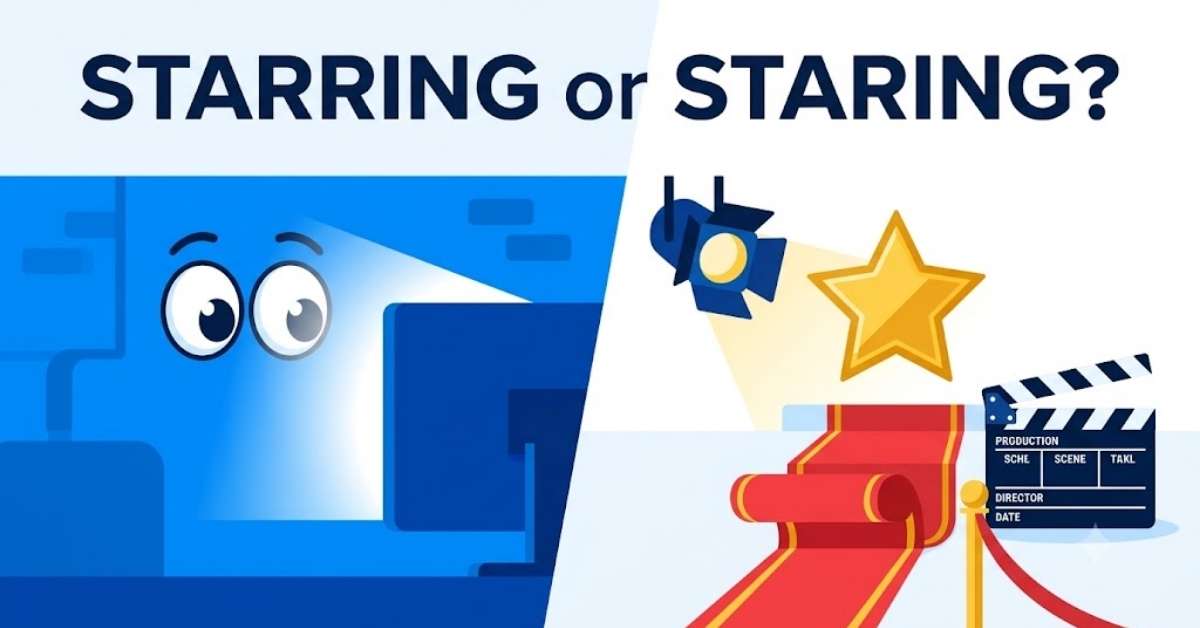
You typed the sentence. You reread it. Now you are stuck wondering if you meant “starring” or “staring,” and Google is not exactly giving you a straight answer. H
ere is the fast fix: staring means looking at something for a long time without looking away, and starring means playing the lead role in a movie, show, or performance. Different roots, different jobs, and once you see the pattern, you will never mix them up again.
What Does “Staring” Mean?
Staring comes from the verb “stare,” which means to look fixedly at someone or something. It usually signals curiosity, shock, confusion, or just plain zoning out.
You stare at a phone screen. You stare at a stranger’s weird haircut. You stare blankly at a math problem that makes no sense at 11pm.
The key giveaway is the double “r.” Stare becomes staring, and that second “r” shows up because of a simple spelling rule we will get to shortly.
What Does “Starring” Mean?
Starring comes from the noun “star,” used as a verb meaning to feature someone as the lead performer. Think “starring Tom Hanks” or “the film starring a golden retriever who somehow steals every scene.”
This word lives in entertainment, casting announcements, and movie posters. If someone is the main attraction, they are starring in something.
Notice the double “r” here too, but for a completely different spelling reason.
Where Does the Confusion Come From?
Both words end in “ing.” Both have a doubled “r.” Both sound almost identical when people talk fast. That is basically the entire source of the mix up.
English does this constantly. Small spelling differences carry big meaning differences, and spellcheck rarely catches the wrong one because both words are spelled correctly. Your computer just does not know which one you meant.
The Real Reason Both Words Double the “R”
Here is something most articles skip entirely.
Stare already has a long vowel sound, so when you add “ing,” English keeps the spelling steady by simply adding the ending: staring.
Star is a short, one syllable word ending in a single consonant after a single vowel. English grammar rules require doubling that final consonant before adding “ing,” which is why star becomes starring, not “staring.” Same logic applies to words like “run” becoming “running” or “sit” becoming “sitting.”
This one grammar rule explains the entire confusion, and almost nobody explains it this clearly.
A Little History Behind These Words
“Stare” traces back to Old English “starian,” meaning to gaze or look fixedly, and it has carried that same meaning for over a thousand years. Old texts, including early biblical translations, use forms of “stare” to describe someone looking in awe, fear, or disbelief, which is honestly the same reason people stare today.
“Star,” on the other hand, comes from Old English “steorra,” referring to the actual stars in the sky. The entertainment meaning came much later, once actors and performers started being called “stars” because they shined the brightest on stage or screen. Starring simply means being that star in a specific production.
Starring vs Staring: Quick Comparison Table
| Word | Meaning | Part of Speech | Example |
| Staring | Looking fixedly at something | Verb (from stare) | She kept staring at the ceiling fan. |
| Starring | Playing the lead role | Verb (from star) | The show is starring a first time actor. |
Real Life Examples of “Staring”
- He was staring out the window during the entire meeting.
- My dog sits by the table, staring at every bite of food.
- I caught myself staring at the same paragraph for five minutes straight.
Staring almost always involves eyes, attention, and something that pulls focus without permission.
Real Life Examples of “Starring”
- The new thriller is starring an actress nobody expected to see in this genre.
- This commercial is starring three kids and one very unbothered cat.
- Her first starring role came after years of small background parts.
Starring almost always shows up near names, titles, movies, or performances.
Common Mistakes People Make
- Writing “the movie is staring Ryan Gosling” instead of starring. This is the single most common mix up online, and it happens because the words sound identical when spoken.
- Writing “she was starring at him” instead of staring, usually from typing too fast.
- Assuming both words follow the same doubling rule, when really the vowel length is what decides everything.
A simple trick: if it involves eyes and attention, it is staring. If it involves a screen credit or spotlight, it is starring.
Which One Should You Use?
Ask yourself one quick question. Are you talking about looking at something, or about someone playing a role?
Looking equals staring. Role equals starring. That single question solves this every time, no grammar textbook required.
Quick Memory Trick to Never Confuse Them Again
Picture a star on a movie poster. Stars get double billing, so the word gets a double “r” for the role.
Now picture someone staring, eyes locked, completely still. That long stare matches the long vowel sound that keeps the spelling steady.
If you remember the poster and the stare, you will spell both correctly for life.
Related Words People Often Search Alongside This
A few related mix ups follow the exact same doubling logic:
- Sitting vs siting follows the same short vowel plus double consonant pattern as starring.
- Baring vs barring works almost identically to staring vs starring, where meaning shifts entirely based on doubling.
- Faring vs farring rarely trips people up, but it shows the same underlying spelling rule at work.
Once you understand the doubling rule behind starring and staring, these related word pairs become much easier to spell correctly too.
FAQs
Is it “starring in a movie” or “staring in a movie”? It is always starring in a movie, since starring refers to playing the lead role. Staring in a movie would only apply if a character is literally staring at something on screen.
Why do staring and starring both have a double r? Staring doubles the r simply to keep the standard ing ending after a long vowel, while starring doubles the r because of the one syllable, single vowel, single consonant spelling rule.
Can staring and starring ever mean the same thing? No. They come from completely different root words, stare and star, so their meanings never overlap even though they look nearly identical on paper.
Final Thoughts
Staring and starring look like twins, but they come from totally different family trees. One is about your eyes locking onto something. The other is about someone owning the spotlight. Remember the poster, remember the stare, and this mix up disappears for good.

I’m Daniel Carter, founder of wordwix.com, a creative space focused on powerful and meaningful words. I explore ideas, meanings, and inspiration to help you find the perfect words for any purpose with clarity and creativity.